
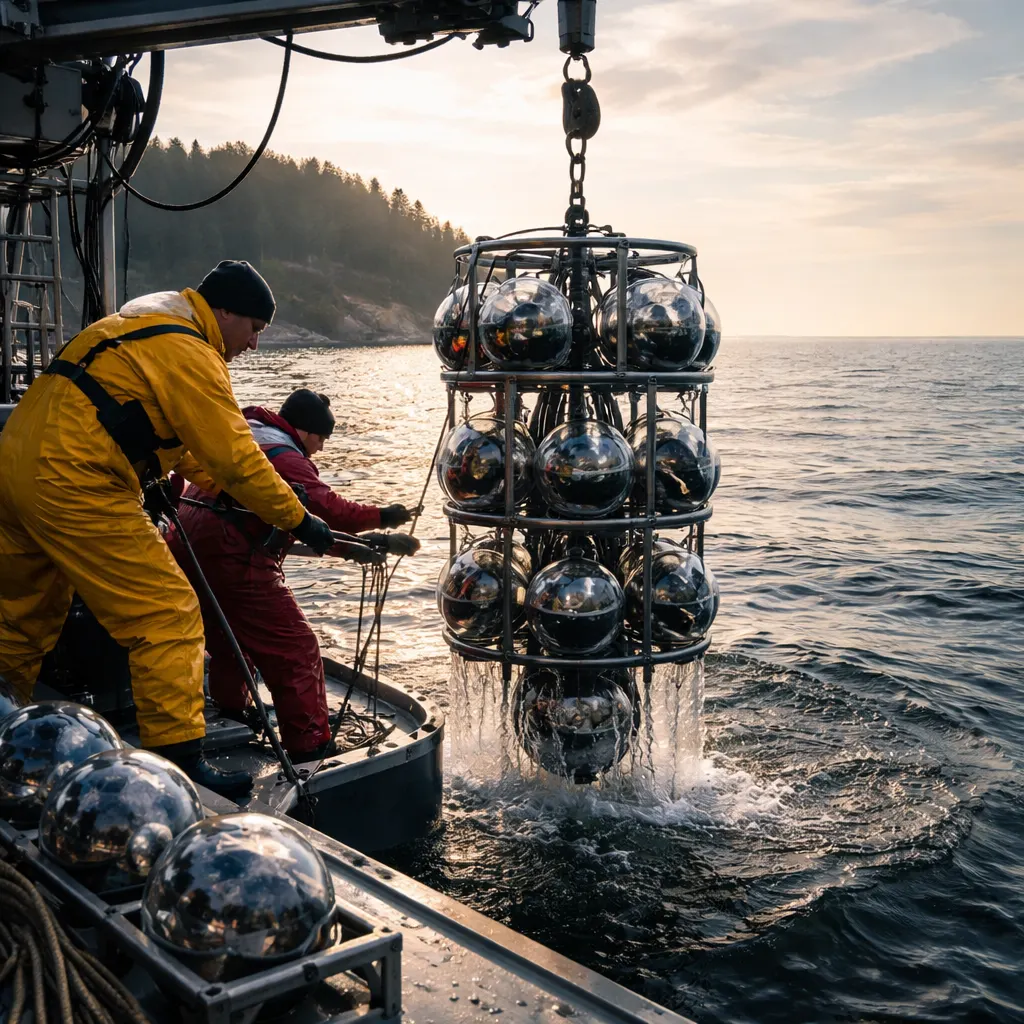
A 238-foot research vessel arrived in Duluth this week to begin installing neutrino detectors 200 meters beneath Lake Superior, marking the first time such equipment will be placed in a freshwater lake. The Experimental Neutrino Detector project aims to capture and study neutrinos — subatomic particles so elusive they're called "ghost particles" — that may reveal clues about how the universe began. Scientists characterize neutrinos as the most plentiful particles in existence, yet paradoxically the least understood.
The installation involves five massive frames, each standing roughly three stories tall and weighing approximately 8,000 pounds. Each frame carries 18 spherical sensors about the size of a beach ball, packed with photo tubes designed to spot faint blue light flashes that neutrinos produce when they rarely collide with atoms in the water. The vessel, named the Neil Armstrong and operated by the Woods Hole Oceanographic Institution, will travel to a location about 3 miles offshore from Two Harbors on Thursday to lower the sensors onto the lakebed using a crane. Crews will then install fiber optic cables linking the underwater equipment to a temporary shore facility near Two Harbors. The project's total budget sits in the tens of millions of dollars, according to organizers who declined to specify an exact figure.
According to Alec Habig, a physics professor at the University of Minnesota Duluth and the project's lead investigator, "there are a billion of them for every normal electron or proton that you're used to," making neutrinos the most abundant particle in the cosmos despite being the least known. The detectors will capture neutrinos from a particle accelerator beam generated by the U.S. Department of Energy's Fermi National Accelerator Laboratory outside Chicago, which fires the world's most powerful neutrino beam underground toward northern Minnesota. That beam passes beneath Wisconsin and crosses under Lake Superior near Two Harbors on its route to existing labs further north, but it's scheduled to shut down in February as scientists transition to a newer system. The sensors can distinguish neutrinos from the Fermilab beam from those created by the sun and other cosmic sources by tracking their direction and path through the water.
The project is sponsored by the Defense Advanced Research Projects Agency, sparking speculation about potential military uses such as tracking nuclear submarines or detecting secret nuclear reactors through their neutrino emissions. But John Bruzzese, a DARPA program manager, compared neutrinos to the discovery of X-rays, noting that when X-rays were first found, no one could envision their applications, yet they became part of daily life. DARPA doesn't have a specific application targeted for this work, he said — the agency's role is to fund research so the nation can prepare when scientists understand neutrinos better. The project builds on Minnesota's long history of neutrino research, including a previous detector in the Soudan Underground Mine near Ely and a current lab in Ash River just outside Voyageurs National Park.
Habig acknowledged this experiment may not produce a groundbreaking discovery on its own. Instead, it will establish the foundation for future neutrino detectors by answering practical questions about how freshwater installations work and what challenges they present. Once the experiment wraps up, the underwater sensors will be recovered and shipped to Europe for use in neutrino research deep in the Mediterranean Sea. Rob Munier, Vice President for Marine Facilities and Operations at Woods Hole, framed the stakes in cosmic terms: the work at the bottom of Lake Superior represents nothing less than exploring the universe to answer why we live in a matter-dominated cosmos — or more simply, why humanity exists at all.