
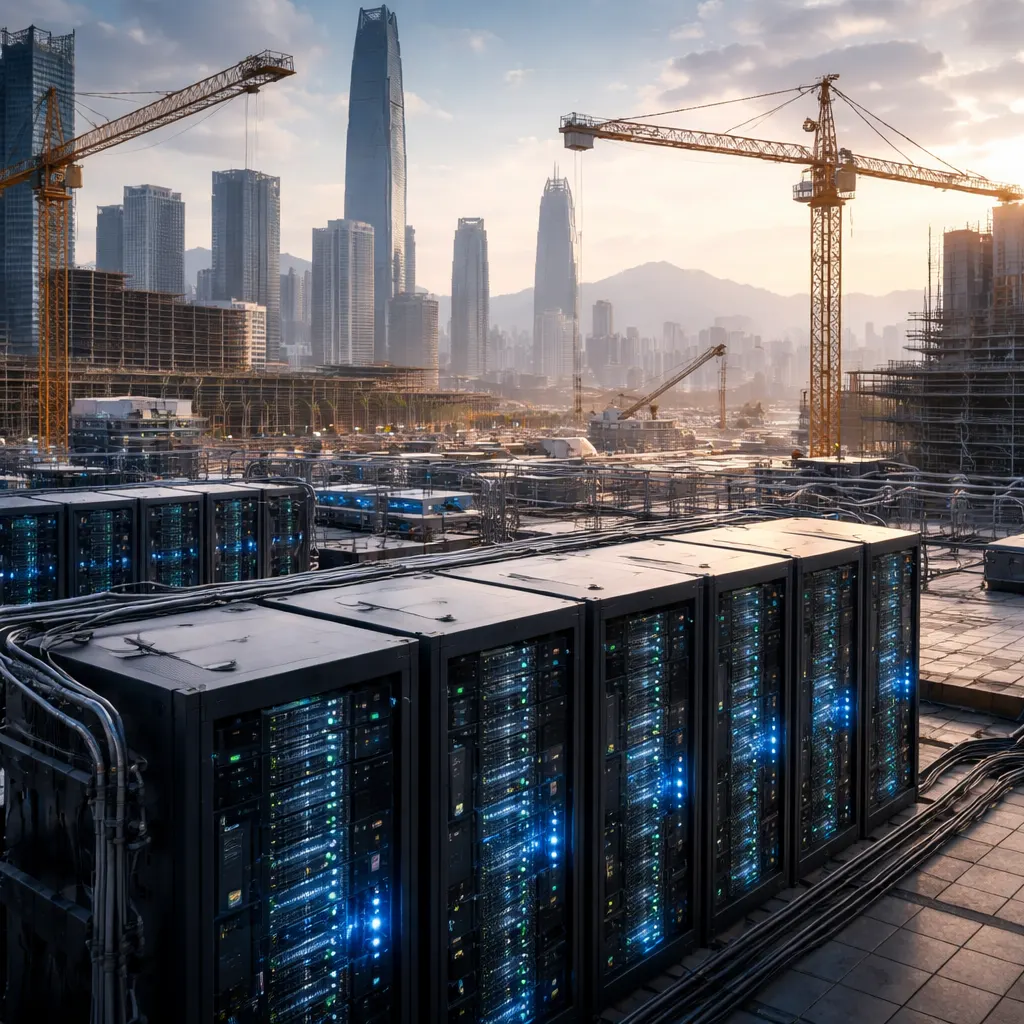
Worldwide spending on artificial intelligence and related industries is expected to surpass $1 trillion in 2026, according to a new report from the Hudson Institute. The analysis, published by Riley Walters, finds that while headlines have focused on North America's AI surge, Asian economies are driving the global buildout through exports and infrastructure investments. Growing exports and investments in modern infrastructure are fueling large economies like Japan, South Korea, and Taiwan while helping middle-income nations like the Philippines and Vietnam move toward higher-income status.
The growth in Asian exports of servers and server parts has been explosive since American tech companies in 2023 began nearly doubling their annual buildout of data centers. Server and server parts exports from Asia jumped 50 percent in 2024 and 110 percent in 2025, with Taiwan serving as the largest single source for these components. Taiwan's annual GDP growth has climbed sharply, from just 1.5 percent in 2023 to 13 percent in 2026. American capital expenditure in AI is forecast to surpass $2 trillion by 2030, while China plans to invest $300 billion on data centers over the same timeline. South Korea allocated a national AI budget of more than $7 billion in 2026, with next year's budget expected to exceed that total. Japan's government proposed over $3 billion for its AI transformation, while Taiwan allocated approximately $1 billion in 2026 toward its Ten AI Initiatives Promotion Plan.
The report finds that Asia is fully integrated into the AI component chain, with servers and graphics processing units largely designed by American firms but dependent on South Korean memory chips and Taiwanese assembly. One data center can hold as many as 45 million chips, with much of the semiconductor manufacturing process, server boards, and rack assembly happening across Taiwan, Malaysia, the Philippines, South Korea, and Vietnam. According to the analysis, AI is now a priority for all governments in Asia, with each taking a different approach—elected officials are looking to support their domestic industries in the hope that local companies increase their participation in global markets. American industries are also expanding in the region: Amazon Web Services plans to invest over $14 billion in Japan and $33 billion across Southeast Asia by 2039, while California-based Nvidia plans to open a new Asian headquarters in Taiwan and spend $150 billion annually across the island's AI supply chain.
The report explains that competition between the United States and China on AI, fueled partly by high demand for AI in the U.S., is supporting the Asian manufacturing boom. Not wanting to fall behind either the U.S. or China, other Asian countries aim to build their own domestic infrastructure and manufacturing. The AI ecosystem can be generally separated between three elements—models, compute power, and supply chains—with the U.S. and China competing and leading for the first two, while Asian countries are looking at how they can stand out amid this intense East-West competition by capitalizing on their strengths in technology manufacturing supply chains. This has led smaller economies to identify their competitive advantages while investing in novel applications for AI in various industries such as manufacturing and robotics, agentic uses, and pharmaceuticals.
In the years ahead, the report projects that governments and industry will continue to invest heavily across Asia's AI supply chain, including in the energy sector. As the U.S. and China rapidly develop their AI ecosystems, Asian countries will find ways to integrate into the global ecosystem, developing their own capabilities, with growth in investments and exports continuing to support regional economic growth. Eventually, the analysis expects greater mutual competition among Japan, Taiwan, and South Korea—especially as each seeks to develop a leading edge in physical AI. Due to demographic realities, manufacturing and exports are essential to Asian economies, with AI expected to support transitions as each country manages declines in their populations and workforce while maintaining economic growth and prosperity.