
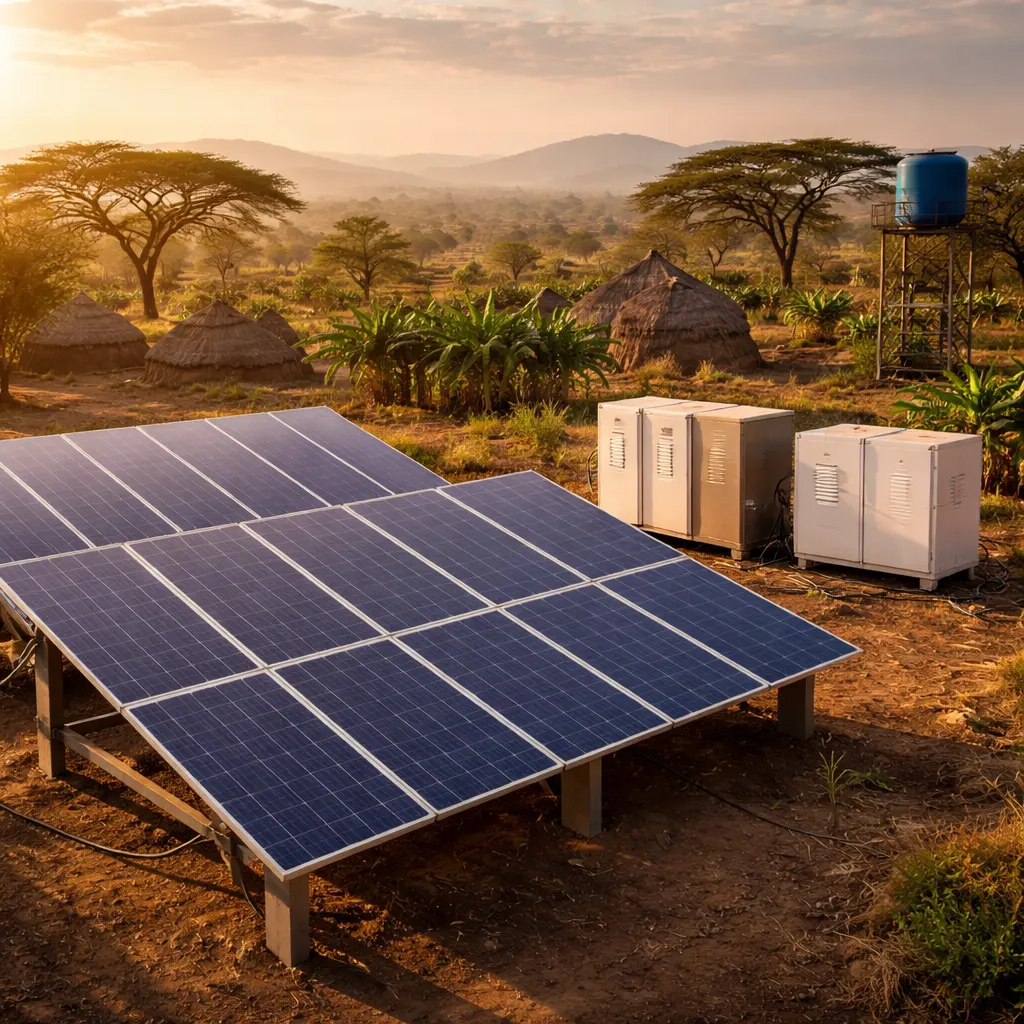
Off-grid solar photovoltaic capacity across Sub-Saharan Africa is forecast to expand sixfold by 2035, according to a new report from Wood Mackenzie titled "Off-grid solar PV in Sub-Saharan Africa: a multi-gigawatt growth opportunity." The analysis describes a fundamental shift in how electricity reaches the region's 600 million people who still lack reliable power, with off-grid solar quietly replacing the national grid as the primary driver of electrification. The story is driven by economics: diesel has become prohibitively costly to operate, solar modules have dropped to prices too attractive to overlook, and private investors are learning to finance the infrastructure gaps that underdeveloped national grids have left behind.
Nigeria dominates the region's off-grid solar landscape, accounting for roughly 35% of installations by 2035, driven primarily by the 2023 removal of fuel subsidies that made diesel self-generation financially punishing. Kenya represents the continent's most developed off-grid market, though its expansion now stems from cost optimization rather than initial access, as net-metering regulations and grid expansion push demand toward commercially sensible applications instead of first-time electricity provision. The Democratic Republic of Congo is emerging as an off-grid solar leader, anchored by one of Africa's strongest mining-related solar project pipelines, exemplified by the Kamoa-Kakula copper complex, which as of summer 2026 operates an integrated 233 megawatt DC solar-and-storage system delivering guaranteed baseline power. Markets across Sub-Saharan Africa, excluding South Africa, have brought in more than 27 gigawatts DC of modules since 2022.
The report finds that for commercial or industrial users in Nigeria, replacing even a quarter of their electricity load with solar delivers immediate cost reductions, with numerous developers offering the solar PV systems without requiring upfront payment. According to the analysis, the Kamoa-Kakula facility "shows what is now possible – renewable baseload that competes with and displaces diesel in heavy industry." The authors note that value stacking, which involves layering financing, appliances, and services onto the energy sale itself, is transforming off-grid solar from a simple product into a platform business model, making more projects financially viable.
The economics behind this expansion rest on steadily declining module costs that bolster the business case throughout the coming decade, while the copper-belt mining sector's substantial emissions create a large opportunity to displace fossil fuel generation at industrial sites. Yet financing remains the tightest bottleneck constraining off-grid solar growth across Sub-Saharan Africa. Currency devaluation and interest rates exceeding 10% keep capital costs elevated, while inconsistent rural electrification policies continue to act as a drag on investment. The national grid was originally expected to reach these populations, but it hasn't kept up with rapid population increases, leaving private and blended-finance models to bridge the funding shortfall.
The report concludes that the scale of this multi-gigawatt opportunity that actually materializes will hinge not on demand, which is certain, but increasingly on the private and blended-finance structures that emerge to close the capital gap. With copper-belt mining a major emissions source and diesel displacement technically proven at industrial scale, the pathway to renewable baseline power is clear. The question isn't whether Sub-Saharan Africa needs off-grid solar—it's whether financing can keep pace with the need.