
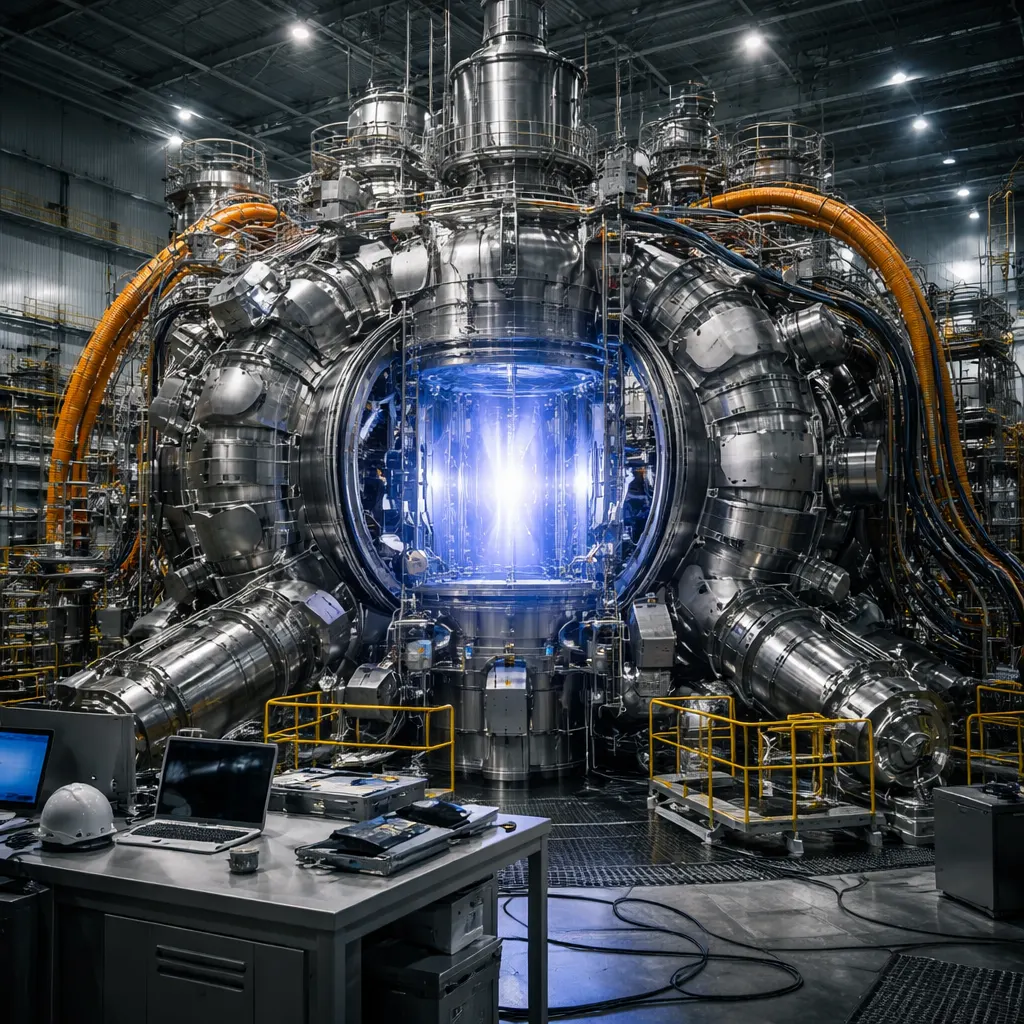
Commonwealth Fusion Systems has now secured $4 billion in total funding to construct what it aims to make the world's first commercial fusion power plant, according to a report from Utility Dive on the company's July 30 announcement. The Massachusetts-based firm pulled in a fresh $1 billion from risk-averse institutional backers including pension funds, sovereign wealth funds, and infrastructure corporations, with only ENI and Google allowing their names to be disclosed. Company CEO Bob Mumgaard said the capital will enable the firm to finish its demonstration reactor and move toward deploying its first commercial plant.
The company's demonstration reactor, SPARC, is roughly 80% complete, and executives expect it to show net energy gain in 2027. Commonwealth is building a 400-megawatt commercial plant on Dominion Energy land in Chesterfield County, Virginia—dubbed the Fall Line Fusion Power Station—that it plans to bring online in the early 2030s. The firm has locked in power purchase agreements with Google and ENI, secured some necessary permits, and submitted an application to connect to the PJM grid. Commonwealth spun out of MIT in 2018 and uses magnetic confinement fusion technology, deploying donut-shaped superconducting magnets called a tokamak to hold superheated plasma at temperatures high enough to fuse deuterium and tritium atoms and release neutrons. While scientists at Lawrence Livermore National Laboratory achieved fusion ignition for the first time in 2022, that breakthrough produced only "scientific" net energy gain—not enough power to run the entire fusion process.
Mumgaard told reporters that "at a time when we need more energy for electrifying everything, fusion is emerging as a next big thing in energy." The report notes that Mumgaard said commitments from infrastructure investors signal they could soon back "a string of ARC power plants," referring to the next-generation reactor design the company plans to use in Virginia, which would require more than $1 billion but less than $10 billion—"the scale of capital needed to do fusion seriously," he added. Commonwealth's senior vice president of corporate development, Ally Yost, recalled that the turning point with Dominion came when the utility's executive team visited the SPARC plant in Massachusetts and "left with a different view of where fusion is going," leading to a joint development agreement in 2024. The competition includes Type One Energy, building a 400-MW project at a former TVA coal plant with a curved tokamak design, and Helion Energy, which has a 500-MW linear accelerator in Washington state and offtake agreements with Microsoft and Nucor Steel.
The report describes several scaling challenges Commonwealth scientists acknowledge they're working through, including optimizing the supply chain, finding the most efficient tokamak materials, and fine-tuning plasma shape. Electric Power Research Institute Senior Technical Executive Andrew Sowder highlighted a critical technical hurdle: tritium released at high temperatures can escape the plasma and requires a "blanket" to capture heat and generate electricity by conventional methods, but "blanket technology is immature globally," though it "can be done at scale." Commonwealth joined the United Kingdom's national fusion laboratory program in July to test new tritium blanket technologies, aiming to demonstrate the blanket in parallel with completing SPARC so there's proof of execution before ARC is built. Sowder noted that all fusion approaches face challenges and emphasized that "until there is actual evidence of net energy gain from a demonstration, none can be called a winner." The report explains that fusion has the potential to produce large amounts of firm power like nuclear fission but with far less hazardous radioactive waste, a key advantage as demand for clean, reliable electricity grows. If Commonwealth hits its 2027 net energy gain target and brings its Virginia plant online in the early 2030s, it would mark a dramatic acceleration from the "probably decades" timeline Lawrence Livermore's director predicted in 2022.