
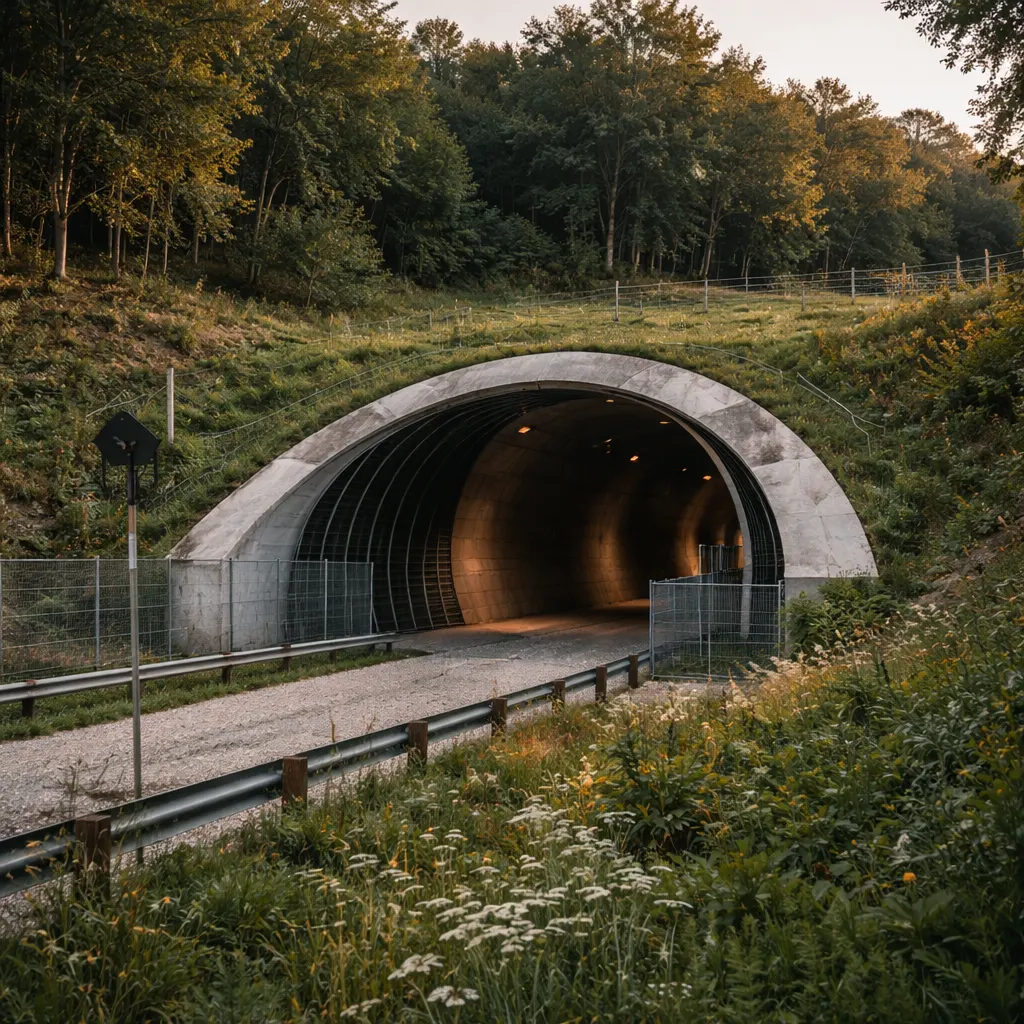
A publicly owned company in the United Kingdom was forced to spend £100 million ($132 million) on a covered structure to protect rare Bechstein's bats from colliding with high-speed trains, according to a new analysis published by the Foundation for Economic Education. Written by Mani Basharzad, a Research Associate at the Institute of Economic Affairs, the report examines how Britain has become what political scientist Francis Fukuyama calls a "vetocracy"—a system with so many regulatory veto points that building anything has become nearly impossible. The bat tunnel, spanning roughly one kilometer alongside a railway through Sheephouse Wood, has become a symbol of how regulatory constraints have paralyzed infrastructure development across Britain.
The costs of regulatory compliance extend far beyond bats. EDF Energy's nuclear power station in Somerset required more than $926 million in fish-protection measures, including specially designed low-velocity intake heads, a fish recovery-and-return system, and an acoustic deterrent system—underwater speakers nicknamed the "fish disco" that cost about $66 million alone to steer fish away from cooling-water intake pipes. Britain now has more than 400 quasi-autonomous non-governmental organizations (quangos)—independent bodies set up by the government—that the TaxPayers' Alliance estimates cost around £400 billion ($528 billion). The housing sector shows the starkest impact: Britain has just 446 homes per 1,000 people, the second-worst rate in Europe, according to research by the Centre for Policy Studies. The country hasn't built a major new conventional reservoir in three decades.
According to Basharzad, vetocracy isn't simply about separating powers and protecting minority rights—"it is about paralyzing democratic institutions and preventing the government from functioning." The report distinguishes between necessary constraints that protect liberties and government capacity, which is the ability to build without drowning in regulations and independent actors empowered to obstruct policies. Residents of Chelsea, one of London's most affluent areas, have even opposed expanding a cancer hospital because it could "harm property prices," the report notes. The visible costs include hospitals that can't expand and houses that could help young people afford homes, but the report emphasizes that the more serious costs are unseen: the products and investments that never happen because of regulatory barriers.
The report frames vetocracy as a product of an overextended state that wants to micromanage every aspect of economic life. Drawing on Austrian school economist Per Bylund's work, Basharzad argues that regulation's real cost isn't just direct compliance expenses—it's the choices that disappear, the investments that never materialize, and the economic freedom that gradually erodes. When institutions become paralyzed and voters can't get the policies they want, the conditions emerge for a populist backlash in which citizens turn to strongmen promising to "get things done." The barriers originally created in the name of better governance, the report concludes, have made effective governance almost impossible. A vetocracy is a democracy that has piled up so many opportunities to say no that it's lost the practical ability to say yes.