
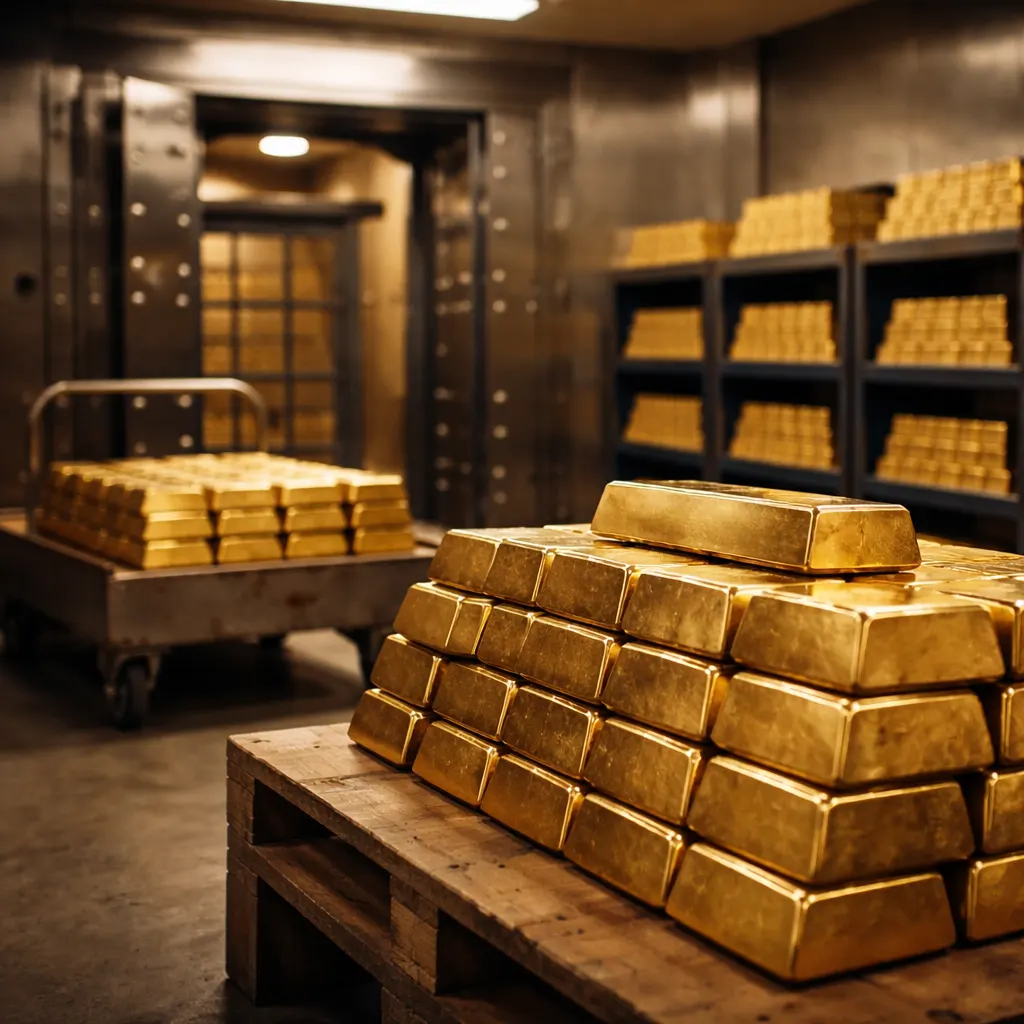
Central banks around the world are pulling their gold reserves out of New York and bringing them home at an unprecedented rate. According to the World Gold Council, 59% of the planet's central banks now choose to store their gold domestically, a sharp jump from 41% just two years earlier. The shift marks a dramatic reversal in the longstanding practice of using the Federal Reserve Bank of New York as a safe haven for foreign gold deposits, driven by geopolitical instability and concerns about the regulatory climate under President Donald Trump.
The exodus has reshaped global gold markets and reserve patterns. Central banks bought a record 289 tons during the second quarter of this year alone, five times what they purchased in the opening quarter. Gold prices have climbed 140% over the past three years, and in 2025 alone they rose roughly 65%, hitting a record of just over $5,000 per ounce this past January. The European Central Bank reported in June that gold has overtaken US Treasury bonds as the world's leading reserve asset, now representing 27% of total reserves compared to 20% in 2025. India has conducted one of the largest repatriations since 2022, now keeping around 77% of its total holdings in Mumbai and Nagpur. The Netherlands recently moved 86 of the 313 tons it had stored in the US and Canada to London, citing rising geopolitical unrest. France just finished a gold repatriation effort that started in the 1960s under President Charles de Gaulle, selling 129 tons held in New York and buying new, higher-quality bars in Paris between January 2025 and 2026, earning about $15 billion from the conversion.
Olaf Sleijpen, governor of the Dutch central bank, said "we do need to strengthen our resilience and preparedness," even though the country expects never to need the gold. Carsten Menke, a researcher at Swiss private banking group Julius Baer, stated that the war in Ukraine is "the main factor that has caused the change in gold's role as a geostrategic asset." The report notes that Menke believes a reversal of the repatriation trend is unlikely, even after a peace agreement is reached over Ukraine. According to the report, Trump's tariff wars and his attack on Iran have both contributed to the run on New York's foreign gold reserves, while Vladimir Putin's invasion of Ukraine in February 2022 and the G7 nations' retaliatory freeze of Russian assets held abroad have also played a major role.
The report explains that nonaligned countries were particularly alarmed by the unprecedented economic sanctions imposed on Russia, spurring them to secure their reserves at home rather than risk foreign seizure. Several European nations have already relocated their gold or face domestic pressure to do so, prompted by worries about the stability of the regulatory environment under Trump. Germany's 3,350 tons—worth about $475 billion and the world's second-largest reserve after North America's—has become a flashpoint, with the center-right AfD party calling in March for all German gold to be returned to Berlin from New York and London. Some leading German economists, including Emanuel Mönch, former head of research at Germany's federal bank, have said the 1,236 tons held in New York aren't safe under Trump, though the government and central bank have so far resisted the calls. The dollar's international convertibility into gold ended under Richard Nixon in 1971 amid fears of a run on US reserves, but gold's reputation as a safe investment during geopolitical turmoil remains undiminished.
The report concludes that while the gold standard as a global fixed benchmark has long since ceased to exist, the precious metal has lost none of its appeal for human beings, either as a symbol of indestructible wealth or a dependable investment in troubled times. New York's vaults might be slightly emptier than they were a few years ago, but many across the rest of the world now house more gold than ever before. The trend shows no sign of reversing: central banks continue to buy and relocate bullion at record rates, fundamentally reshaping where the world's gold reserves are stored and who controls them.