
Trade negotiations between the United States and Canada have collapsed, clearing the way for 50% U.S. tariffs on C$28 billion worth of Canadian goods to take effect, according to a special report published August 24, 2026 by BMO Capital Markets Economic Research. Prime Minister Carney blamed "last-minute changes in the U.S. proposed terms" that he characterized as unfair and economically unsound, while Canada prepares dollar-for-dollar retaliation that could trigger further escalation. The breakdown marks the most severe action in the trade dispute since spring 2025 and raises fundamental questions about the future of the USMCA trade agreement.
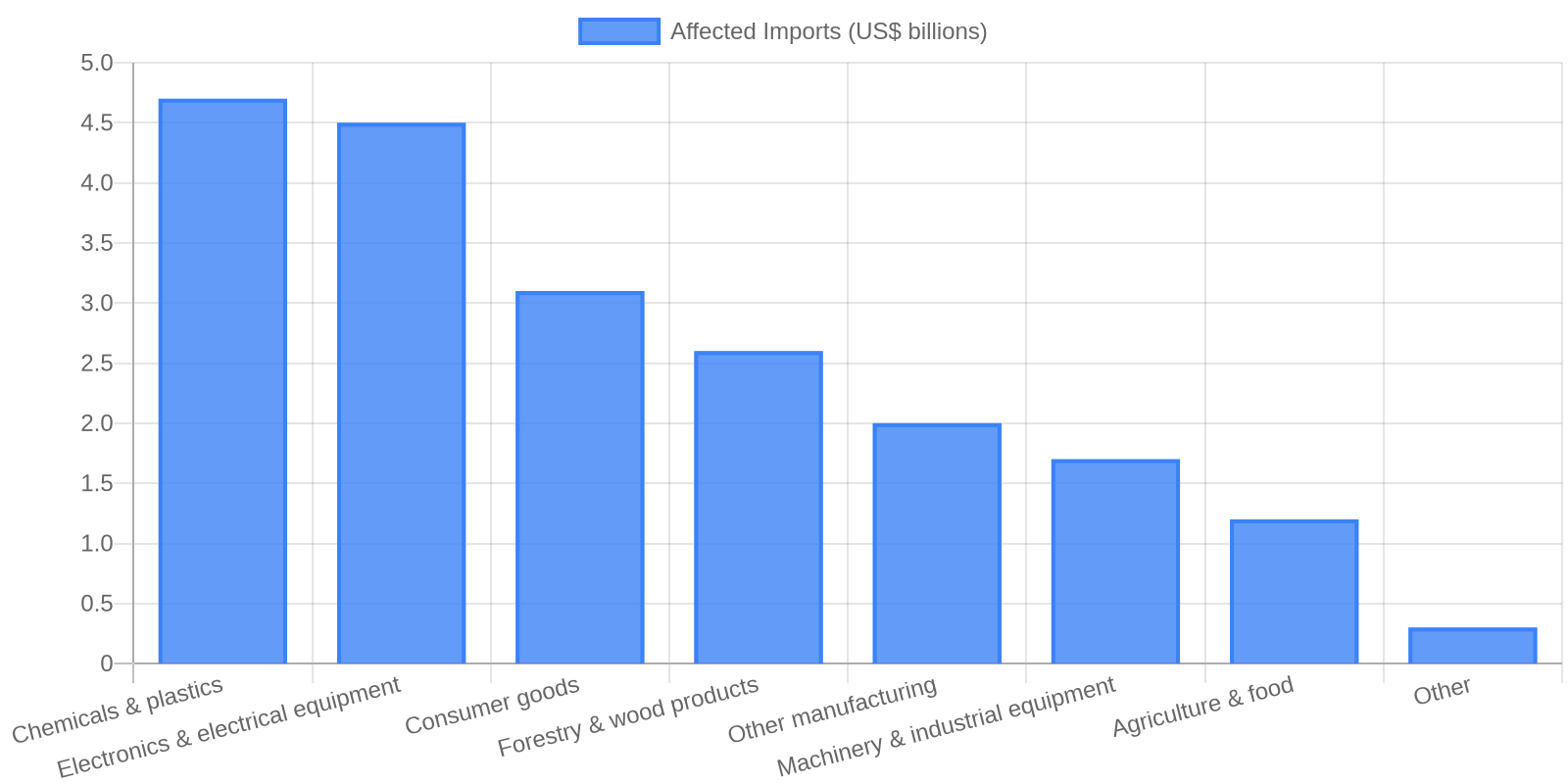
The new 50% U.S. tariffs hit eight Canadian sectors unequally, with chemicals, plastics, electronics, and electrical equipment accounting for nearly half of the $20.1 billion total affected imports.
The new tariffs will hit eight major sectors with vastly different severity, covering roughly 5% of Canada's goods exports to the U.S. and approximately 0.8% of Canadian GDP. Chemicals and plastics face the largest dollar impact at US$4.7 billion in affected imports, representing 23.3% of all targeted goods, while electronics and electrical equipment come in a close second at US$4.5 billion or 22.7% of the total. Consumer goods account for US$3.1 billion (15.5%), forestry and wood products US$2.6 billion (12.9%), and other manufacturing US$2.0 billion (10.0%). Machinery and industrial equipment will see US$1.7 billion affected (8.5%), agriculture and food products US$1.2 billion (5.8%), and other sectors US$0.3 billion (1.5%). Energy, potash, critical minerals, fish, and goods already facing Section 232 tariffs are exempt, but the levies will apply to goods currently moving tariff-free under USMCA—a significant departure from the existing trade environment where over 90% of Canadian exports not hit by specific duties have continued without tariffs under the agreement.
The report calculates that the weighted average effective tariff increase jumps from about 5 percentage points currently to around 7.5 percentage points as a result of the new duties. The White House is invoking Section 338 of the Tariff Act of 1930, an emergency trade authority permitting the President to impose additional duties up to 50% on imports from countries deemed to "discriminate against or impose unequal burdens on American commerce," targeting Canadian policies on alcohol, dairy, and autos. According to the report, the U.S. has threatened to escalate further by raising tariffs on Canadian autos and parts to 50% at the start of 2027, which would likely push the overall effective tariff rate up another 2 percentage points and represent another major step up in trade tensions.
BMO economists project these tariffs will shave roughly half a percentage point from Canadian economic growth, though the firm cautions that estimate could shift depending on details of Canada's retaliation and any fiscal support measures Ottawa deploys. The report notes the federal government appears to have fiscal capacity to respond without seriously deepening the deficit. While the aggregate numbers may seem manageable, the analysis warns that some specific businesses and industries will be hit extremely hard, and if the USMCA framework is truly broken and trust in the trade relationship further damaged, business confidence would suffer additional harm. Regionally, British Columbia, Quebec, and Ontario are expected to feel the biggest impacts, as these three provinces are already bearing the heaviest burden from existing duties on steel, aluminum, and lumber.
The breakdown arrives just as Canadian growth appeared to be gaining momentum, and the elevated uncertainty reinforces the Bank of Canada's inclination to remain on hold in the near term. Over the medium term, however, a weaker growth backdrop tilts the risks toward a slightly more dovish stance, since the central bank has specifically identified worsening tariffs as a potential reason to cut rates further. The report judges that the growth impact will outweigh any upward pressure on inflation, estimating that pass-through to consumer prices will be modest at around 25% even if Canada follows through on retaliation—leaving the trade war's drag on output as the dominant force shaping Canada's economic outlook.