
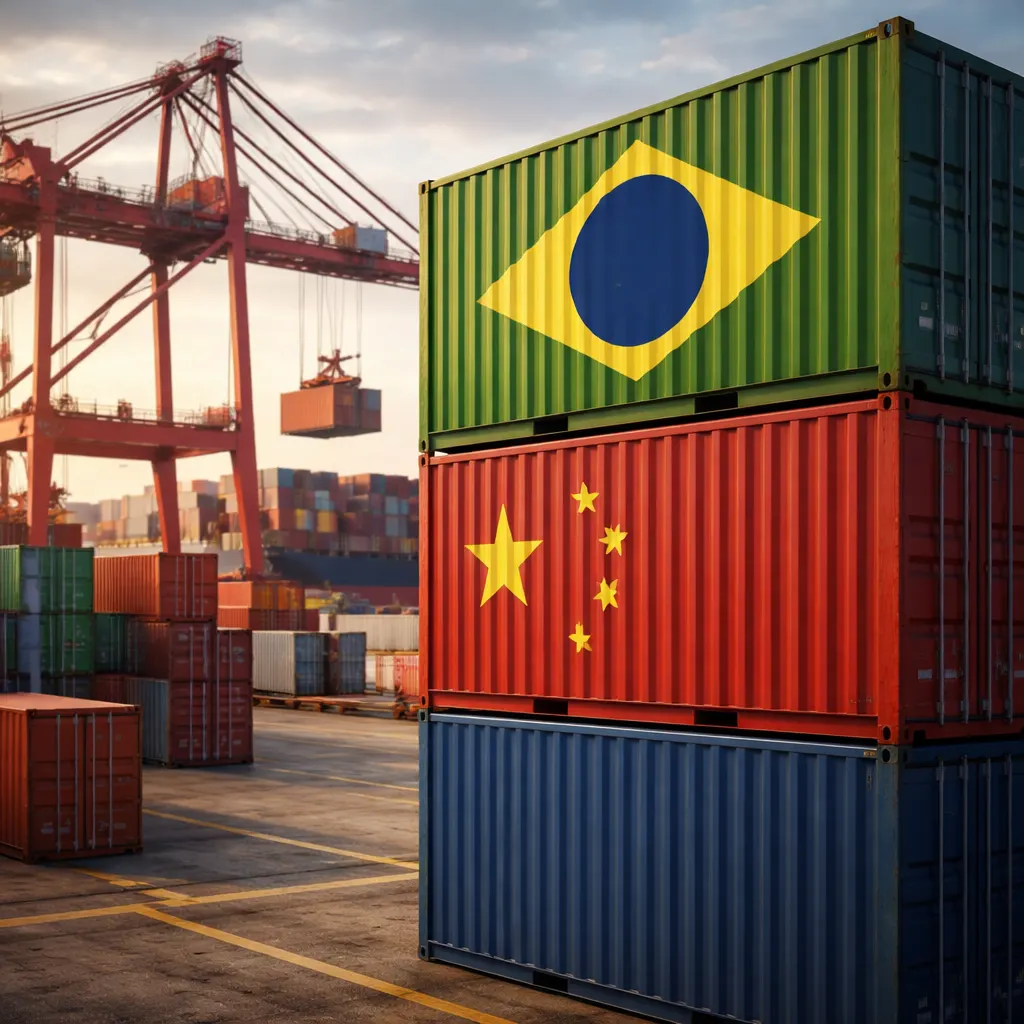
Brazil has reversed years of resistance to a China–Mercosur trade agreement following new American tariffs that now cover nearly half of all Brazilian exports to the United States, according to an analysis published by the Foundation for Economic Education. The shift came after a late July phone call between President Luiz Inácio Lula da Silva and Chinese President Xi Jinping, in which the two leaders announced plans to accelerate the long-stalled deal alongside cooperation on satellites, critical minerals, and visa waivers. The reversal marks what the report describes as a return to "pragmatic equidistance," Brazil's century-old strategy of balancing relationships with competing powers without committing fully to either side.
The tariff escalation has been swift and severe. A 25% tariff covering a broad range of Brazilian goods took effect in late July, and the Brazilian National Confederation of Industry estimates that close to half of all Brazilian exports to the US now face some form of additional duty. An additional 12.5% "forced-labor" levy was imposed to enforce bans on importing goods made with forced labor abroad, bringing the combined tariff on the hardest-hit products to 37.5%. The policy change took only two weeks to emerge after the tariffs came into force, with Brasília—which had previously led Mercosur's resistance to a China deal—deciding the cost of alignment with Washington had exceeded its benefits. China is already Brazil's largest trading partner, with bilateral trade valued at $188 billion.
President Lula has publicly called the tariffs a "strategic mistake" in the Washington Post and warned they will push Brazilian companies to replace American suppliers with partners elsewhere. Brazil has filed for consultations with the World Trade Organization to challenge both the broad tariffs and the forced-labor levy as violations of the 1994 General Agreement on Tariffs and Trade, while simultaneously continuing negotiations with the US. The report notes that Brazil's trade promotion agency launched a R$105 million ($20.5 million) program this month to help just under 2,500 exporters across 57 industries find new markets in the EU, Southeast Asia, and Central Asia. Mercosur is also pursuing parallel deals with India, Japan, and Canada, with Brazil at the center of this strategy.
The report explains that the tariff imposition has had domestic political effects beyond trade policy. Many Brazilians interpreted the tariff regime as a direct attempt to influence Brazil's October 2026 elections, allowing Lula to position himself as defending the country's sovereignty against foreign interference. This framing appears to have worked: Lula's polling has held steady in the mid-40s while his main challenger, Flávio Bolsonaro, has seen his popularity decline steadily since April 2026, widening Lula's lead. When the US sent election officials to verify Brazil's electoral system, their visas were denied—a message the report suggests resonated with a public heavily resistant to the perception of being managed from abroad.
The China–Mercosur deal faces obstacles despite Brazil's pivot. Because Mercosur operates as a customs union, all members must negotiate jointly, and Argentina's President Javier Milei is ideologically opposed to China and likely to veto any deal the bloc pursues. Brazil had previously blocked the China agreement itself, with Lula traveling to Montevideo in January 2023 to argue that Mercosur should secure an EU deal first. That EU agreement was signed in January 2026 after 26 years of negotiations and came into effect in Brazil in April, clearing the roadblock on Brasília's end. The report concludes that regardless of whether the China deal advances, Brazil's careful maneuvering to hedge its international trade relations may prove the smart long-term move in an increasingly multipolar world.