
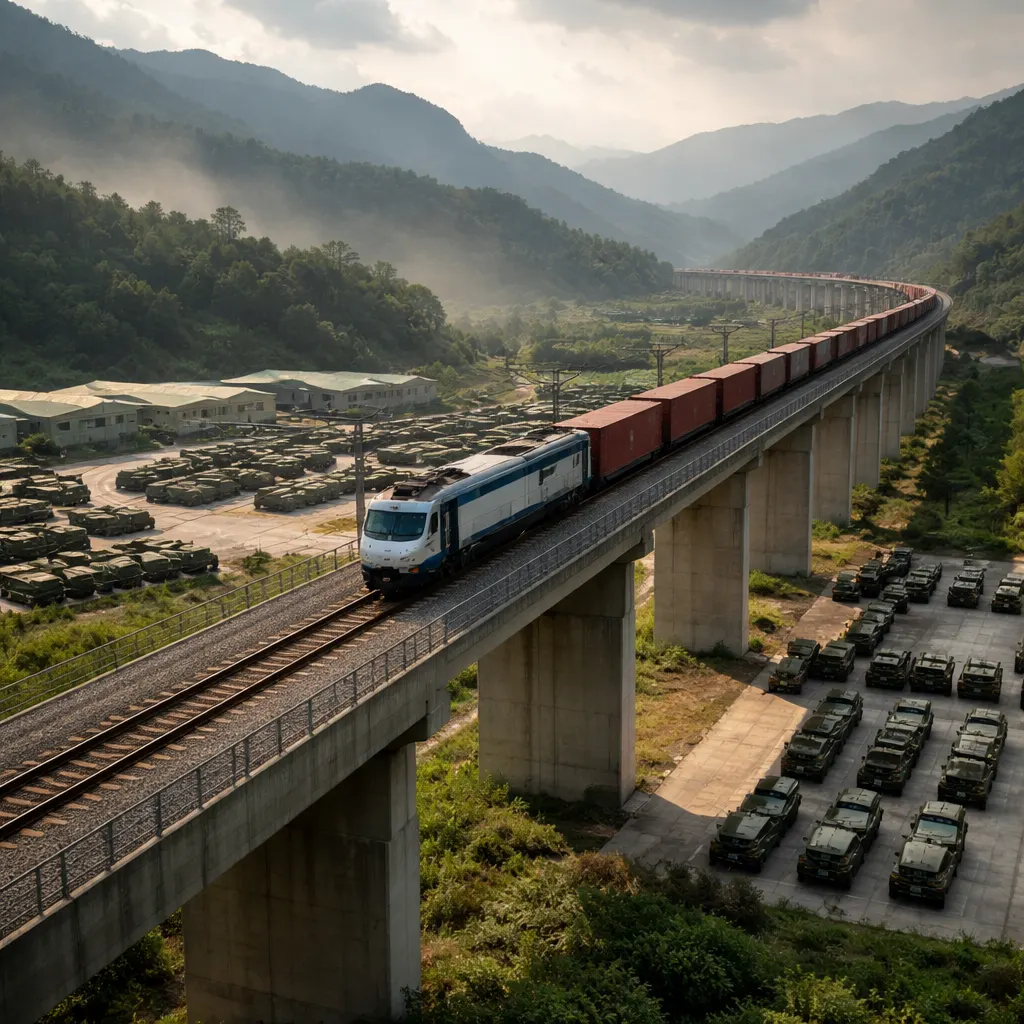
China is drawing Laos deeper into its sphere of influence through a railway freight line and a joint military air facility, according to a new analysis published by the Foundation for Economic Education. The moves are reshaping mainland Southeast Asia's strategic landscape, with neighboring Vietnam watching warily as Beijing uses infrastructure investment to create a secure southern flank through tight economic bonds. The approach mirrors China's imperial-era treatment of peripheral nations as vassals in a hierarchy centered on Chinese power, though officially Beijing maintains all countries are equal.
The Laos–China railway, which opened in December 2021, connects the capital Vientiane with the border town of Boten at an initial estimated cost of $6 billion. Beijing provided as much as 70% of the funding, with Laos's 30% share financed largely through a $460 million loan from China Exim Bank—the Laotian government could only afford $250 million itself. In the first half of 2026 alone, trade moving through the line reached 17.17 billion yuan (roughly $2.53 billion), up 33.8% from the previous year. The loan uses Laotian shares in the railway, the track itself, operating rights, and revenues from one bauxite mine and three potash mines as collateral. Freight costs from Kunming to Thailand via Laos have dropped 30–50%, though the railway was built to Chinese standards and plugs directly into existing Chinese rail infrastructure.
Beyond the railway, China and Laos jointly opened a military support and training center and a friendship aviation academy at Ban Keun airport on September 29, officially aimed at strengthening Laotian air force pilot training. But diplomats monitoring construction are searching for signs of air defenses, ammunition and fuel storage, and surveillance facilities, according to the analysis. Alexander Neill of Hawaii's Pacific Forum cautioned that such installations could signal military functions beyond training, with Ban Keun potentially hosting larger aircraft for signals intelligence and electronic surveillance that would extend China's reach across Southeast Asia. Vietnam responded coolly on November 5, with Foreign Ministry spokesperson Pham Thu Hang expressing hope that Laos will develop "in a peaceful, independent and self-reliant manner"—the mention of self-reliance carries an unmistakable edge.
The analysis explains that China is pursuing this strategy as part of the Belt and Road Initiative, launched in 2013, which uses infrastructure investment to deepen relationships and pull other nations closer to Beijing's center of gravity. Of all Southeast Asian countries, Laos has been among the most enthusiastic in embracing the Belt and Road Initiative, making it vulnerable to Chinese leverage over pricing and governance due to the financing arrangement and China's dominance in operational control. The approach reflects a 2010 statement by then-Foreign Minister Yang Jiechi, who told ASEAN counterparts that "China is a big country, and other countries are small countries." Thailand is next: a planned high-speed railway line initially approved in 2017 and now expected to begin operation in 2030, with the Thai government planning to tender Phase 2 in 2027. Thailand's stronger economy means it can pay for investment itself, limiting China's financial leverage, though the technology comes exclusively from China—a 2020 contract with China Railway International was worth just over 50 billion baht (about $1.5 billion at the time). More than 90% of Thai respondents to an ISEAS regional opinion survey expressed concern over China's growing regional economic influence.
Looking ahead, the analysis warns that China's use of economic muscle to bind foreign economies tightly to itself, combined with expanding military presence in Laos, Cambodia, and Djibouti, demands close attention. Whether claims that these developments could "redraw the region's strategic map" are overblown remains uncertain. What's clear is that the Belt and Road Initiative spans the globe, and China isn't hiding its intent to make mainland Southeast Asia a secure flank through infrastructure that doubles as leverage.