
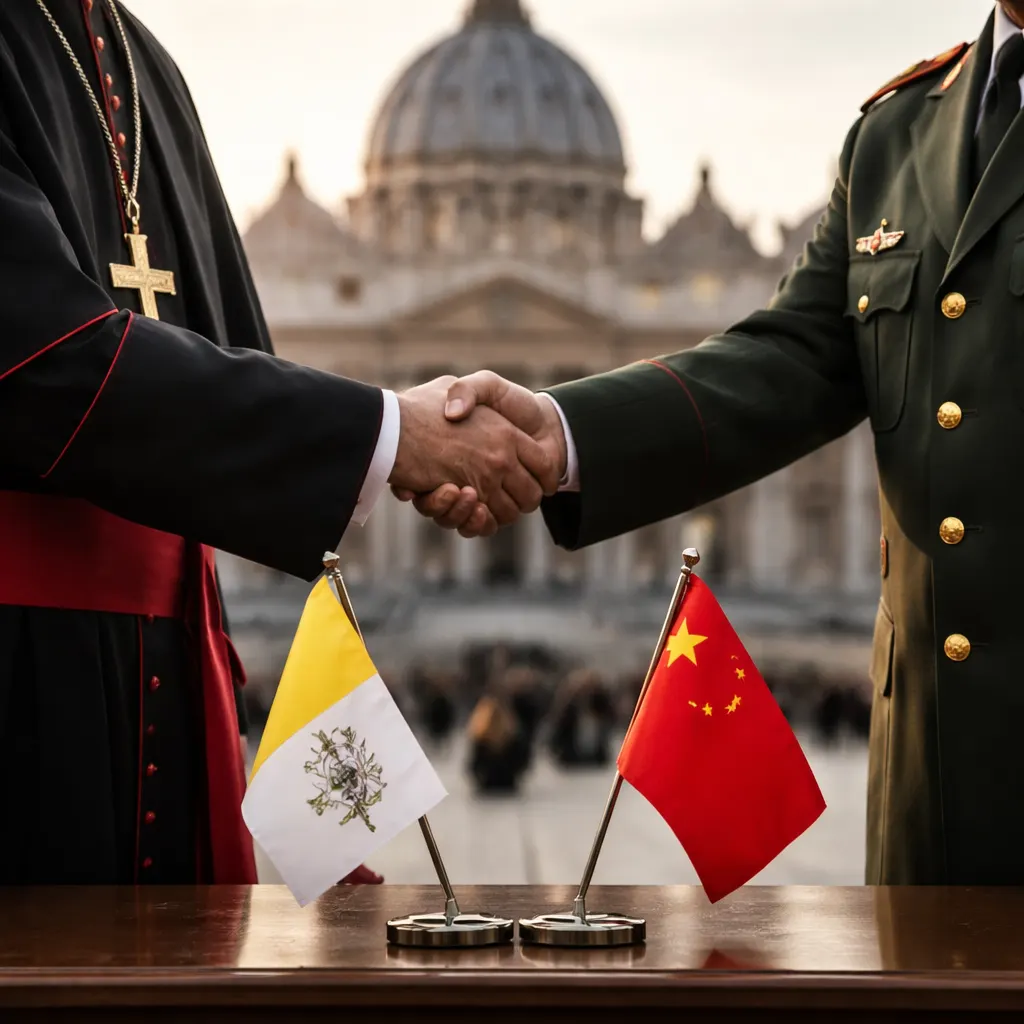
The Vatican's 2018 agreement with China has led to the appointment of top Chinese Communist Party religious officials as Catholic bishops, according to a January 2026 report by Nina Shea at the Hudson Institute. The secret pact gives Beijing a role in selecting bishops, with the pope retaining at least a veto right. Eight years after the deal, the report finds that the CCP is using it to place leaders of its state-controlled Patriotic Catholic Association in charge of dioceses across China, advancing President Xi Jinping's campaign to force religions to conform to communist ideology.
Most of the 18 bishops named under the agreement, plus two more the pope approved as a precondition for the deal, hold senior positions in the Patriotic Association and its committees, the report states. Recent appointments include 44-year-old Father Andrew Ding, named archbishop of Chongqing, whose main credential is serving as vice secretary of China's Council of Catholic Bishops within the Patriotic Association. Bishop Joseph Wang, deputy director of the Patriotic Association in Hebei province, was installed to head Zhangjiakou diocese, replacing the long-detained Bishop Augustine Cui Tai, whom the Vatican retired without saying whether he was free. Beijing's bishop, who leads the entire diocese, serves as president of the Patriotic Association. At least ten bishops loyal to the Vatican have been detained, disappeared, demoted, or forced into retirement, while four elderly underground bishops have died in detention or police custody since the agreement took effect.
According to Shea, Xi describes his Sinicization campaign as "adapting religion to socialism with Chinese characteristics," and its rules demand that sermons focus on Xi Jinping Thought, that religious and biblical teachings align with communist ideology, and that churches bar minors from entering. The Patriotic Association, created under Mao Zedong to cut China's Catholics off from Rome, requires members to pledge "independence, autonomy, self-management and democratic administration of the Church"—in effect, rejecting papal authority. Pope Benedict XVI wrote in 2007 that this stated purpose is "incompatible with Catholic doctrine." Despite this, the Vatican went along when Xi transferred control of the association from the state bureaucracy to the CCP's United Front Work Department in 2018, issuing new pastoral guidelines even though it considers the association illegitimate.
The newly appointed bishops are enforcing Sinicization aggressively. Shanghai's Bishop Joseph Shen Bin, president of the Patriotic Association's bishops' council, declared in 2023 that "we must adhere to the principles of independence and autonomy in running the Church," and stressed that dioceses need to "jointly promote the translation and interpretation of the Bible" under CCP supervision. Beijing's Archbishop Joseph Li Shan led Hong Kong clergy in prayers that the Chinese church "will be able to promote the work of evangelization and spirituality along the direction of sinicization." In December 2025, Bishop Francis Li Jianlin ordered a Henan Catholic church padlocked for "allowing minors to enter the church and play musical instruments," personally signing a directive banning all youth. A 2023 Pew study found that "all available sources suggest that China's Catholic population is not growing," with estimates holding steady at 10 million to 12 million believers, half of them underground. By contrast, sociologist Fenggang Yang at Purdue University estimates 100 million practicing Protestants in China, with most of the recent growth happening in unauthorized house churches outside CCP control.
The report concludes that China's Catholic Church faces an existential crisis if the Vatican continues its current path. With the Vatican no longer approving appointments of underground bishops, questions are mounting about the future of China's 400-year-old Catholic community. An essay published in September by the Vatican's own Fides news agency warned that a Sinicized Church focused only on "institutional transmission" and "reducing the Gospel to ethical rules" will be merely "a stage in history" rather than a living faith. The bottom line: papal approval for the Communist Party's takeover of bishop appointments is quietly dismantling the independent Catholic Church in China.