
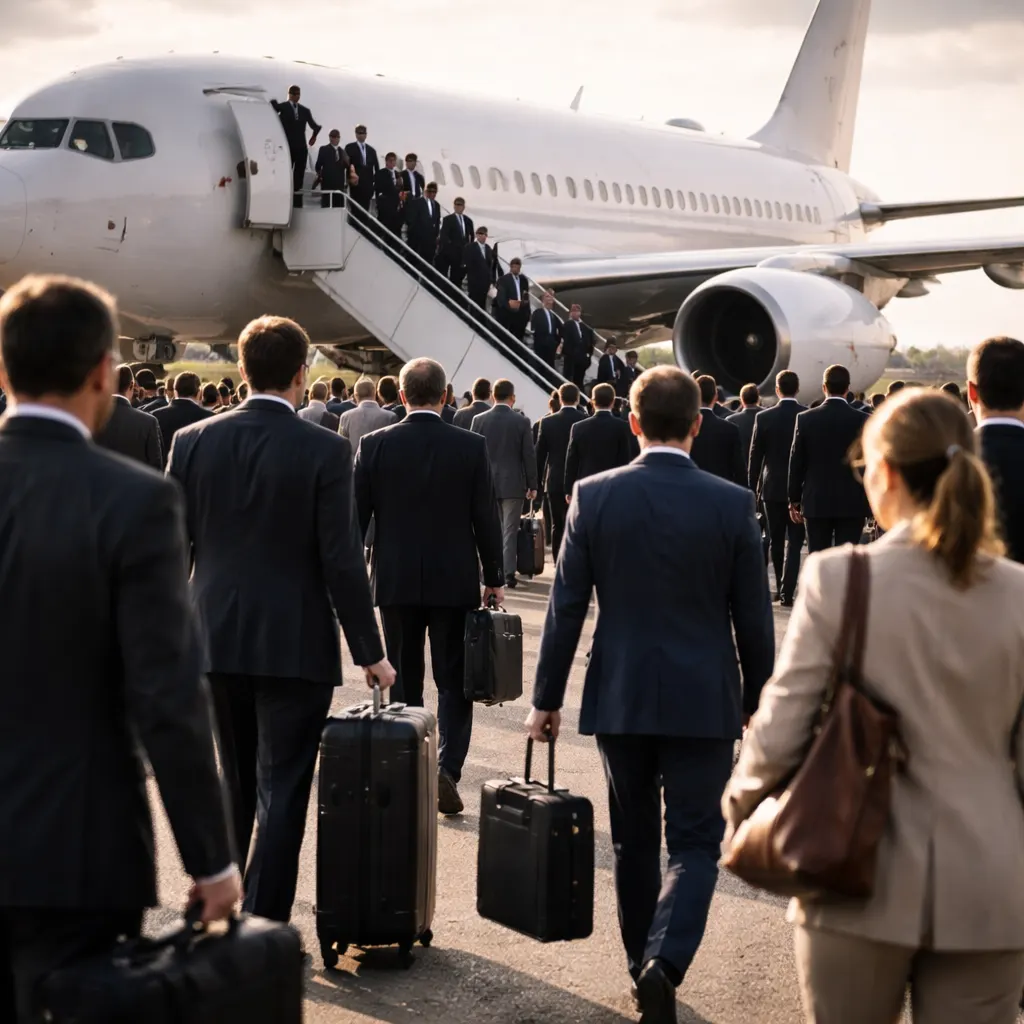
US Secretary of State Marco Rubio will travel to Uzbekistan this weekend with more than 200 business leaders as the Trump administration pushes to strengthen commercial ties and expand America's strategic foothold in Central Asia, according to a report by Radio Free Europe/Radio Liberty published October 16. Rubio will participate in an October 17-20 ministerial gathering in Samarkand under the C5+1 format, which unites the United States with Kazakhstan, Kyrgyzstan, Tajikistan, Turkmenistan, and Uzbekistan. The visit reflects growing US interest in the region's critical minerals, energy assets, and transport corridors as governments there seek to diversify partnerships and reduce reliance on Russia and China.
The report states that Rubio will conduct bilateral meetings with senior officials from all five nations and lead what the State Department described as a commercial delegation of over 200 business leaders. Washington has invited both Uzbek President Shavkat Mirziyoev and Kazakh President Qasym-Zhomart Toqaev to attend the G20 summit in Miami this December, according to background information cited in the report. The diplomatic push has sparked speculation about a potential Central Asia visit by President Donald Trump, which would mark an unprecedented move for a sitting US president. A senior Wall Street executive traveling with Rubio's delegation told the outlet he had never witnessed such strong interest from American businesses after several decades working in the region, speaking anonymously because he wasn't authorized to talk to media.
Ken Moriyasu, a senior fellow at the Hudson Institute, told RFE/RL that "there is unprecedented engagement between the US and Central Asian countries," calling this trip "the first step toward even more, such as a presidential visit." He explained that Central Asian nations "are not really that comfortable replacing Russian dominance with Chinese dominance," which is why regional capitals are reaching out to Washington and European partners. Republican Senator Steve Daines emphasized the need to "continue to expand on those partnerships by removing the outdated, Soviet-era Jackson-Vanik trade restrictions," referring to legislation that denies normal trade relations status to certain current and former nonmarket economies unless they meet specific freedom-of-emigration requirements. Laura Linderman, a senior fellow at the American Foreign Policy Council, suggested the event would be seen as "an even bigger success if the US expanded the format to be C6+1 and included Azerbaijan as part of it."
The administration's focus on commercial diplomacy comes as China has broadened its regional presence through trade, infrastructure investment, and its Belt and Road Initiative, while Russia's war against Ukraine has diverted Moscow's attention and resources, creating openings for other powers to deepen ties with Central Asia. Ariel Cohen, a nonresident senior fellow at the Atlantic Council, noted that while "China is the dominant economic partner, and Russia still provides a lot of security connections," the United States "is not walking away and is not abandoning that sandbox." The anonymous Wall Street executive explained that American business has realized "if they don't intensify their business activities in the region, China will soon swallow everything there," adding they "want to compete with China globally and at its footsteps, since the region is right next to it." Stronger economic and diplomatic ties could help Washington secure supply chains, expand commercial opportunities, and prevent any single power from gaining overwhelming influence across the region, analysts told RFE/RL.
The visit's success will depend on whether the diplomatic momentum produces concrete investment commitments and sustained commercial engagement, rather than simply a high-profile gathering, the report concludes. Critical minerals remain an important part of the picture, but Central Asia's strategic value also lies in its location between China, Russia, South Asia, and Europe, with transport routes like the Middle Corridor—connecting Central Asia across the Caspian Sea and the South Caucasus toward Europe—gaining importance as governments seek alternatives to routes passing through Russia. After Uzbekistan, Rubio will travel to Mumbai and Jamnagar, India, for his second official visit to the country this year to discuss the US-India strategic partnership, regional and global developments, energy cooperation, and commercial investment.