
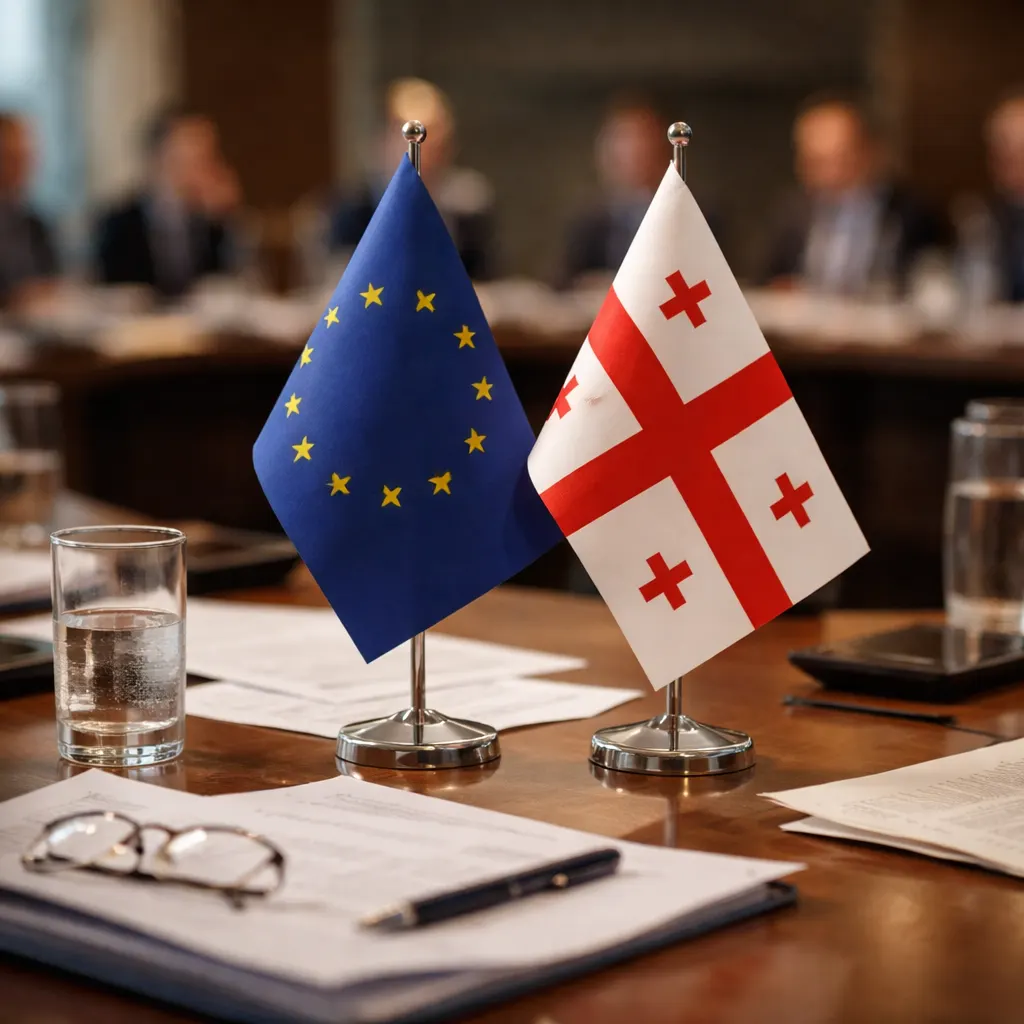
The European Union has publicly admitted that its current approach toward Georgia is failing both to alter the Georgian Dream government's direction and to safeguard Europe's strategic priorities, according to a JAMnews report published October 13. EU foreign policy chief Kaja Kallas acknowledged after a Luxembourg meeting on October 12, 2026, that the bloc's tactics aren't generating sufficient pressure for change while simultaneously preventing Brussels from fully pursuing its own interests in the region. The frank assessment leaves the EU facing an uncomfortable dilemma: how to escalate pressure on Tbilisi without losing a partner it considers essential in the Black Sea area.
The October 12 foreign ministers' meeting produced no fresh sanctions against Georgia, only expressions of worry over democratic regression, even as Georgian Dream moves forward with a constitutional lawsuit aimed at banning the country's main opposition parties. Enlargement Commissioner Marta Kos has already characterized Georgia as a candidate "on paper only," and Brussels is now preparing accession roadmaps for Montenegro, Albania, Moldova, and Ukraine that exclude Georgia entirely. The EU instead announced it's channeling resources directly to Georgian civil society, with ambassador Pawel Herczynski revealing €38 million ($42 million) in new 2026 projects at a Europe Day event in Telavi, targeting education, employment, rural development, and food quality. Meanwhile, Georgia's economy has expanded at an average rate of 7.6% during the first eight months of the year, a figure parliamentary speaker Shalva Papuashvili cited to argue that countries ignoring Brussels' advice enjoy economic growth while those following it suffer damage.
According to the JAMnews report, Kallas told colleagues that "our current approach is not creating enough pressure to bring about change, nor is it allowing us to fully pursue Europe's strategic interests," adding that the EU will revisit the Georgia question in January. Commissioner Kos stated that "as long as they are not moving forward—and are actually moving backwards because of the laws they have adopted—and until there is progress and steps towards European values, we will not cooperate with them." Bulgarian Foreign Minister Velislava Petrova-Chamova emphasized the importance of keeping Georgia engaged in conversations about Black Sea security, while Georgian opposition leader Gigi Tsereteli warned that "betting on the Russian market will one day lead to disaster," referencing Moscow's recent ban on Georgian wines, beer, and mineral water.
The underlying tension reflects Georgian Dream's effort to maintain a European identity while rejecting EU institutional demands. Prime Minister Irakli Kobakhidze insists his government's European orientation hasn't changed, but he blames the European Commission's leadership for blocking closer ties and claims—without supporting documentation in official EU papers—that Brussels is demanding adoption rights for same-sex couples. The government defends its refusal to join sanctions on Russia as pragmatic, though that calculus appears shakier after Moscow's import ban this month. Member states with Black Sea coastlines, particularly Bulgaria and Romania, remain eager to preserve Georgia as a regional partner for security and infrastructure reasons, even as Brussels weighs tougher measures. The opposition anticipates a harder EU line when the issue returns in January, though Tsereteli noted that Brussels has so far been "reluctant to take that final step" of completely blocking Georgia's membership path.
The admission that current policy isn't working signals that the EU's next move could involve either meaningful escalation—possibly including sanctions on Georgian Dream founder Bidzina Ivanishvili, as the European Parliament has urged—or a strategic retreat that accepts Georgia's drift away from Brussels' orbit. With Georgia's economy outperforming many EU candidates and Tbilisi officials openly mocking European leaders, the leverage Brussels assumed it held appears weaker than anticipated. The January review will test whether the EU is willing to impose real costs on a government that shows no sign of reversing course, or whether the bloc's need for a Black Sea partner ultimately outweighs its insistence on democratic standards.