
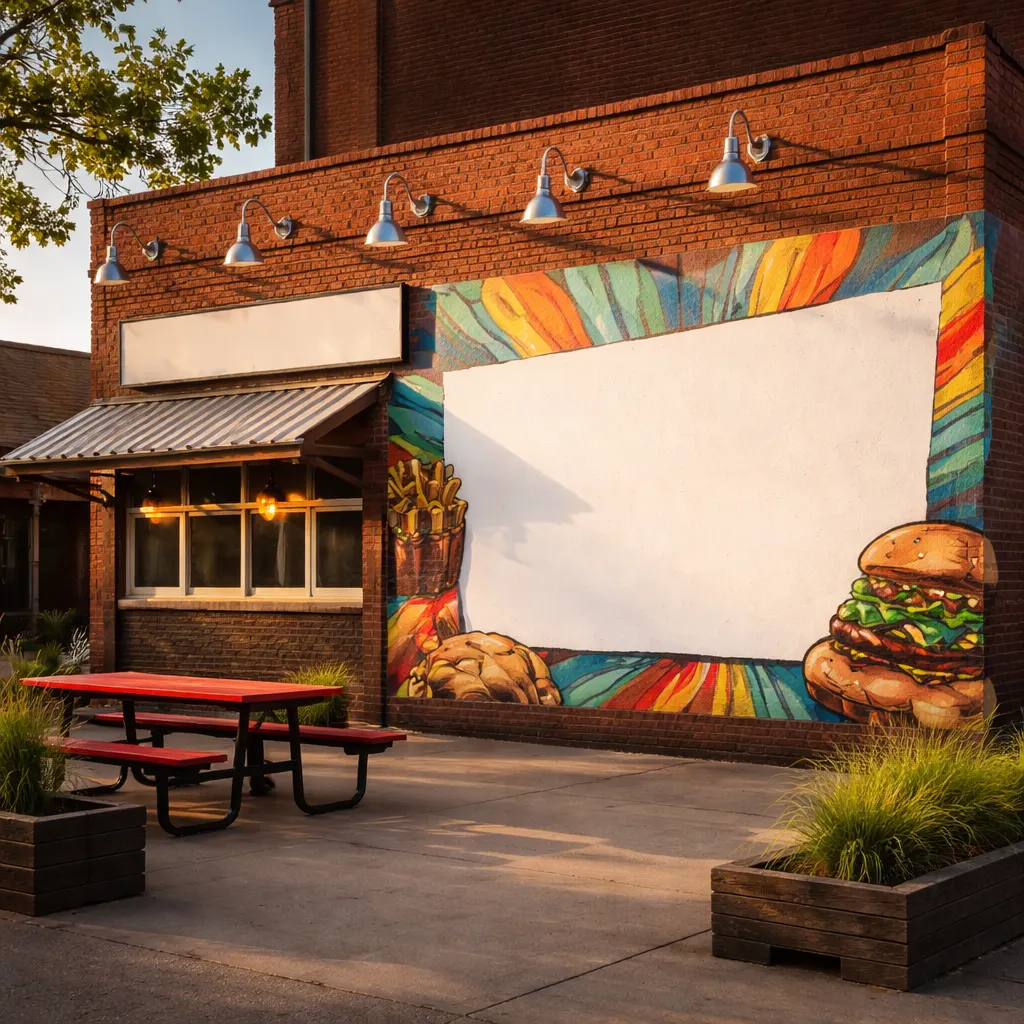
The owner of a Kansas hamburger restaurant has won a significant victory in federal court after city officials blocked him from painting a mural on his building. The 10th Circuit Court of Appeals affirmed a lower-court decision that the City of Salina violated Steve Howard's First Amendment rights by classifying his artwork as a regulated sign rather than an unregulated mural. Howard, who owns the Cozy Inn in Salina, filed the lawsuit with help from Kansas Justice Institute in early 2024 after city officials ordered him to stop painting.
Salina's objection centered on the mural's content: it depicted UFOs that city officials said looked too much like hamburgers, the restaurant's signature product. The city argued its sign code was content-neutral, but the appeals court found that the city was objecting specifically to hamburgers appearing on a hamburger restaurant. The court also determined the code was overly broad, noting that while Salina's interests in traffic safety, aesthetics, and property values are "substantial in the abstract," this doesn't permit the city to "justify any regulation simply through talismanic invocation of that interest." Additionally, the city code requires a permit decision within 10 days, but Howard had been waiting approximately three years without his consent, which the court ruled constituted a prior restraint on his speech.
The court wrote that "Salina's evidence failed to justify the distinction between regulated signs and unregulated murals," finding the city "did not show that signs pose greater danger to Salina's interest in safety, aesthetics, and property values." Sam MacRoberts, director of litigation at Kansas Justice Institute, pointed out the arbitrary nature of the enforcement: "Salina's code would have allowed Steve to paint a mural depicting flying pizza slices, but not burger-esque UFOs, just because The Cozy sells sliders." Howard, whose restaurant has served hamburgers from its small storefront since 1922, expressed gratitude for the community support he received throughout the legal battle.
The ruling has drawn national attention because cities across the country use similar sign codes to restrict expression. Friend-of-the-court briefs supporting the First Amendment challenge came from the National Federation of Independent Business, Institute for Justice, Pacific Legal Foundation, Liberty Justice Center, Alliance Defending Freedom, and a joint brief from Goldwater Institute and Manhattan Institute. The decision establishes that when government attempts to regulate speech, artwork, or expression, it must provide hard evidence supporting its restrictions rather than mere speculation. MacRoberts said the ruling sends a clear message to municipalities: "quit playing art critic."
The court's decision means the hamburger mural can remain on the Cozy Inn's exterior, ending a three-year dispute that pitted a century-old local business against its own city government. The ruling sets a precedent for business owners facing similar restrictions on artistic expression, requiring cities to prove with evidence—not assumptions—that artwork poses actual harm to safety or community interests. For Howard and the Cozy Inn, the victory preserves both a piece of artwork and the principle that government can't selectively ban images based on what a business sells.