
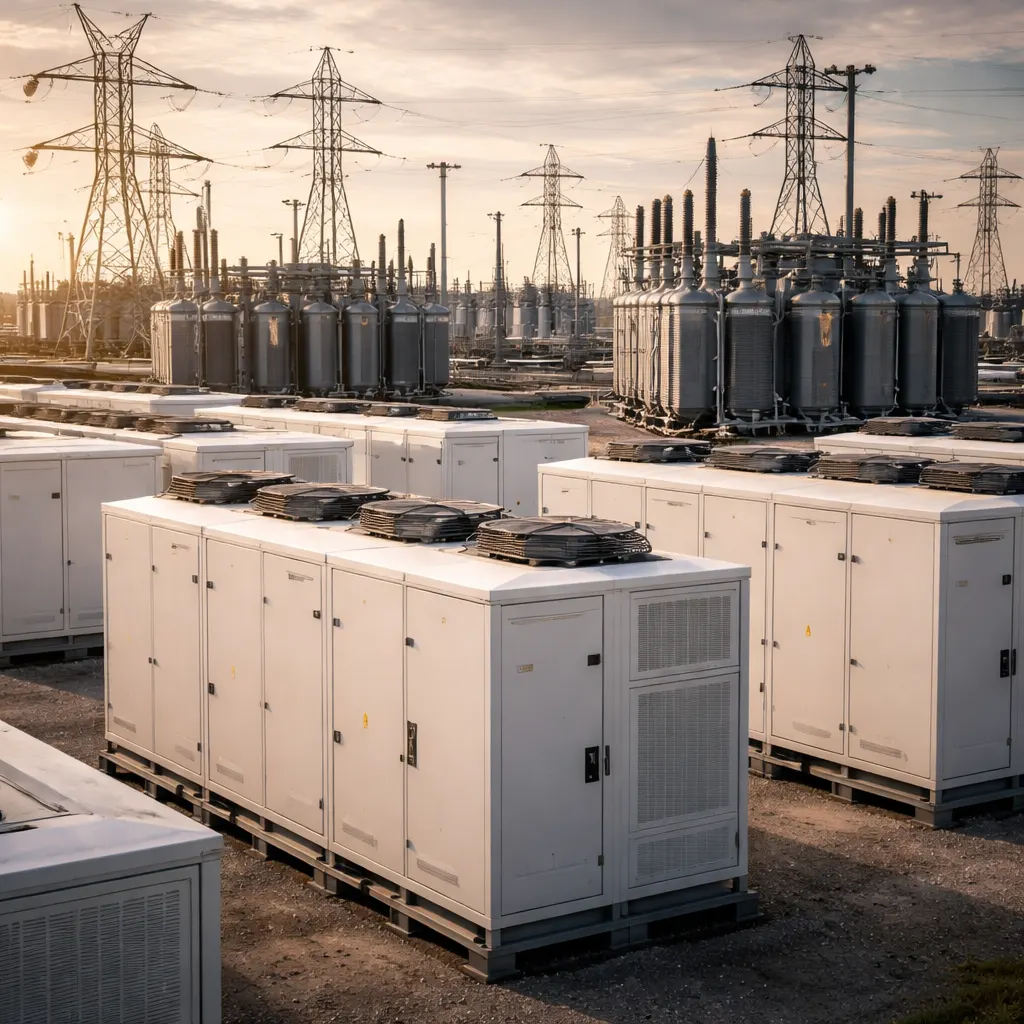
President Donald Trump's August 26, 2026, Executive Order 14421 aimed at securing the U.S. electric grid from foreign cybersecurity and supply-chain threats is more likely to disrupt battery storage than the transformers and circuit breakers that have already shifted away from Chinese sources, according to an analysis published by Rystad Energy on or around October 12, 2026. The order grants the Secretary of Energy authority to block or impose conditions on foreign-produced bulk-power equipment from countries under U.S. sanctions or deemed national security risks, with rules due by December 24, 2026. Rystad argues the measure could slow the buildout of AI data centers and their supporting infrastructure rather than harden grid security without economic cost.
For the twelve months ending June 2026, China accounted for 50% of U.S. lithium-ion battery imports by value, followed by South Korea at 15% and Japan at 13%, with no alternative source able to absorb displaced Chinese volume at the scale demanded by data centers and AI facilities. By contrast, China supplied just 3% of transformer imports and under 1% of high-voltage circuit breaker imports by value during the same period. South Korea, Mexico, and Canada together provided 74% of breaker imports and 48% of transformers. Chinese inverter exports to the U.S. fell 34% between 2022 and 2025 as the 45X advanced manufacturing production credit took effect, and U.S. inverter capacity is projected to reach 126 GW by 2028. Independent trade data from S&P Global Market Intelligence showed China's share of lithium-ion battery imports at 66.5% in Q2 2026, supporting Rystad's directional findings.
The executive order invokes the International Emergency Economic Powers Act and defines bulk-power system electric equipment to include battery energy storage systems, uninterruptible power supplies, substation transformers, grid-connected inverters, and associated software and services. The Department of Energy emphasized a targeted approach to avoid blanket prohibitions that would harm reliability or impose unnecessary consumer costs. Rystad's analysis concludes that the order's core exposure lies in batteries—the category with the highest remaining Chinese import dependence and direct relevance to data center resilience—while transformer risks are lower due to prior market shifts, though Wood Mackenzie has noted that data centers increasingly turned to Chinese large transformers to manage lead times as utilities avoided those suppliers after earlier restrictions.
Higher equipment costs, longer lead times, and project delays stemming from restricted battery and UPS options could raise electricity prices and strain reliability as AI-driven demand accelerates, the report warns. Data centers already face transformer and UPS bottlenecks, and limiting access to Chinese-linked lithium iron phosphate cells that dominate stationary storage could slow new load interconnection or force costlier alternatives, ultimately increasing capacity costs passed through to ratepayers. Hyperscalers and data center developers face elevated risk of delays, higher capital expenditures, and potential stranded assets if existing equipment requires expensive mitigation or replacement, while non-Chinese suppliers—Korean firms like Hyosung Heavy Industries, Mexican and Canadian producers, and emerging U.S. battery manufacturers—stand to gain market share and pricing power. The December 2026 rulemaking on which foreign entities are covered will determine whether the order hardens supply chains or creates bottlenecks that slow America's AI expansion, with consumers facing potential rate and reliability pressure and investors navigating both substitution opportunities and execution risks.