
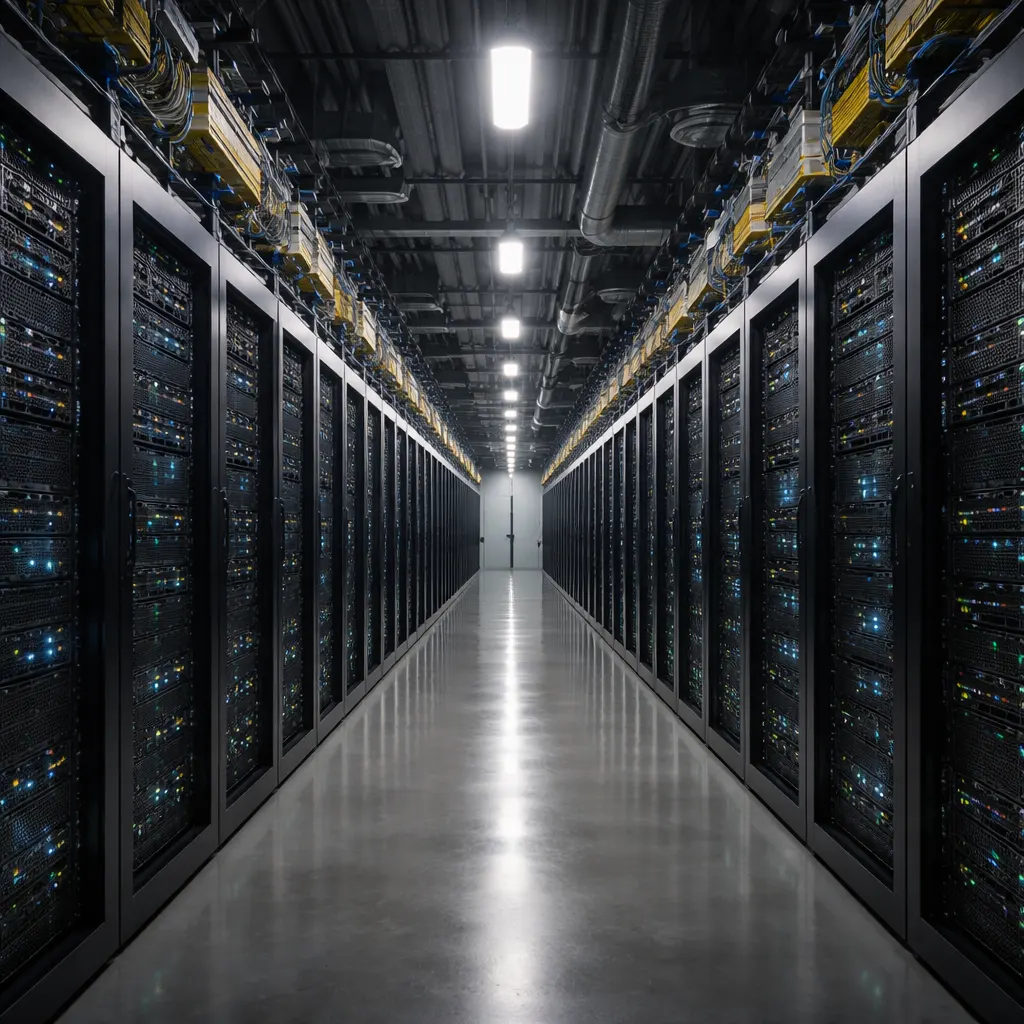
Data centers could consume up to 17 percent of total U.S. electricity by 2030, yet no federal agency currently measures their energy use on a regular basis, according to a report published by Advancing American Freedom, a policy institute. The analysis, authored by Kevin Dayaratna and released in 2026, examines how the rapid expansion of artificial intelligence is driving electricity demand while policymakers operate with remarkably limited information. The paper calls for statutory requirements to track data center load, permitting reform, and rejection of state-level development moratoria.
National electricity consumption reached 4,195 terawatt-hours in 2025, representing a 3.2 percent increase above 2022 levels and ending a plateau that had lasted since 2008, the report finds. Data centers accounted for less than 5 percent of U.S. electricity through 2024, but projections for 2030 range widely from 9 to 17 percent based on estimates from Lawrence Berkeley National Laboratory and the Electric Power Research Institute. Between 2019 and 2025, combined commercial and industrial electricity sales grew 7.3 percent nationally, but state-level variation was dramatic: North Dakota led at 53.3 percent growth, followed by Virginia at 35.7 percent, New Mexico at 35.2 percent, Oregon at 34.3 percent, and Nebraska at 33.9 percent. Meanwhile, 22 jurisdictions consumed less electricity in these categories in 2025 than in 2019, with Maine declining 9.8 percent, the District of Columbia falling 8.8 percent, and Connecticut dropping 7.8 percent.
Forecasting errors have been severe. Georgia Power's 2022 Integrated Resource Plan predicted less than 400 megawatts of peak load growth through winter 2030–31, but one year later the utility increased that estimate to 6,600 megawatts—almost 17 times the previous forecast—and by 2025 raised it again to approximately 8,500 megawatts, according to the analysis. PJM Interconnection, the nation's largest regional transmission organization, projected 4,312 megawatts of growth to 2030 in its 2021 report, then revised upward annually to 29,739 megawatts in 2025 before trimming to 26,635 megawatts in 2026. State tax revenue projections have missed by similar magnitudes. Ohio estimated its data center equipment tax exemption would cost $130 million and $136 million for fiscal years 2024 and 2025, but the Ohio Department of Taxation later reported actual costs of $554.9 million and $1.569 billion—4.3 and 11.6 times the projections. Texas revised its fiscal 2025 estimate from $130 million in February 2023 to $1.016 billion in January 2025. The report notes that Georgia attributed its most recent revision to "new data on a dramatic increase in data center construction."
The absence of consistent federal measurement forces utilities, regulators, and state legislatures to make billion-dollar infrastructure and tax decisions based on estimates of questionable accuracy, the report argues. Forecasting errors threaten reliability when demand is underestimated and burden ratepayers with unnecessary generation costs when overestimated. Thirty-eight states currently exempt data center equipment or electricity from certain taxes, but transparency varies: Ohio's actual costs were provided to reporters rather than published on the state website, while PJM publishes every forecast vintage in downloadable form. The report examines two policy approaches to managing new load: large-load tariffs, which place the cost of serving new demand on the customers who caused it, and consumer-regulated electricity, which would allow privately financed utilities to serve new nonresidential load under voluntary contract without state rate regulation. Twenty-one states have both tax exemptions and large-load tariffs in place, while 17 states have exemptions without an approved tariff.
Congress should require the Energy Information Administration to collect data center load on Form EIA-861 and reform permitting and interconnection processes, the report recommends. States should publish what tax exemptions actually cost, review them on a fixed schedule, authorize consumer-regulated electricity with broader eligibility, and reject data center moratoria—which as of September 2026 were under consideration in 16 states. The authors argue that rising demand should be met by expanding supply through an all-of-the-above energy strategy rather than imposing prohibitions. Better federal data collection would provide utilities, regulators, and policymakers a stronger foundation for forecasting future demand as American leadership in artificial intelligence increasingly depends on whether the country can supply the energy required to sustain it.