
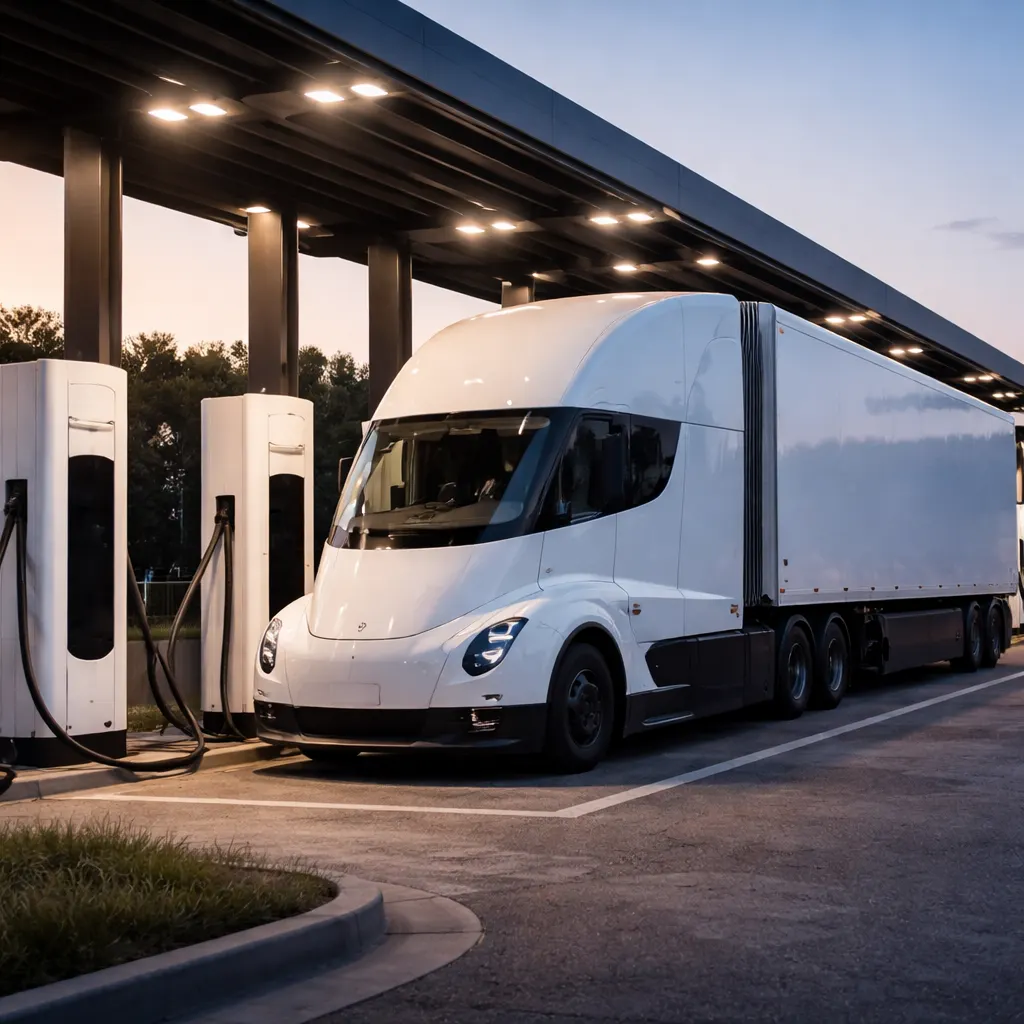
A new heavy-duty charging facility in Bryan County could make electric trucks more viable for freight fleets along I-16, especially as diesel prices climb. The Pilot Travel Center in Ellabell unveiled six Tesla Megachargers on Thursday, each capable of delivering up to 1.2 MW of power, according to a report published October 9, 2026 by The Current GA. The installation marks the start of a broader push to build charging infrastructure for Class 8 trucks across key U.S. freight corridors.
Each Megacharger can provide roughly 300 miles of range to a Tesla Semi in around 30 minutes, the report states. Tesla produces two versions of its semi: a standard-range model that travels 325 miles per charge and a long-range variant with 500-mile capacity. From a fuel cost perspective, operating an electric semi is about 50% less expensive than diesel, with a trip from Ellabell to Atlanta costing roughly $80 in a Tesla Semi versus $160 in a diesel truck last year, according to Tesla's East Coast business development lead Jason Gies. AAA reported diesel averaged $5.68 per gallon in the Savannah area on Friday. The upfront cost gap remains wide: the median 2025 battery-electric Class 8 tractor was priced at $411,200, while the diesel equivalent carried a median price of $172,500, according to Transport Topics.
Tesla opened an eight-stall Megacharging site in Conley, just south of Atlanta, on Wednesday, and the I-16 route is slated to become "one of our core centers" over the next year, Gies said at the ribbon cutting. "This year we'll have over 100 posts in the ground running with mega charging. By the end of next year, our goal is to have 700 posts for mega charging," Gies stated. Pilot has 12 more truck charging locations planned this year in California, Indiana, Nevada, and Texas, with a broader aim to create network access across major U.S. freight routes, according to Shannon Sturgil, the company's senior vice president of alternative fuels. A September report from the Southern Alliance for Clean Energy and Atlas noted that public and private investment in medium and heavy-duty electric vehicle charging infrastructure in the Southeast reached about $366 million, and as of June 30, 2026, the region had more than 90 public charging sites accessible to these vehicles—50% more than the previous year.
For trucking operations logging 75,000 to 100,000 miles annually, the return on investment for electric semis comes in about three to four years, even before the recent diesel price surge, Gies explained. Electric semis produce zero emissions and avoid the pollution profile of diesel, which Gies described as "the most polluting vehicles in the country." Drivers also report less fatigue because electric trucks vibrate less, and the Tesla Semi's 1,076 horsepower allows it to merge with traffic flow and maintain steady speeds on hills without the usual slowdown-acceleration cycle. Knoxville-based Pilot operates over 900 locations and is the largest travel center network in North America. The company's expansion aims to "help remove barriers, increase confidence, and make it easier for fleets to operate wherever the road may take them," Sturgil said, as electric heavy-duty trucks have been adopted more rapidly in China and Europe than in the U.S., according to the International Energy Agency.