
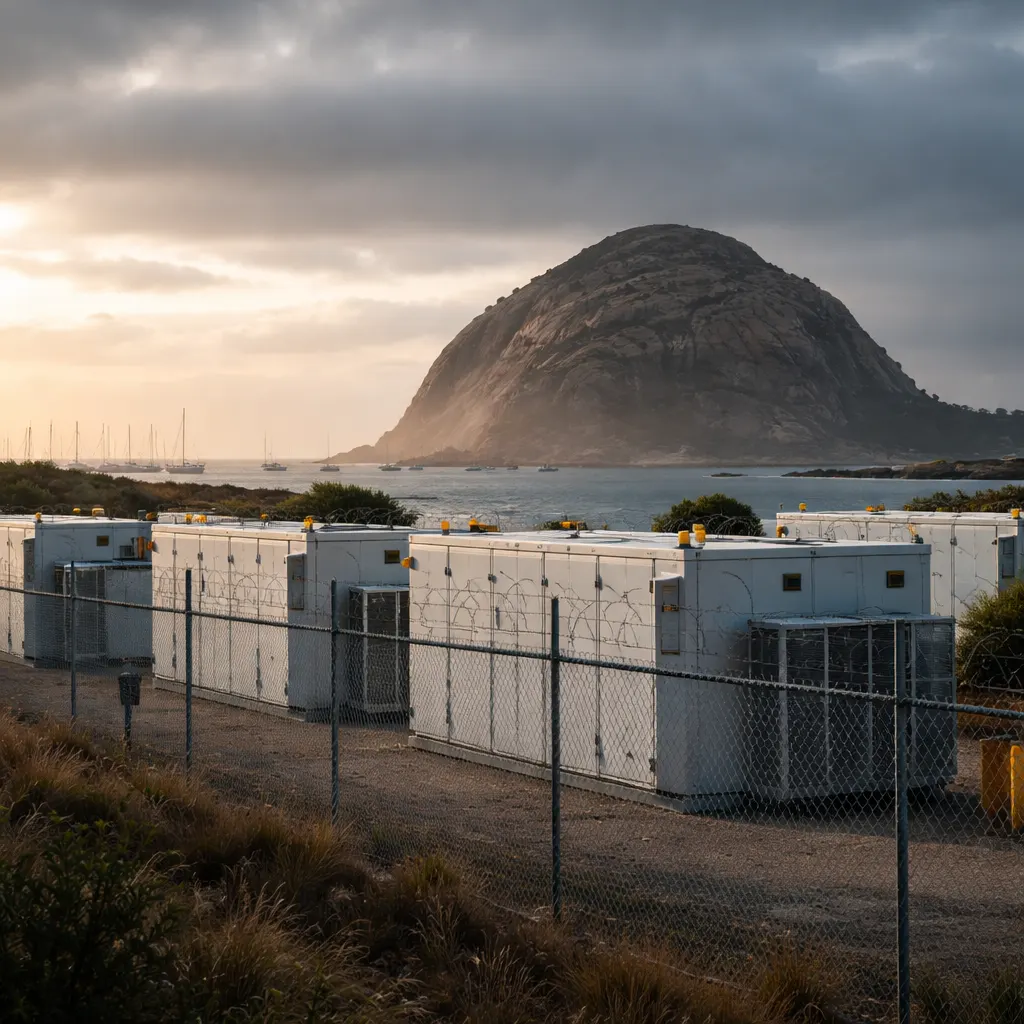
A Texas-based power company withdrew plans for a major battery storage facility in California after the city of Morro Bay unanimously banned such plants within its borders, a decision that could derail the state's push toward zero-emissions electricity by 2045. The April 2025 withdrawal by Vistra Energy came months before the city council made the prohibition permanent, blocking what would have been a 600-megawatt battery facility on a retired power plant site. According to an analysis published by the Pacific Research Institute, the rejection highlights a growing clash between local safety fears and statewide climate targets that depend on a massive expansion of industrial-scale energy storage.
California needs 52,000 megawatts of battery storage capacity within the next two decades to meet its carbon-free power supply deadline, but the state currently has less than half that amount at 23,000 megawatts. The existing capacity took just over seven years to build, starting from 700 megawatts in early 2019, according to California Energy Commission figures cited in the report. The proposed Morro Bay facility would have occupied roughly 24 acres of a 107-acre waterfront property where an old oil-and-gas power plant once operated. The city's resistance isn't happening in isolation—the California Coastal Commission raised substantial environmental and land-use objections to the project in an August 2024 letter to the city, even though state law technically allows local approval to be bypassed for such energy projects.
Morro Bay residents remain shaken by a battery fire that erupted at the Moss Landing facility in Monterey County in January 2025, which burned for multiple days and forced 1,200 people to evacuate after officials declared a state of emergency. The report notes that Moss Landing holds the dual distinction of being among the world's largest battery farms and the site of one of history's biggest battery facility fires. That same January 2025 blaze reignited in September 2026, prompting authorities to order nearby residents to shelter in place. According to the report's author Kerry Jackson, who serves as the William Clement Fellow in California Reform at the Pacific Research Institute, "sometimes NIMBYism is a reasonable position."
The rejection creates a precedent that could spread to other California communities, potentially crippling the state's ability to store renewable energy when wind and solar generation drops off. Even if the 52,000-megawatt storage target is reached, the report warns that wind and solar farms may not be built out sufficiently to supply the batteries with enough energy to store. Battery performance itself poses another obstacle—utility-scale batteries provide "valuable short-term support to the grid" but aren't long-duration power sources, according to the National Center for Energy Analytics quoted in the report. Storage capabilities typically last only one to four hours, and the batteries function as "energy sinks that carry significant economic and environmental costs." The report cautions that without clear understanding of these limitations, investments and regulations "could undermine energy reliability and security while misallocating and depleting raw materials, energy, finances, and other resources."
The report concludes that California faces a widening gap between its carbon-free electricity ambitions and the reality on the ground, similar to the state's perpetually delayed high-speed rail project. While the energy transition has progressed more smoothly than the train, Morro Bay's decision signals that the path forward will only grow more difficult. The fundamental question remains unanswered: are Californians prepared to live with an already vulnerable power system that could deteriorate further as dependable electricity sources are shut down before battery technology overcomes its current shortcomings?