
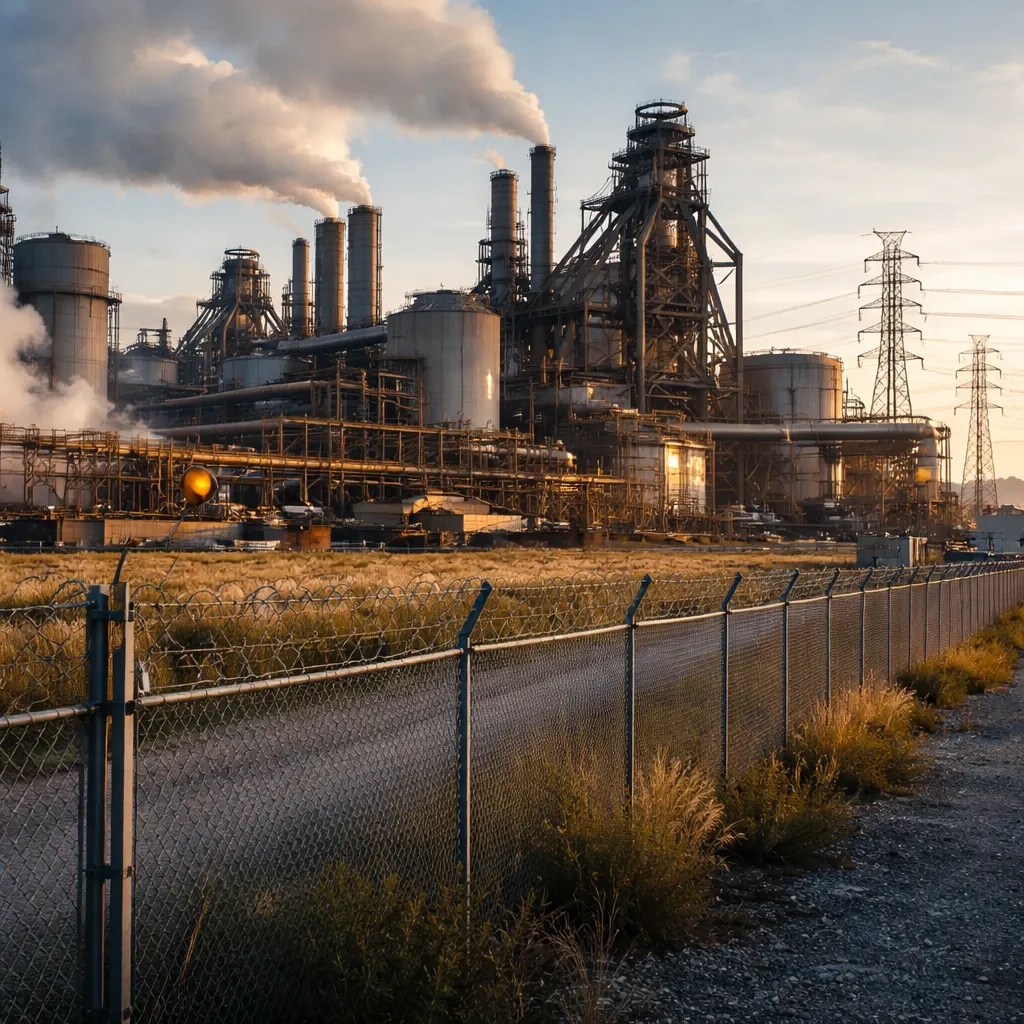
Minnesota's industrial electricity rates climbed 140% between 2002 and 2026, according to a new report from the Center of the American Experiment published this week. The analysis links this surge in power costs to Mesabi Metallics' decision to build a $15 billion steel facility in Iowa rather than Minnesota, despite mining the iron ore on Minnesota's Mesabi Iron Range. The report argues that energy affordability played a decisive role in the location choice for what President Trump called the "largest-ever steel plant" when announced on September 30, 2026.
Minnesota's industrial power rates jumped from 4.07 cents per kilowatt-hour in 2002 to 9.75 cents in 2026, the report found, while Iowa's industrial rates rose 82% over the same period, from 4.06 to 7.38 cents per kilowatt-hour. For total customers combined—residential, commercial, and industrial—Minnesota's rates inflated 125% between 2002 and 2026, climbing from 5.80 to 13.03 cents per kilowatt-hour, compared to Iowa's 67% increase from 6.01 to 10.03 cents. Minnesota's state ranking for total electricity rates deteriorated from its best position of 9th in 1988-1990 to its worst of 37th in 2021, improving only slightly to 30th by 2026. Iowa overtook Minnesota in 2007 and now ranks 7th nationally, while Minnesota sits at 30th for total rates and 33rd for industrial rates.
The report highlights that Mesabi Metallics emphasized energy efficiency repeatedly in its announcement, noting the technology would "significantly lower energy usage," "reduce the energy required," and cut "energy use and emissions compared to traditional blast furnaces." According to the report, electricity input costs can reach as high as 40% for steel producers, citing the World Steel Association. The analysis criticizes one mainstream media outlet for calling Iowa's electricity prices "marginally lower" than Minnesota's, when industrial rates in Iowa are actually 32% cheaper. Author Darren Nelson, a policy fellow at the center, writes that electricity prices in Iowa are "whoppingly lower" than the media characterized.
Rate volatility also diverged sharply between the two states. Between 2002 and 2026, Minnesota's total and industrial electricity rates showed volatility of 23.1% and 23.3% respectively, measured by relative standard deviation, compared to Iowa's 14.9% and 17.4%. The report traces the acceleration in Minnesota's electricity rates to 2002, identifying that year as the "take-off" point when costs began climbing faster than Iowa's. The analysis attributes this to state policies that "encouraged (since 2001) and mandated (since 2007) electricity unaffordability" under environmental goals, leading to what the report calls "state-wide de-industrialization." The report recommends that Minnesota's Public Utilities Commission and the state's political leadership "look in the mirror" on energy affordability, suggesting these policies directly cost the state an $18 billion steel investment that would have united the iron ore mine with a steel complex in-state rather than shipping raw materials across state lines.