
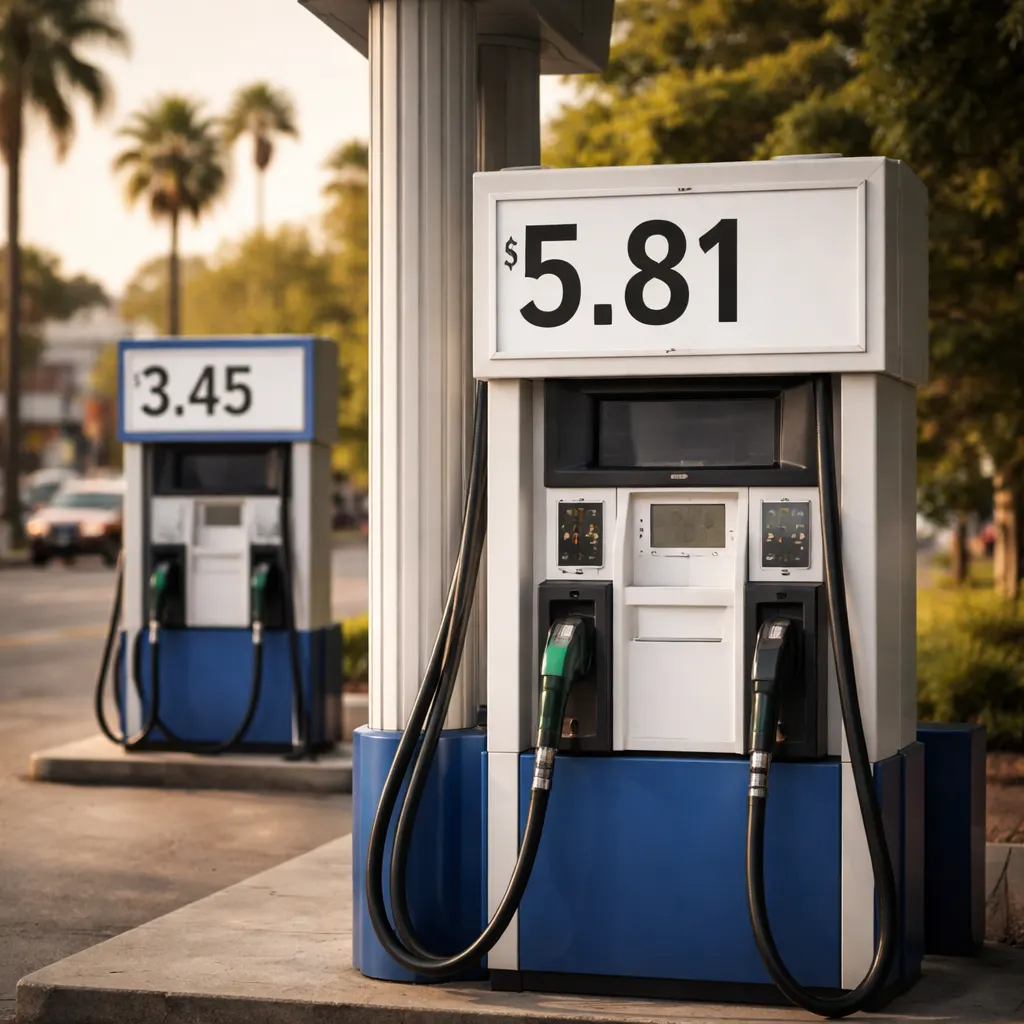
Americans traveling over Labor Day weekend faced the highest holiday gasoline prices ever recorded, according to a September 2026 analysis published by Energy News Beat. AAA's nationwide regular average reached $4.15 per gallon on Friday — the first Labor Day ever to break $4, and roughly 95 cents higher than the prior year's $3.20. The starkest finding: California drivers paid $5.81 per gallon while Indiana motorists paid $3.45, creating a $2.36 spread on the same holiday weekend driven by state policy rather than crude oil cost.
Diesel prices set an all-time national record at $5.85 per gallon, up about $2.14 year-over-year, with California diesel climbing to $7.71 — $2.25 above Texas and $2.33 above the cheapest state, Oklahoma, at $5.38. The ten most expensive gasoline states were California ($5.81), Hawaii ($5.46), Washington ($5.09), Nevada ($4.81), Oregon ($4.80), Alaska ($4.58), Arizona ($4.41), Utah ($4.16), Idaho ($4.11), and Illinois ($4.01). The ten most affordable were Indiana ($3.45), Mississippi ($3.47), Louisiana ($3.48), Oklahoma ($3.49), Arkansas ($3.51), Kansas ($3.52), Texas ($3.68), Missouri ($3.69), Kentucky ($3.70), and Alabama ($3.71). Aviation fuel also surged: retail Jet-A averaged $7.88 per gallon nationally as of September 4, with sustainable aviation fuel reaching $10.09 where available, based on GlobalAir's survey of more than 3,200 fixed-base operators.
The report attributes California's premium almost entirely to state policy layers rather than oil market fundamentals, noting that West Texas Intermediate crude hovered near $90 per barrel for all states. California's combined state excise tax, sales tax, underground storage fees, Cap-and-Trade pass-through, and Low Carbon Fuel Standard costs total roughly $1.20 to $1.40 per gallon, compared to Texas's 38.4 cents in policy costs. California's gasoline excise tax rose to 63.4 cents per gallon on July 1, 2026, versus Texas's unchanged 20 cents, while the state's carbon programs alone add about 42 cents — more than Texas's entire fuel tax. The analysis finds that of the $2.12 California-Texas price gap, policy and mandates explain $1.00 to $1.05, with the remainder stemming from California's requirement for unique CARB-compliant gasoline that can't be easily replaced with Gulf Coast supplies and the isolation of the West Coast refining system.
The isolation of the Pacific refining network amplifies price shocks because no large-diameter pipeline connects Gulf Coast refineries to California, Oregon, Washington, Nevada, or Arizona — which is why those five states cluster at the top of every ranking, the report explains. When a West Coast refinery falters, replacement fuel must arrive by ship rather than pipeline. Indiana's position as the cheapest gasoline state reflects local oversupply this particular week rather than low taxes; the state's diesel price sits at the national average of $5.85 because its tax structure is heavy on both fuels. For truckers operating at 6.5 miles per gallon, $5.85 diesel translates to roughly 90 cents per mile in fuel costs alone, rising to about $1.19 per mile in California — a differential that flows directly into grocery prices, construction materials, and every other good transported by truck.
GasBuddy analyst Patrick De Haan noted that any post-holiday relief depends on crude oil movement and the seasonal shift to winter-blend gasoline, which is cheaper to produce. A family filling a 15-gallon sedan pays $51.70 in Indiana, $55.33 in Texas, $62.21 at the national average, and $87.12 in California. The report concludes that crude oil is the same molecule in Beaumont and Bakersfield, but the $2.12 gap is built from taxes, carbon programs, boutique fuel specifications, and refining geography — with only the last factor beyond policy control.