
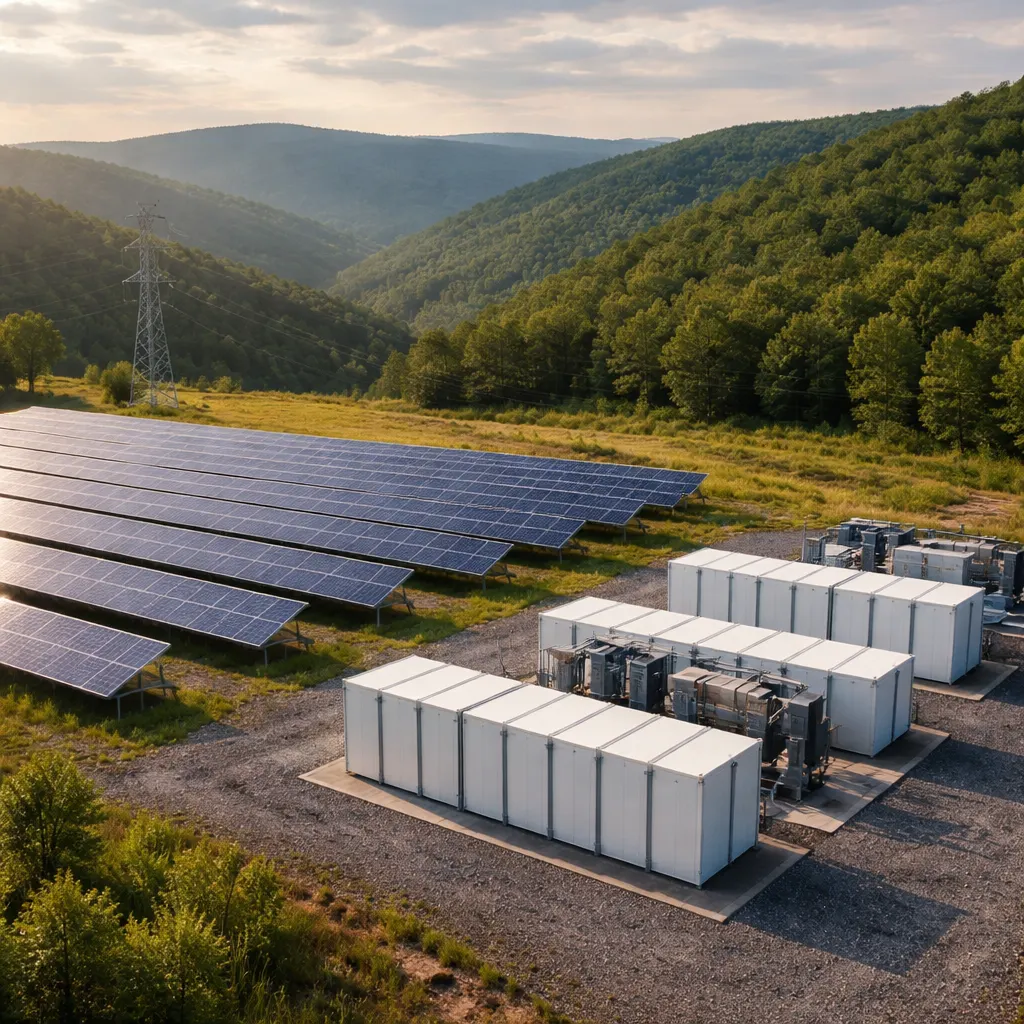
Google will purchase all the energy, capacity, and clean energy credits from a solar-and-storage installation planned for a former coal mine site in West Virginia, the tech company and its partners announced last week. The Mammoth Solar project represents one of the largest deployments of zinc-based battery technology to date and is designed to power Google's regional data centers around the clock.
The installation in Kanawha County will feature 86 MW of utility-scale solar generation, 10 MW/100 MWh of zinc-based long-duration batteries, and 70 MW/280 MWh of lithium-ion batteries, according to the September 2, 2026 announcement from Google, developer MN8, and battery manufacturer Eos Energy Enterprises. The solar portion is slated to begin commercial operations in 2028, with the storage components following in 2029 and 2030. The project will feed into the PJM Interconnection system, where recent capacity auctions have hit price ceilings and a one-time backup auction this fall is expected to address a nearly 7 GW capacity gap. Most existing zinc battery installations have power ratings of 1 MW or less, according to the U.S. Department of Energy cited in the release. Eos batteries rely on a nonflammable, zinc-based electrolyte instead of lithium and can economically discharge power for more than eight hours at a stretch.
The companies said in a joint statement that the project is engineered to align clean energy capacity with Google's regional data center demand patterns throughout the day. Lucia Tian, Google's director of advanced energy technologies, said the effort "aims to deploy a smart portfolio of round-the-clock technology solutions to help power our digital infrastructure." Jon Yoder, MN8 Energy's president and CEO, credited Google for being "willing to pair next-generation storage with utility-scale solar" and enabling MN8 to create a tailored solution for its facilities' load profiles.
The announcement is part of a wider push to speed up the commercialization of long-duration energy storage technologies, according to the companies. Last year, MN8 and Eos Energy signed a supply agreement under which Eos could provide up to 750 MWh of its zinc-based Z3 battery modules to various MN8 projects within PJM and other U.S. markets, with the first projects combining 200 MWh of 10-hour energy storage with solar generation. Separately, Google is financing construction of what Xcel Energy describes as one of the world's largest battery installations of any kind: a 300 MW/30 GWh iron-air battery deployment in Minnesota that manufacturer Form Energy says can deliver up to 100 hours of full-power discharge. Like the West Virginia installation, Google's Minnesota project is one piece of a broader effort to secure clean energy resources for data centers the company plans to activate in the region.