
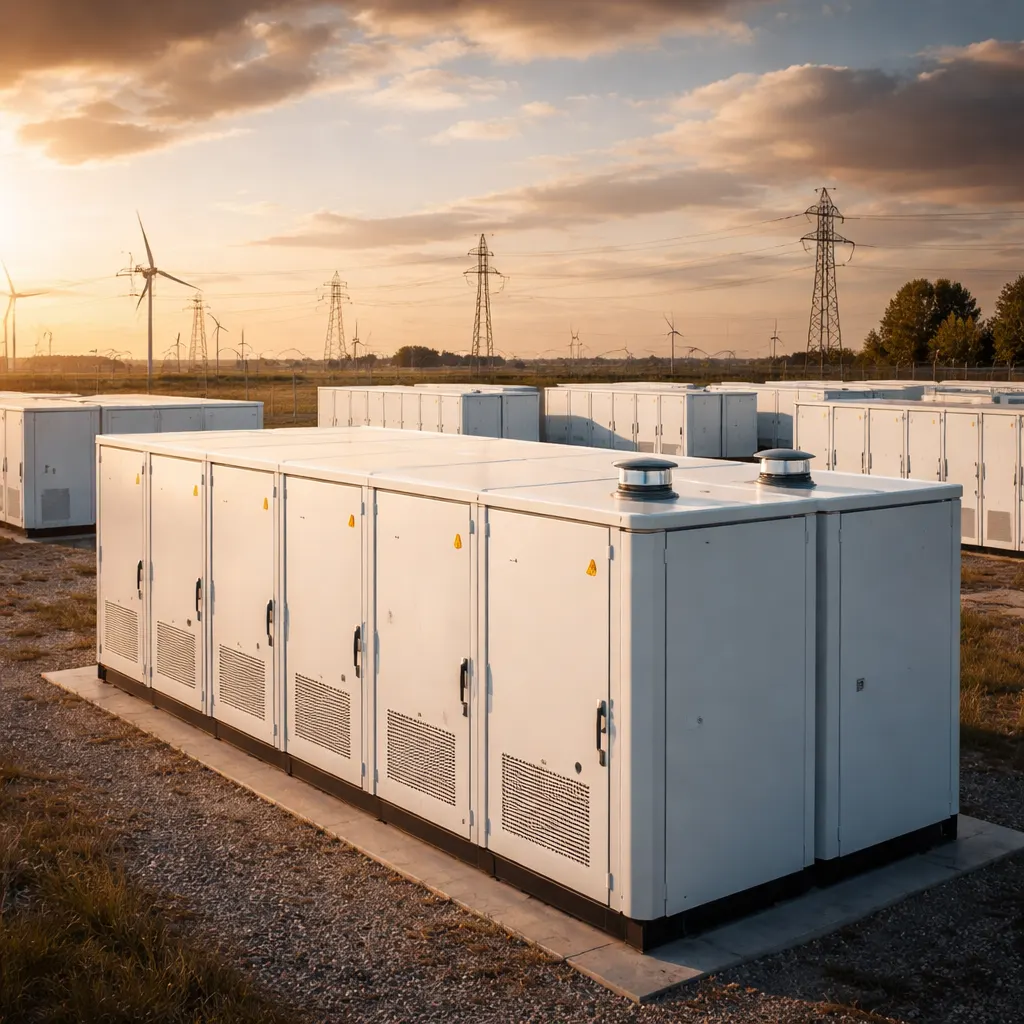
Global energy storage capacity is forecast to surpass 7 terawatt-hours by 2035, representing a sevenfold expansion from current levels, according to Wood Mackenzie's latest outlook published this month. Demand growth in 2026 alone is approaching 30%. The energy storage market is entering what the research firm calls a new phase of scale and complexity, where the composition of growth matters as much as the totals.
The report reveals that Europe's annual installations overtook those of the United States for the first time in 2026, claiming second place globally behind China. Poland has emerged as the world's leading new market, driven by capacity-market auctions and grid flexibility shortages. In the utility segment, government-led tenders have cleared more than 80 gigawatts of de-rated capacity globally, with India contributing the largest share. Contracted offtake for storage has passed 130 gigawatts, with utility power purchase agreements and tolling deals making up more than three-quarters of all signed contracts. Australia has overtaken Germany as the world's top residential storage market, aided by more than half a million installations under its Cheaper Home Batteries subsidy, while the US residential market is contracting this year as tax credits become less accessible.
Wood Mackenzie now divides the utility energy storage market into three categories—standalone, solar-paired, and wind-paired—because the three are expanding for different reasons, at different speeds, and in different locations. The research director Anna Darmani notes that standalone projects still dominate and will continue to do so through 2035, but paired capacity is no longer negligible: close to a third of the storage expected online by 2035 will be co-located with a wind or solar plant. The report also identifies commercial and industrial storage as "the sleeping giant now waking," with industrial demand materially larger than commercial in some regions. Aging storage assets will begin coming offline and being replaced at scale after 2030, adding 40 gigawatt-hours of repowered capacity by 2035, led by the US, Japan, and Germany—the first sign of a market mature enough to require replacement.
The breakdown exposes sharp regional differences shaped by distinct policy and economic conditions. Europe remains the most standalone-heavy market globally, with the vast majority of its utility pipeline unpaired, yet it's also positioned for the fastest growth in paired capacity as worsening economics for standalone solar push developers toward co-location—making it the market most likely to shift quickly as an economic solution for stranded solar projects in Spain or Germany. The Americas sit at the opposite end: in the US, close to half of utility storage additions are solar-paired, a legacy of early investment tax credit pairing requirements and poor solar capture rates in key markets like California's grid operator territory. That share is expected to decline as storage spreads into states with lower solar penetration, where standalone economics perform better. Asia Pacific falls in between, with solar pairing the fastest-growing utility category, driven largely by India, which has overtaken Australia as the region's largest utility-scale market. India's new rules will require solar and wind projects commissioned after July 2027 to include co-located storage equal to at least 10% of capacity, rising to a four-hour minimum duration from 2029.
The outlook points to falling costs and policy support as the forces accelerating battery storage momentum in emerging and advancing markets alike. The shift toward pairing reflects both regulatory mandates—like India's co-location requirements—and economic necessity, as standalone solar projects face deteriorating returns in saturated markets. Data center-linked battery projects are also taking shape in the US, though not all are paired with renewables: gas-plus-storage pairings are becoming the preferred co-location option for emerging data center projects. The market is no longer just about how much capacity gets built, but where, how it's configured, and what it's paired with—a complexity that reflects both the maturation of the industry and the diverging needs of regional grids trying to balance intermittent renewable generation with reliable power delivery.