
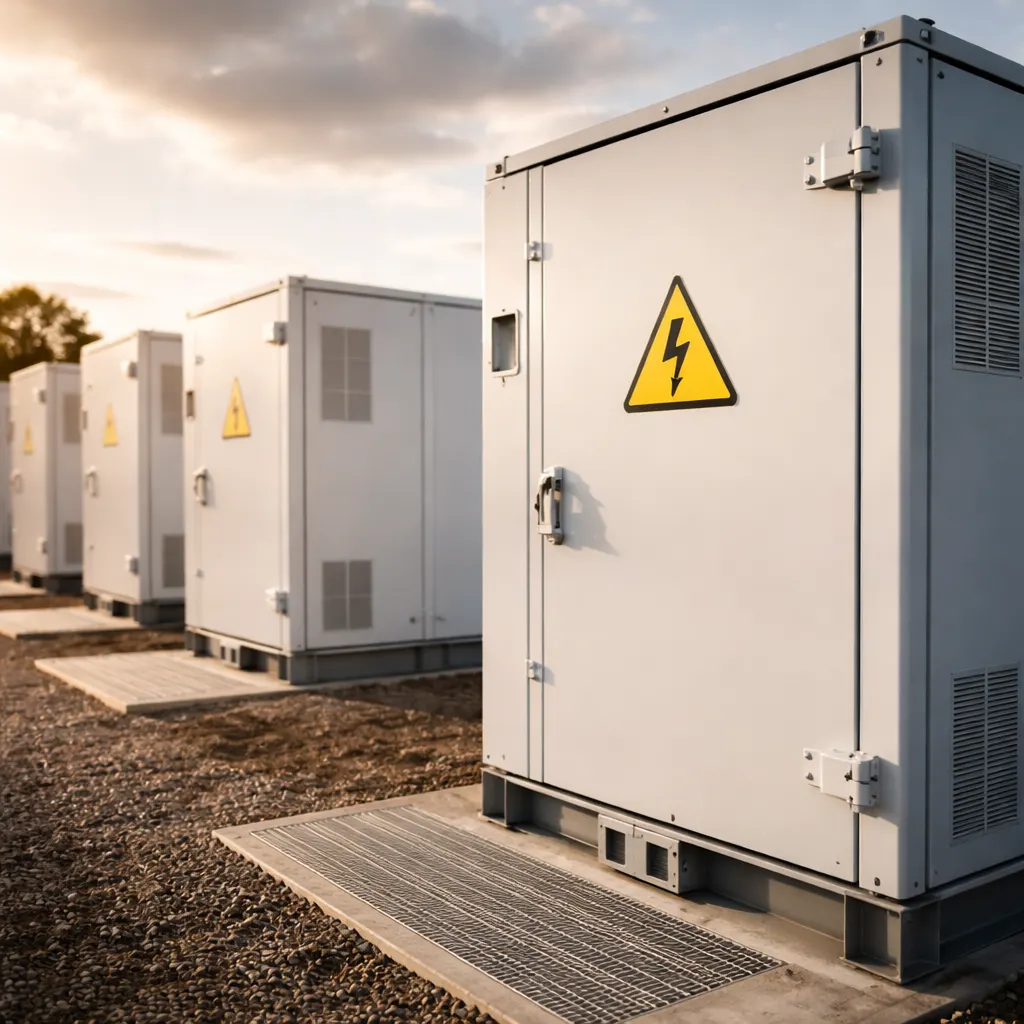
The worldwide failure rate for lithium-ion battery energy storage systems plummeted 98% between 2018 and 2025 on a per-gigawatt-hour basis, according to a new analysis published by the Electric Power Research Institute. The organization examined its database of battery storage system failure incidents and found that stationary energy storage systems now fail at rates comparable to oil-filled electrical transformers. The report, titled "Risk Factors and Failure Statistics of Lithium-Ion BESS," concludes that systems built under stricter codes perform significantly better than older installations, though safety reviews and retrofits can reduce risk in earlier-generation facilities.
The analysis shows annual failure rates for stationary energy storage systems now range from 0.04% to 0.14%, matching the 0.1% annual failure rate for oil-filled electrical transformers. The failure rate dropped 50% from 2024 to 2025 alone. Ninety-three percent of the battery storage safety incidents EPRI reviewed worldwide resulted in no injuries or fatalities. In the United States, no reported injuries or fatalities have occurred from battery storage failures since April 2019, when an explosion at an Arizona Public Service facility seriously injured four firefighters. That Arizona installation was commissioned before the initial release of NFPA 855, the safety standard governing energy storage systems today.
Lakshmi Srinivasan, a senior technical leader with EPRI's energy storage program and a principal investigator on the report, told Utility Dive that battery systems deployed over the past five years "appear significantly more reliable than earlier vintages." The report finds that indoor battery storage facilities fail at higher rates and sustain more damage on average than outdoor facilities. Battery storage facilities commissioned before 2021 account for just 3% of global energy storage capacity. The most dramatic U.S. battery storage failure involved a 300-megawatt array at Moss Landing in California, where thermal runaway in January 2025 caused fire to spread throughout an indoor facility housed in a decommissioned 1950s-era turbine hall, ultimately destroying most of the installation though no injuries were reported.
The sharp improvement stems from lessons learned over the past seven years, according to the report. "There are things we know in 2026 that were not necessarily understood in 2019 or 2020, when the older systems were being put in place," Srinivasan said. The 2019 Arizona incident revealed that older facilities need to address explosion risk, which represents "a different risk than fire and a bigger one from a personnel and equipment standpoint." The report notes that explosion-mitigation retrofits range from relatively simple changes like installing flammable gas detectors inside battery enclosures to major projects like installing new ventilation systems or making structural upgrades to direct pressure waves upward and away from first responders. Propagation-prevention measures within battery units and fire walls between units can mitigate fire spread within indoor facilities.
It's worthwhile for owners of older facilities to run thorough risk assessments and take corrective action if warranted, Srinivasan said, though in some scenarios it could make more sense to prematurely decommission an outdated, higher-risk system. Although newer battery systems appear safer than early-vintage systems, local permitting remains challenging in some jurisdictions due to limitations in the NFPA 855 standard that lead most developers to apply for exemptions to allow for higher energy densities or other project modifications. To help local authorities that may lack in-house expertise, New York added a requirement to its fire code in January that allows those authorities to make energy storage developers pay for independent technical reviews of exemption applications.