
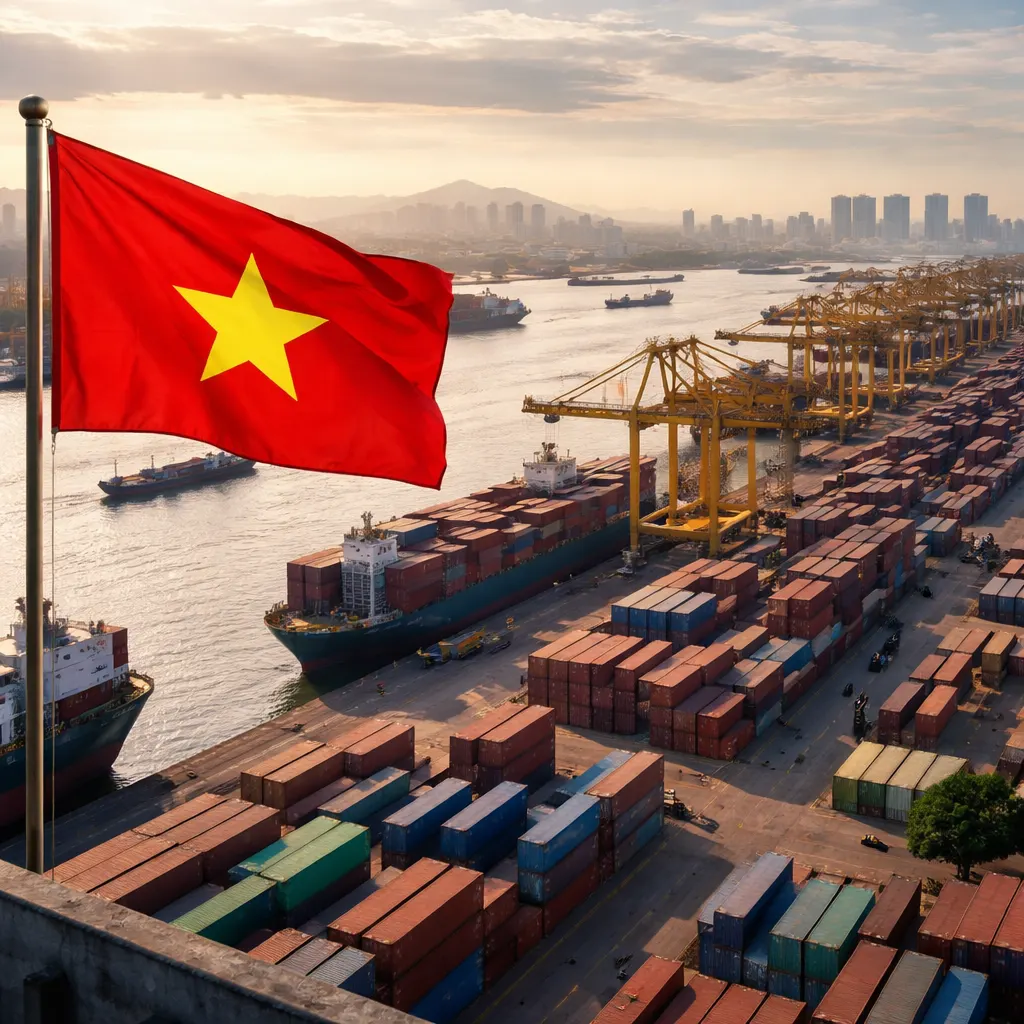
Vietnam achieved economic growth of 9.95% in 2026, the fastest rate since 2022, yet the figure has sent legislators into a panic because it falls short of the government's target. According to a report published by the Foundation for Economic Education, Vietnam's National Assembly set a goal in April 2026 for average annual growth of at least 10% over the next five years as part of the country's "Tiger Economy" strategy. Now the country is counting on a newly signed free trade agreement with the European Free Trade Area (EFTA) to provide the final push needed to reach that mark.
The numbers reveal both the strength and the strain in Vietnam's economy. Exports climbed 24.5% throughout the third quarter of 2026, but imports surged even faster at 36.7%, creating a record trade deficit of $19.42 billion. Vietnam's trade balance shows stark dependence on two warring economic giants: the country ran a surplus with the United States of $122.6 billion while posting a deficit with China of $121.5 billion. The EFTA bloc itself is small, comprising just 15 million people across Switzerland, Norway, Iceland, and Liechtenstein, but it packs considerable purchasing power with a collective GDP of about $1.33 trillion, or roughly $108,000 per person in 2024. Switzerland alone accounted for approximately $3.5 billion in bilateral trade with Vietnam in 2025, making it Vietnam's largest trading partner within EFTA.
The agreement was signed on October 18, 2026, in Hanoi, and according to Norwegian Ambassador Stein Iversen, it's expected to come into force "three months after Vietnam and at least one of the four EFTA members complete ratification." The report notes that the deal has been presented by both sides as a way to diversify markets while an ongoing trade war disrupts global commerce. Vietnam already exported roughly €33.8 billion (about $38 billion) in machinery and electrical equipment to the EU in 2025, with more than half of all imports in that category coming from Vietnam. The agreement also promises Vietnam farm concessions in line with EFTA's recent free trade agreements with other countries, opening doors in food exports where European nations traditionally protect their agricultural markets stringently.
The report explains that Vietnam's strategy is driven by its Communist Government's politically motivated growth target rather than an economically determined one, creating risk about what or who gets blamed when targets are missed. With such symmetrical figures between the United States and China, Vietnam looks more like a conduit than an independent economy, but diversifying markets away from two sides of a trade war can reduce the dependency risk of being tied so firmly into that supply chain. For EFTA nations, Vietnam offers a gateway into Asia: the Vietnamese economy links to the ASEAN single free trade area of roughly 680 million people, meaning a Swiss watchmaker could relocate production to Vietnam and ship products back to Switzerland or tariff-free to nations like Japan or Australia. The deal doesn't vary massively from the current status quo for industrial goods, but for electronics, clothing, and shoes, it makes trade rules more predictable and locks in zero tariffs as the standard. Vietnam's ability to meet its 10% annual growth target through 2030 now hinges on whether access to 15 million wealthy European consumers can close a 0.05 percentage point gap that's become a political flashpoint.