
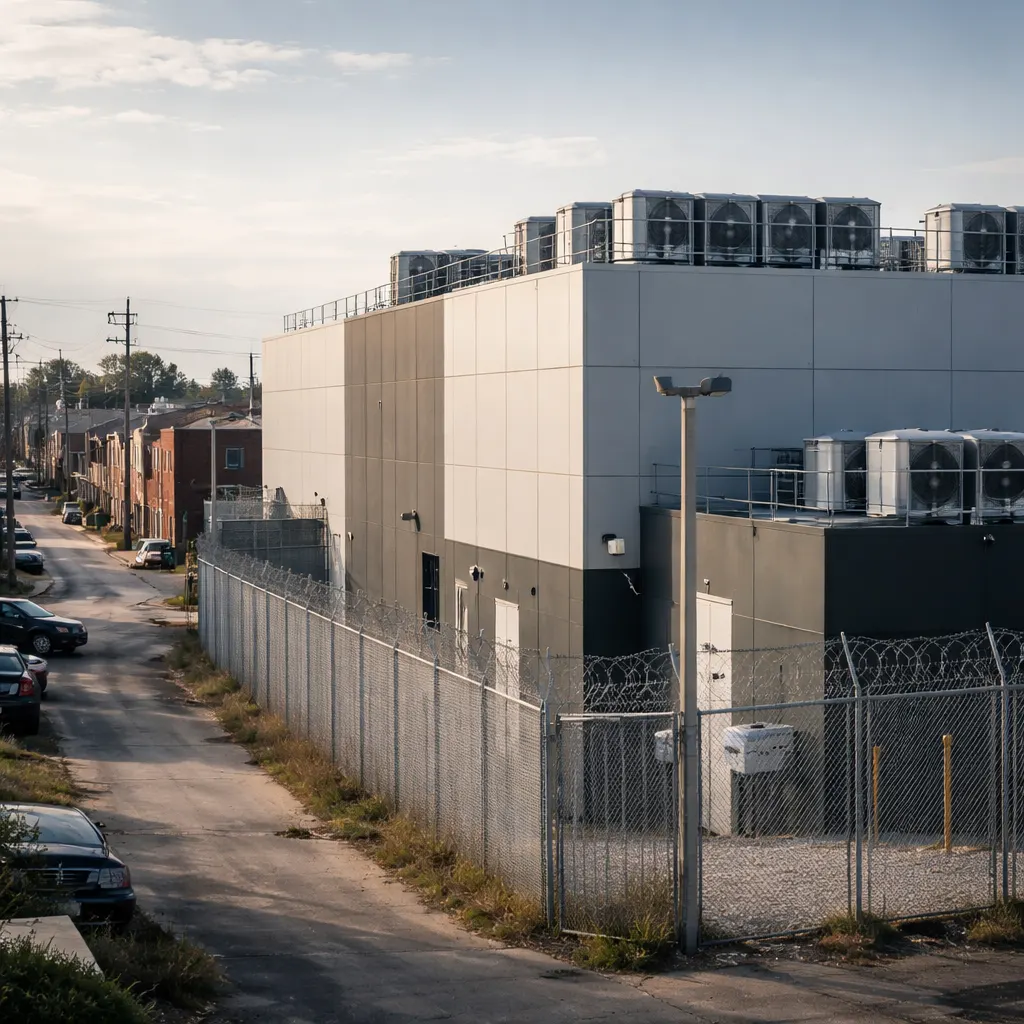
Counties with larger non-white populations have significantly higher expected numbers of data centers, even after accounting for factors like population density, land availability, existing environmental conditions, and state tax policy, according to a new Purdue University study titled "Digital Footprints" discussed at the Niskanen Center. The research examined how the physical infrastructure underlying the digital economy is distributed across the United States, finding that data center siting follows social and political patterns rather than random geographic distribution. The findings come as opposition to AI data centers has emerged as a major 2026 campaign issue, with communities increasingly questioning who benefits from this infrastructure and who bears its costs.
The study found that data centers are heavily concentrated geographically, with the top five states—Virginia, California, Oregon, Texas, and Washington—holding the highest counts. Counties with higher poverty levels and lower median household income also tend to host more data centers, consistent with economic disadvantage patterns seen in earlier infrastructure research. However, the unemployment findings proved more complex: areas with higher proportions of unemployed residents actually had more data centers, the opposite of what researchers initially expected. States offering stronger tax incentives were more likely to attract data center development, indicating that state-level policy plays a substantial role in determining where this infrastructure gets built.
The researchers argue that data center geography isn't determined by a single cause but reflects broader social patterns. "The siting of data centers is actually a governance question," lead author Vasundhara Kaul explained, "because we are asking who receives the benefits of this digital infrastructure and who's bearing the costs of these infrastructure decisions and who has a say in these decisions." The study draws parallels to previous research on coal plants and landfills, which also tend to be concentrated in non-white communities. Co-author Daniel Schiff noted that much of the AI governance conversation has focused on technical algorithm evaluation, while the physical infrastructure supporting AI development has received less attention despite its significant local impacts on electricity grids, water resources, and land use.
The report identifies a mismatch between the governmental level where siting decisions occur and the scale at which consequences are felt. Municipalities approve zoning and permits, but electricity demands affect entire regional grids and water use can cross jurisdictional boundaries. This creates what the authors call a "classic problem of multi-level governance," where local governments make decisions about facilities whose impacts extend far beyond municipal borders. Public opinion polling from May and June 2024 showed bipartisan opposition to data centers, with concerns centered on environmental impacts and quality of life—traditional development worries rather than AI-specific fears. The authors emphasize that local governments do retain leverage through zoning authority and discretionary approvals, pointing to Indianapolis where community organizing successfully prevented a proposed Google data center from moving forward.
The researchers conclude that AI governance can't stop at algorithms and models—it must address the physical infrastructure that supports the cloud. Policymakers need to consider how costs and benefits are distributed across communities, not just aggregate calculations. Community participation plays a major role in how projects are designed, where they're located, and the level of acceptance or resistance they face. The study warns that without attention to public trust and meaningful participation, industry and policymakers risk accumulating a "debt" that's now creating backlash, as powerful actors tend to offload harms to those without the power to object.