
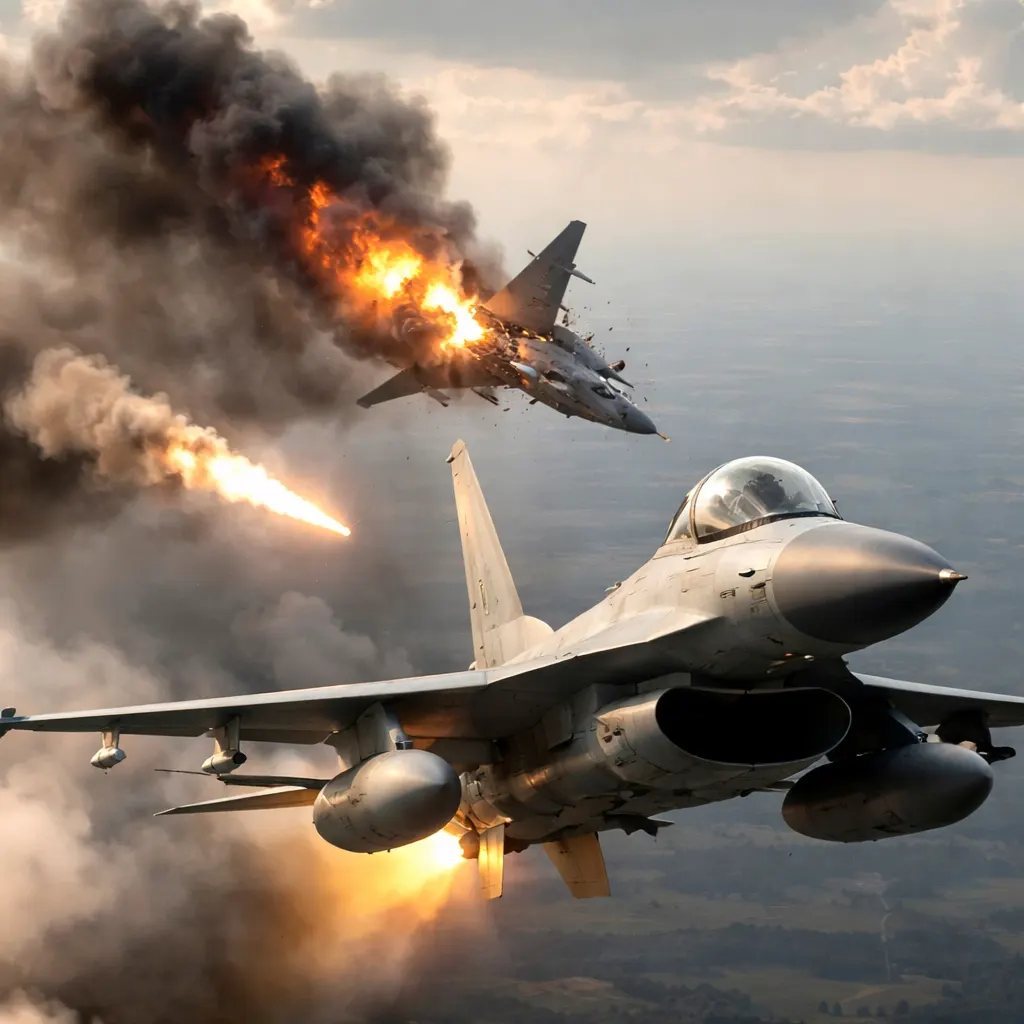
A Ukrainian F-16 fighter jet shot down a Russian Su-35 air-superiority aircraft, marking the first confirmed kill of its kind in the war, according to a military situation report published July 22 by the Hudson Institute. The report details Russia's sustained offensive pressure across contested cities in Donetsk Oblast, a major shake-up in Ukraine's military leadership amid nationwide protests, and innovative battlefield tactics combining aerial and ground drones. General Dan Caine, chairman of the Joint Chiefs of Staff, publicly confirmed the F-16's downing of the Su-35, likely validating an earlier Ukrainian Air Force announcement from July 8.
Russia and Ukraine fought between 200 and 250 tactical clashes daily last week, with Russian forces concentrating attacks on six Ukrainian cities: Kramatorsk, Sloviansk, Huliaipole, Pokrovsk, Lyman, and Kostiantynivka. Declassified British intelligence revealed that General Valery Gerasimov, Russia's chief of the General Staff, told President Vladimir Putin three weeks ago that Moscow had fully captured Kostiantynivka, though open-source evidence suggests Russian troops most likely occupy slightly more than half of the metropolitan area. Ukraine's 15th Separate Artillery Reconnaissance Brigade struck a Russian MiG-29 fighter jet and a Pantsir-S1 air-defense system at Khalino airfield in Kursk Oblast, destroying roughly $25 million in aircraft alone. On the night of July 19–20, Ukrainian forces destroyed multiple Russian air-defense assets, including Tor-M2 surface-to-air missile systems and Nebo radars, with the majority located in Krasnodar Krai and two in occupied Zaporizhzhia Oblast. Footage also showed Ukraine using a heavy-lift hexacopter to airlift a kamikaze unmanned ground vehicle—an Ark Robotics ARK-1 carrying anti-tank mines—across difficult terrain.
The report notes that Kostiantynivka is a strategically important component of Ukraine's fortress belt, a heavily fortified defensive line in Donetsk Oblast, and its capture would provide Russia with a potential launching point for further operations against Druzhkivka, Kramatorsk, and Sloviansk. According to the analysis, Ukraine doesn't need to destroy Russia's entire air-defense network to succeed—by forcing Moscow to spread its combat platforms across an immense geographic area extending from occupied Ukraine to the Caucasus and the Russian interior, Kyiv can progressively weaken the rear-area sanctuary that supports Russian air operations. President Volodymyr Zelenskyy dismissed Oleksandr Syrskyi as commander in chief of the Armed Forces on July 22, appointing General Mykhailo Drapatyi as his successor amid protests now in their sixth day over the removal of Defense Minister Mykhailo Fedorov, a popular and tech-savvy official.
The leadership crisis exposes a deeper struggle over Ukraine's military future, with Syrskyi representing a traditional military culture centered on infantry, artillery, and centralized authority while Fedorov embodies a competing paradigm focused on innovation, decentralization, and technological modernization. Zelenskyy convened a special meeting of the Staff of the Supreme Commander-in-Chief on July 20, bringing together army corps commanders and representatives from Ukraine's leading defense companies for the first time, establishing a regular mechanism for meetings between commanders, manufacturers, and government institutions. The report highlights that combining aerial and ground drones into a single strike system could carry strategic significance—a hexacopter helps an unmanned ground vehicle bypass difficult terrain and engage closer to its objective while shortening exposure to Russian reconnaissance, artillery, and electronic warfare. The ARK-1, which weighs approximately 26 pounds and carries a 33-pound payload at speeds up to 25 miles per hour, has already been deployed by Latvia's 2nd Mechanized Infantry Battalion during Exercise Crystal Arrow 2026 just 120 miles from the Russian border. The report concludes that the military leadership reshuffle currently roiling Ukraine's political environment could shape the nation's postwar future, with civil-military relations meriting close monitoring for the foreseeable future.