
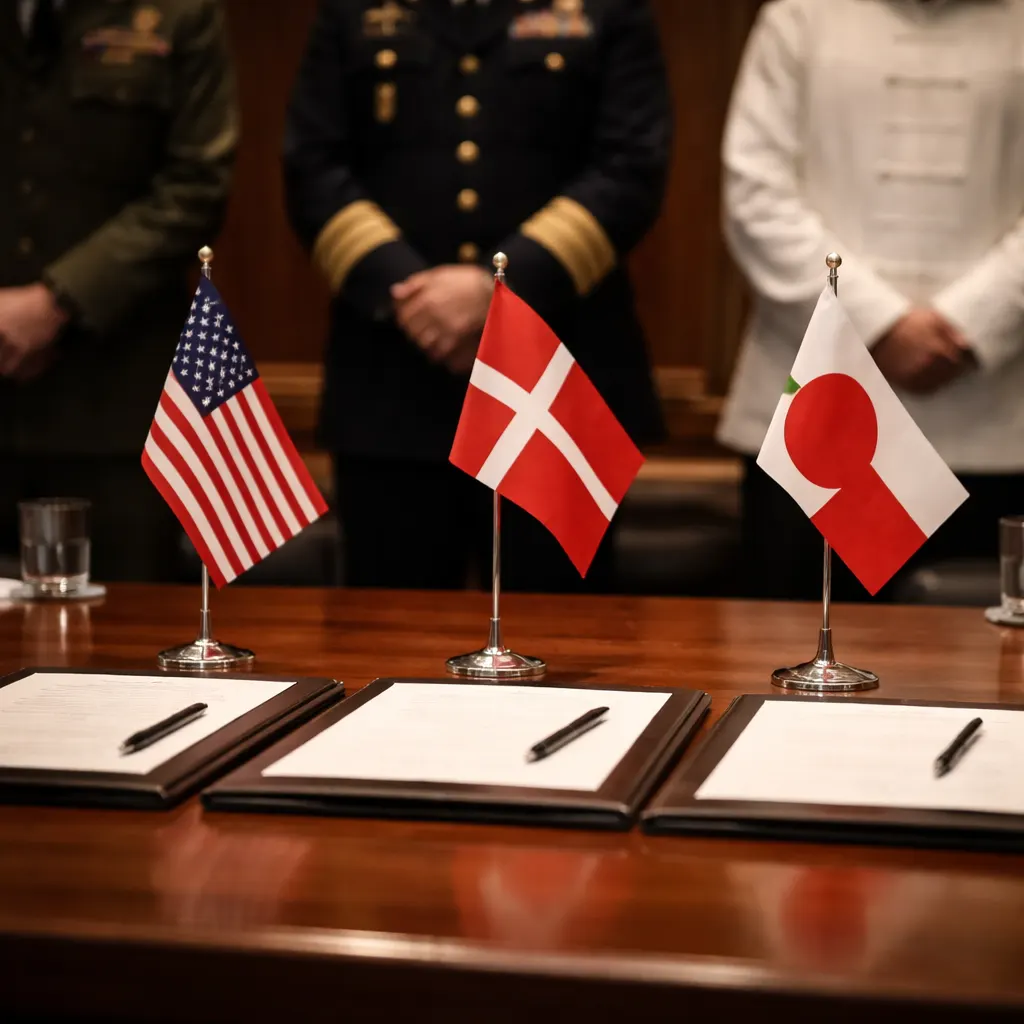
The United States, Denmark, and Greenland reached a trilateral security agreement in September 2026 that allows Washington to significantly expand its military footprint on the Arctic island, according to a Council on Foreign Relations analysis published September 29, 2026. The deal permits the U.S. to modernize operations at its existing space base, establish two new defense installations, and deploy advanced missile defense systems while maintaining Greenland's status as a semiautonomous Danish territory. The pact comes after nearly two years of aggressive rhetoric from President Donald Trump about assuming control of the strategically located island.
Under the open-ended agreement, which modifies a 1951 U.S.-Denmark defense treaty, Washington can modernize and grow its operations at Pituffik Space Base, formerly known as Thule Air Base. The deal also authorizes the U.S. to set up two defense zones at Narsarsuaq in southern Greenland and Mestersvig in eastern Greenland, along with unrestricted overflight, land, and undersea access across the island and its surrounding waters. The pact permits deployment of the proposed "Golden Dome" missile defense system, prohibits non-NATO nations from building military installations on Greenland, and limits foreign investment to NATO members, NATO partners, and European Union states only. Denmark currently provides Greenland with an annual subsidy of roughly $600 million and maintains control over the island's foreign affairs, defense policy, and monetary policy, though Greenland gained home rule in 1979 and expanded self-government powers in 2009.
The report notes that Trump's push to acquire Greenland echoed other territorial ambitions he voiced at the start of his second term, including regaining control of the Panama Canal and making Canada the fifty-first state. According to the analysis, both Greenlandic and Danish leaders rejected U.S. attempts to take control, with then Prime Minister Múte B. Egede stating in January 2025: "We don't want to be Danish, we don't want to be American, we want to be Greenlandic." The report states that Trump ruled out using military force at the World Economic Forum in January 2026, after previously suggesting the U.S. would take the island "one way or the other." Danish leaders said Greenland wasn't for sale while respecting Greenlanders' right to choose their own path forward.
The agreement responds to mounting concerns about Chinese and Russian expansion in the Arctic region. Russia controls more than 50 percent of the Arctic coastline and operates roughly forty icebreaker vessels, compared to just three each for China and the United States, the report explains. China has labeled itself a "near-Arctic state" and sent three icebreakers into Arctic waters simultaneously for the first time in 2024, while the two nations have conducted joint military exercises that alarm U.S. officials. Greenland's position between Europe and North America makes it critical for monitoring adversary activity and defending against potential missile strikes, particularly from Russia. The report also highlights economic factors: climate change is making Greenland's rare earth minerals like lithium more accessible, while melting ice is opening Arctic trade routes that could serve as faster connections between Asia, Europe, and North America. Pituffik Space Base currently houses about two hundred active-duty U.S. personnel and radar systems that provide early warnings for intercontinental ballistic missiles launched from Russia, and the new pact will allow Washington to grow those capabilities while blocking Chinese and Russian military installations on the island.