
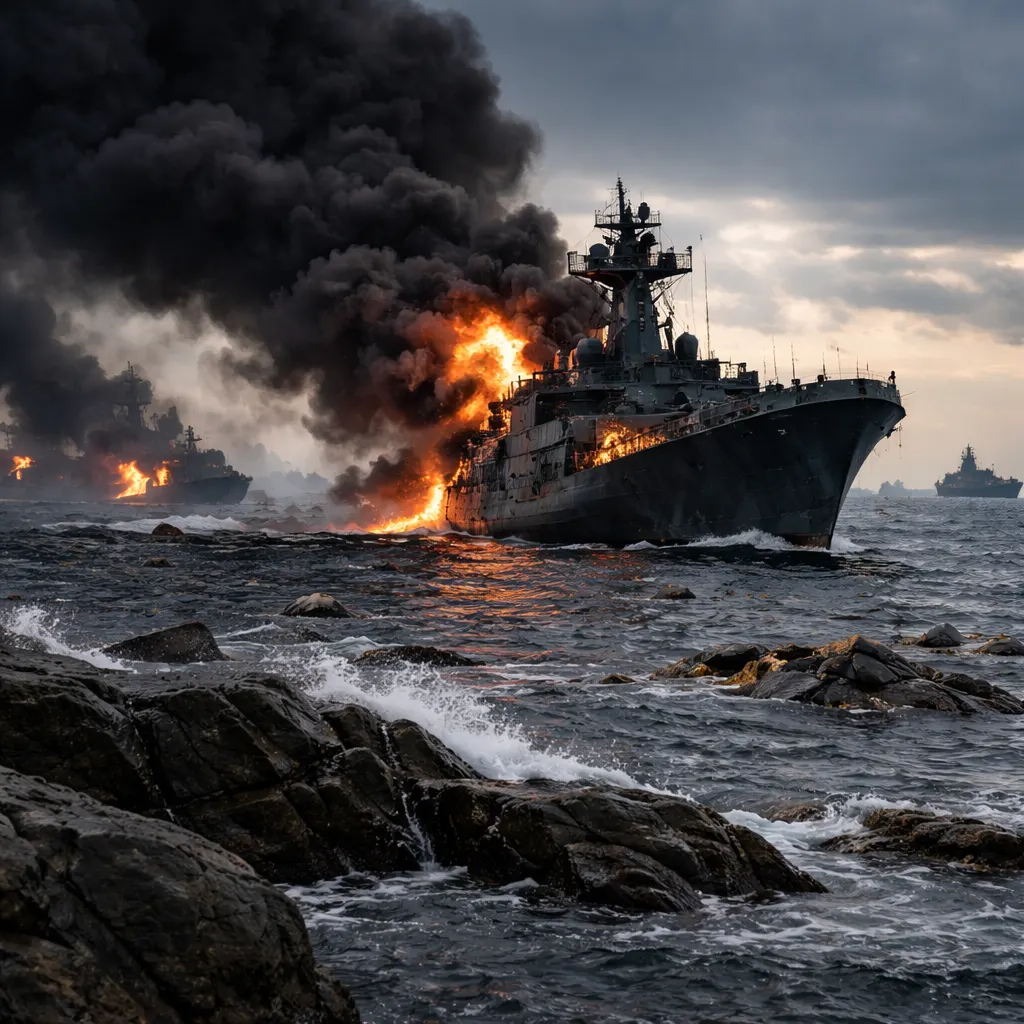
Ukrainian forces have struck as many as 13 vessels linked to Russia's Caspian Flotilla over recent months, including corvettes, patrol boats, and minesweepers, according to a new analysis published by the Hudson Institute. The report, authored by Luke Coffey, finds that this campaign, combined with an Israeli strike that damaged roughly half of Iran's Caspian warships in March, is dramatically reshaping the balance of maritime power in the region. The attacks come as the Caspian Sea gains importance as a critical link in the Middle Corridor trade route connecting Asia and Europe.
Open-source intelligence estimates suggest the Ukrainian strikes account for a significant portion of Russia's overall naval presence in the Caspian, though the severity of damage to individual vessels varies. Some ships are believed to have suffered serious harm, while a smaller number may have been destroyed or left permanently unusable. Ukraine has also hit key Russian port facilities that enabled goods to flow between Iran and Russia, as well as oil platforms in the Caspian. The most recent documented attack occurred in July, and this month Ukraine struck an Iranian cargo ship in the Caspian for the first time, claiming it carried military goods between Russia and Iran. Meanwhile, Israel's March 18 strike on Iran's Bandar Anzali naval facility destroyed or damaged multiple Iranian ships, including one corvette and two missile boats, according to open-source reporting.
The report notes that as Russia and Iran lose naval capabilities, other Caspian states are moving quickly to strengthen their own. Azerbaijan is emerging as a prime example: Vice President J.D. Vance has announced the sale of patrol ships to Azerbaijan in coming months, and the country has taken steps to boost naval modernization, domestic shipbuilding, coast guard upgrades, joint exercises, and maritime surveillance. According to Coffey, it's possible that in the years ahead Azerbaijan could become the most powerful maritime force on the Caspian Sea, which would contribute greatly to regional security and could encourage Kazakhstan and Turkmenistan to build up their own naval capabilities.
The analysis warns that a longer-term problem will compound these shifts in power. Satellite imagery and NASA's Global Water Monitor show Caspian water levels have been dropping since the mid-1990s, and if current trends hold, the Caspian could fall by 9 to 18 meters by century's end. That would mean the loss of about a quarter of its surface area, exposing dry land roughly the size of Indiana. Russia's main naval base at Astrakhan sits in one of the Caspian's shallowest zones, and falling water levels could make it increasingly difficult, and perhaps eventually impossible, to use as a naval port without major dredging or relocation. This could also complicate Russia's use of the Volga-Don Canal, severing Russia's direct link between the Caspian Sea and the Black Sea.
The report recommends that the United States play a role in helping friendly countries in the region boost their capabilities and capacities, including selling or providing military equipment such as smaller patrol boats, coastal defense weapon systems, and radars. It also suggests encouraging regional countries to work closely with Ukraine, especially in the unmanned systems area, to apply lessons from the Black Sea to the Caspian and strengthen regional defense. The report calls for reviving older initiatives such as the Caspian Guard Initiative, launched in 2003 to improve maritime, airspace, and border-security cooperation in the Caspian region. With the right steps taken now, the report concludes, friendly countries in the region can be better prepared for the changing geopolitical currents across the Caspian.