
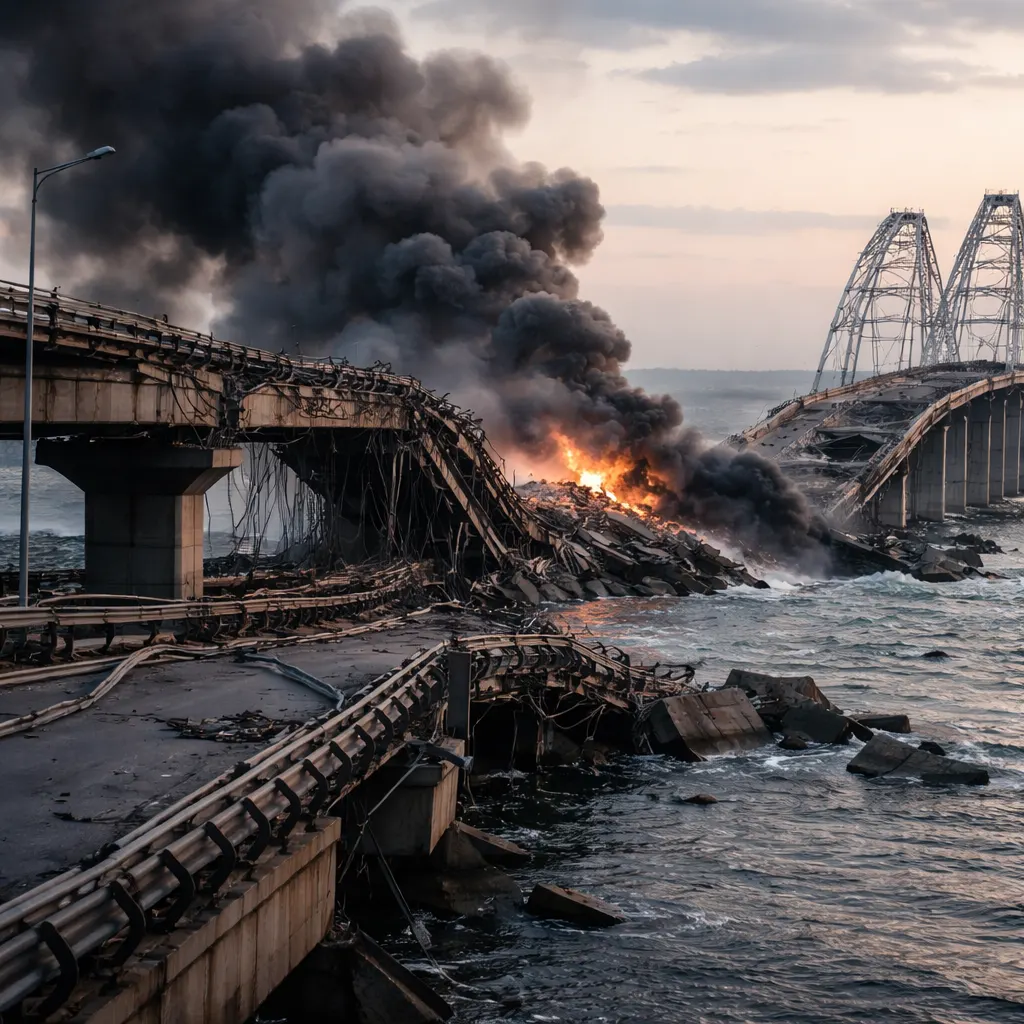
Ukrainian forces destroyed roughly 880 feet of roadway on the Crimean Bridge in coordinated strikes on November 16–17, marking the most significant damage to the strategic crossing since Russia occupied Crimea in 2014, according to a November 18 military situation report published by the Hudson Institute. The attacks collapsed a major roadway span and its supporting steel arch into the Kerch Strait, obstructed the shipping channel linking the Black Sea and the Sea of Azov, and damaged railway infrastructure on the bridge. The strikes threaten Moscow's ability to supply troops and equipment to occupied Crimea and southern Ukraine, and demonstrate Kyiv's expanding arsenal of domestically built long-range weapons.
The operation concluded a seven-stage Ukrainian campaign conducted over several weeks under coordination by Ukraine's Security Service and General Staff, the report says. President Volodymyr Zelenskyy said the earlier stages targeted Russian air defense systems, radar installations, electronic warfare equipment, and other military assets protecting the bridge. The final assault employed 11 Ukrainian-manufactured weapons systems, including Palianytsia hybrid drones that struck the roadway, and Neptune missiles, Ruta drones, and FP-5 Flamingo cruise missiles that reportedly hit the railway section. A separate strike on November 16 damaged one of the bridge's principal arches, prompting Russian authorities to impose traffic restrictions before the larger collapse occurred overnight on November 17. Open-source intelligence assessments suggest the collapsed steel arch measured approximately 750 feet in length.
The report notes that wreckage from the attack obstructs the navigable channel between the Sea of Azov and the Black Sea and threatens maritime traffic through the strait, including Russian military vessels moving between the two bodies of water. Meanwhile, Ukraine's persistent shortage of air-defense interceptors continued to limit its ability to counter Russian missile and drone salvos, the report says. At a November 17 meeting of the Contact Group on Defense of Ukraine, Zelenskyy proposed a mechanism under which Ukraine would receive Patriot and IRIS-T interceptor missiles from existing allied inventories and later compensate partner nations with newly manufactured missiles that Kyiv has already ordered. On November 12, Ukraine's 426th Separate Unmanned Systems Regiment reported the first successful aerial deployment of an unmanned ground vehicle onto the Dnipro River's Russian-held eastern bank, using a Perun aerial drone to transport a ground robot equipped with a 16-pound explosive payload.
The bridge destruction is especially significant because Russia retains an alternative corridor to Crimea through occupied Ukrainian territory, but that route is longer and increasingly vulnerable to Ukrainian medium-range strike drones targeting military convoys and logistics shipments, the report finds. Ukrainian attacks have also damaged several connections along this corridor, while earlier operations have degraded Russian ferry capacity, though the Kremlin can still use ferries as an alternate means of transportation. Taken together, these efforts form part of a Ukrainian campaign, reportedly underway for roughly six months, to undermine Russia's logistical connectivity with Crimea and complicate Moscow's continued use of the peninsula as a staging area for ground offensives, as a naval operating base, and as a platform for military aviation. Moscow built the Crimean Bridge as a physical expression of its claim to the peninsula, and Ukraine has repeatedly shown that even one of Russia's most heavily defended infrastructure projects remains vulnerable to attack.
The report warns that seven Russian drones reportedly violated Moldovan airspace on November 17 during large-scale Russian aerial attacks against Ukraine, with five drones crashing on Moldovan territory and one Shahed-type drone approaching Moldova's capital, Chișinău. Any further incursions could prove notable in the coming weeks, given Moldova's limited air-defense capabilities, the potential for escalation involving the Russian military presence in the breakaway republic of Transnistria, and the security implications for neighboring Romania, a NATO member. The overall battlespace featured a medium-to-high-intensity operational tempo that on some days saw more than 270 tactical engagements, while Russian forces continue to face concerns over mounting casualties that rise nearly every week.