
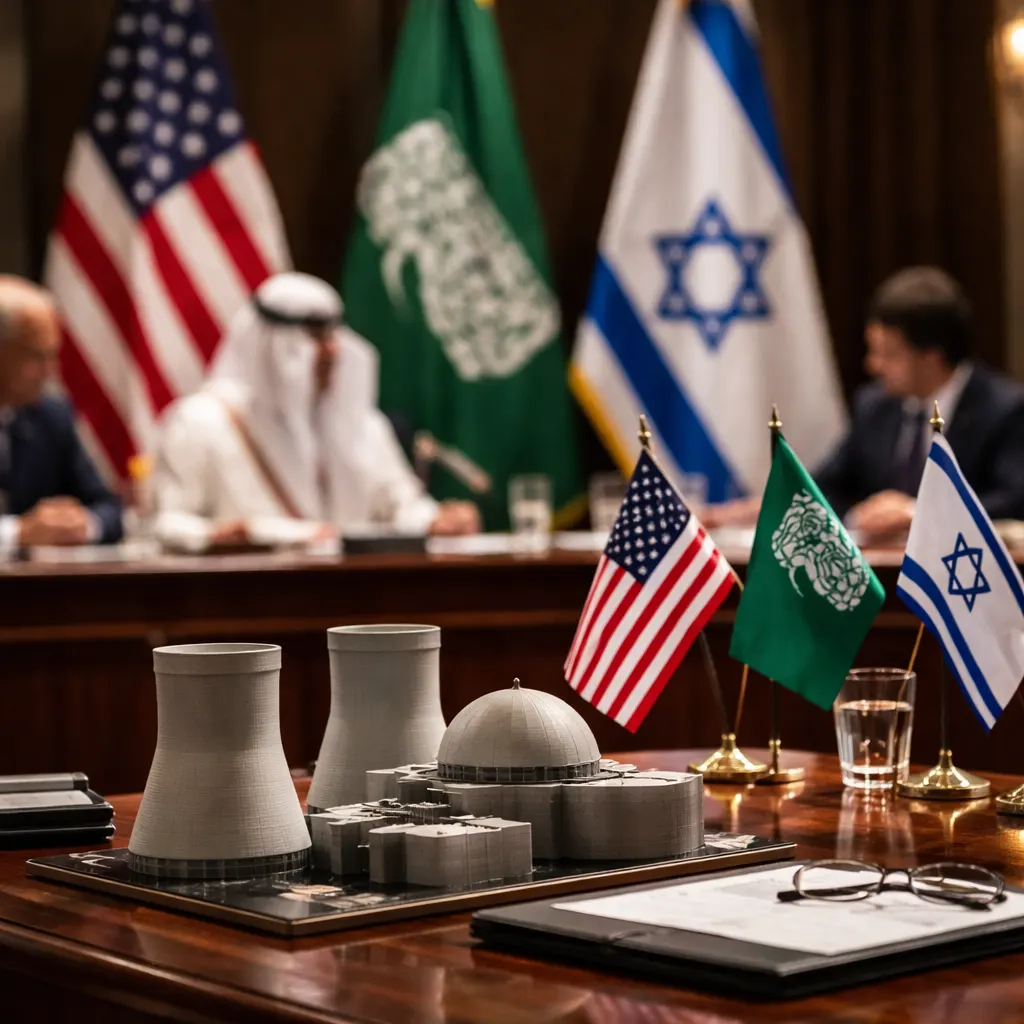
The Trump administration is conditioning a 30-year civil nuclear cooperation agreement with Saudi Arabia on the kingdom's formal accession to the Abraham Accords and establishment of diplomatic relations with Israel, according to a new analysis published by the Hudson Institute. The arrangement would grant Riyadh access to American nuclear technology and materials for civilian energy programs, but only if it joins a US-led regional security framework. The report argues the deal represents a strategic effort to limit Chinese and Russian influence in the Middle East while building an integrated coalition to counter Iran.
The proposed agreement extends far beyond energy cooperation, the report states. Saudi Arabia faces ongoing threats from Iranian missiles and Houthi drones targeting oil infrastructure, ports, airports, desalination facilities, and urban areas across the kingdom. As the country's Vision 2030 initiative expands its industrial footprint through nuclear plants, logistics centers, data facilities, and advanced manufacturing, the volume of high-value targets vulnerable to attack will grow. Israeli defense systems including Arrow and David's Sling have repeatedly intercepted long-range and medium-range ballistic threats during sustained combat operations. China brokered a Saudi-Iran rapprochement in 2023 and has positioned itself as an alternative security partner for Gulf states, while Russia's Rosatom is currently building nuclear reactors in Egypt and Turkey, and Chinese state-owned nuclear firms are pursuing reactor projects throughout the region, including in Saudi Arabia.
The report contends that Saudi Arabia and Israel confront the same adversary: the Islamic Revolutionary Guard Corps, which coordinates the network supplying the Houthis, financing Hezbollah, directing Iraqi militias, and supporting missile forces threatening Gulf infrastructure. According to the analysis, Israeli intelligence has spent decades penetrating that network, producing operational knowledge unmatched by any regional partner. The report finds that normalization would enable Israeli radar, intelligence, early-warning systems, and missile-defense technologies to be integrated directly into Saudi security planning, strengthening deterrence while reducing the burden on US forces. For Washington, closer Saudi-Israeli coordination would gradually shift the US from serving as the indispensable intermediary to leading a network of partners capable of reinforcing one another.
The timing matters because nuclear cooperation creates strategic relationships that persist for generations through fuel supply, engineering services, maintenance, regulatory assistance, and workforce training, the report explains. Whichever country builds Saudi Arabia's civilian nuclear infrastructure will retain long-term influence over one of the region's most consequential strategic sectors. Recent events have exposed the limits of Beijing's approach: Chinese diplomacy didn't prevent Iranian weapons from reaching the Houthis, attacks on commercial shipping in the Red Sea continued, and Chinese purchases of Iranian oil remained a critical revenue source for Tehran's regional proxy network. Meanwhile, military operations over the past year demonstrated the effectiveness of the US-led security framework, where integrated intelligence, air defense, and operational coordination produced tangible results against common threats. Conditioning civil nuclear cooperation on Saudi accession to the Abraham Accords aligns US technological leadership with its broader strategic interests, strengthens a regional coalition confronting Iran, and limits opportunities for China and Russia to establish long-term influence through critical infrastructure. Using that leverage now could shape the Middle East's strategic balance for decades.