
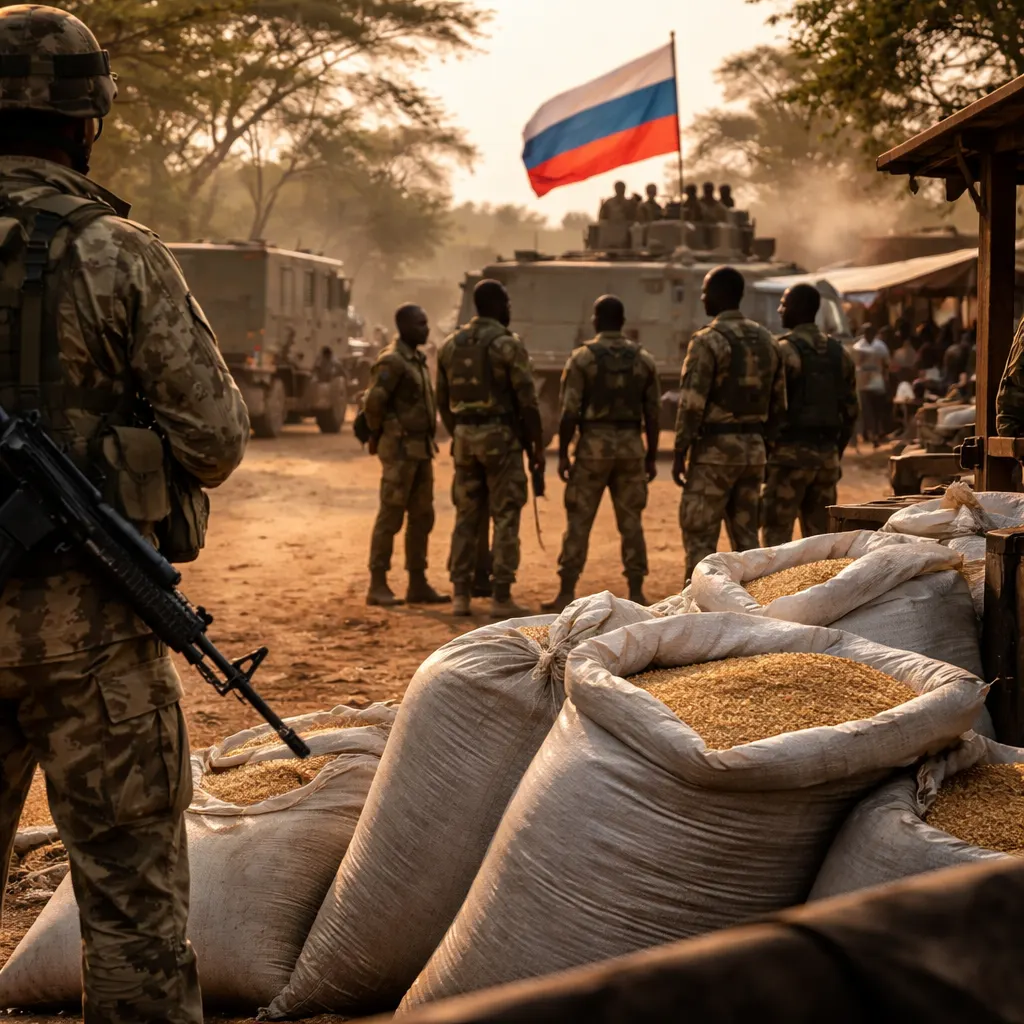
Russia has rebuilt a sweeping presence across Africa through military contractors, arms sales, and control over critical commodities, according to a new Hudson Institute report analyzing Moscow's strategic expansion on the continent. After decades of post-Soviet retreat, the Kremlin has deployed the Wagner Group—now rebranded as the Africa Corps—to at least a dozen countries, secured security partnerships with 40 African states, and positioned itself as the supplier of roughly 40% of Africa's imported wheat and 20% of its fertilizer. The report finds that despite severe economic constraints from the Ukraine war, Russia is running "a range of diplomatic, economic, and intelligence activities among numerous nations across the length and breadth of Africa" that signal Moscow's determination to remain a long-term player on the continent.
The scale of Russia's security footprint rivals Cold War levels, the report documents. Between 2018 and 2022, Russia became Africa's largest arms supplier, and President Putin claims Moscow now maintains formal security agreements with 40 different African countries. Wagner and its successor, the Africa Corps, have earned over $2.5 billion from African gold operations, primarily in the Central African Republic and Sudan, using the commodity to evade Western banking sanctions. Russia's oil sales to Africa jumped more than 140% between 2022 and 2023 as Moscow sought to replace European customers. The state nuclear agency Rosatom has signed cooperation agreements with at least 20 African nations, though only Egypt's El Dabaa project has broken ground. Foreign Minister Sergey Lavrov recently announced plans to open four new embassies to complement the 45 Russia already operates across the continent—approaching full diplomatic coverage for the first time since the Soviet era.
"While the Kremlin managed the transition smoothly, some of the resulting operations face serious headwinds," the report states, citing a July 2024 battle in northern Mali where a combined terrorist and rebel force killed over 100 Malian soldiers and Wagner fighters, including several senior commanders. The Africa Corps evacuated from the strategic northeastern city of Kidal in April 2026 during a nationwide insurgent offensive. Beyond military setbacks, the report finds that Russia's influence operations have grown increasingly sophisticated, with the Foreign Intelligence Service inheriting Wagner's clandestine propaganda network and a centralized "African Initiative" coordinating public-facing operations from journalism training to cultural centers. The Russian Orthodox Church's presence exploded from four priests in four countries at the end of 2021 to over 270 priests and deacons in 36 countries by August 2025, with the Kremlin's 2023 Foreign Policy Concept Paper listing "protecting traditional spiritual and moral values" as a priority for Africa engagement.
The report explains that Moscow's refocused attention stems from sharpening competition with the West, especially after the 2022 invasion of Ukraine left Russia facing diplomatic isolation and international sanctions. The Kremlin is leveraging Soviet-era goodwill—tens of thousands of African elites received degrees or military training in the USSR, including future presidents of Angola, Central African Republic, South Africa, and Namibia—to stymie Western influence and secure economic benefits. Russia's concentrated control over wheat, fertilizer, and oil gives Moscow outsized leverage despite small overall trade volumes, as African countries fear the consequences of a diplomatic rupture. Well over half of Africa's 54 countries voted against, abstained, or were absent on recent UN resolutions condemning Russia's Ukraine invasion, a diplomatic firebreak the Kremlin values highly. But the report warns that Moscow's double-dealing may eventually backfire: Russian entities have supported both sides of Sudan's civil war, and covert operations against sitting governments have led to arrests of Russian operatives in multiple countries.
The report concludes that Russia's engagement will persist as long as the continent's political terrain remains hospitable—corrupt and authoritarian regimes that value Moscow's services are common, and Soviet nostalgia lingers among Southern African liberation-era parties still in power. "The nature of this engagement will only change when there is meaningful political transformation in Russia itself," the authors write. Until then, Africa Corps' brutal presence likely deepens popular disillusionment with governments and makes terrorist claims about Islamic renewal more compelling, while Moscow continues extracting benefits from limited resources. For those seeking a less violent, more prosperous future for Africa, the bottom line is stark: they'll need to contend with a Russia actively driving the continent in the opposite direction.