
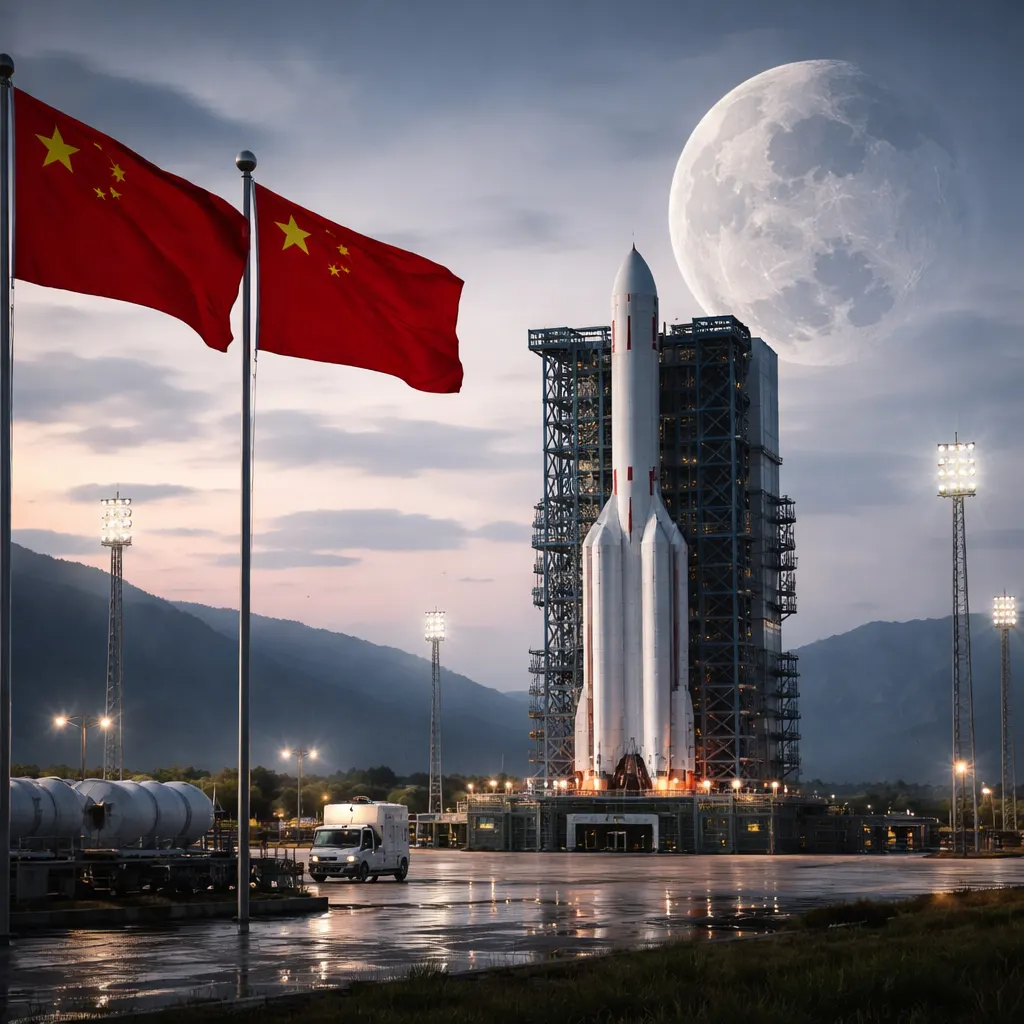
China has set a goal to land taikonauts on the Moon before 2030—ahead of the United States' return to the lunar surface—in a race that will determine which country gets to set the operating rules governing future lunar activity. That's according to a new report published in July 2026 by the Hoover Institution, authored by Dan Berkenstock and Walter J. Manuel. The report warns that whichever nation establishes a sustained lunar presence first will have outsized power to claim the most strategically valuable sites and potentially block competitors from accessing critical areas.
China has conducted an ambitious series of robotic lunar missions and partnered with Russia to establish the International Lunar Research Station at the Moon's south pole before 2035, according to the report. The US currently has 67 countries who've signed the Artemis Accords, a framework for international cooperation in lunar exploration. However, the report notes that the 1967 Outer Space Treaty—the foundation for international space law—has no enforcement mechanisms, and the Artemis Accords' provision of "safety zones" around nations' lunar bases remains undefined.
The report presents four conflict scenarios to illustrate what's at stake and emphasizes that traditional methods of deterring adversaries won't work on the Moon, where the US lacks the ability to project military force. The authors argue that the US needs to make getting astronauts back to the Moon a top national priority. According to the report, America should work with allies now to establish clear operating rules, with the 67 Artemis Accords signatories needing to agree on concrete definitions and standards before China establishes its own competing framework.
The Moon is becoming a strategic battleground precisely because existing space law can't prevent conflict in a domain where military deterrence doesn't apply. The report explains that without enforcement mechanisms in the Outer Space Treaty and with undefined safety zones in the Artemis Accords, there's nothing stopping one nation from interfering with another's satellites or equipment. The authors argue this creates a vacuum that China could fill by setting its own rules once it establishes a presence. The cislunar environment—the space between Earth and the Moon—presents unique challenges that require new thinking about how nations operate and compete beyond traditional military domains.
The report recommends a near-term US strategy built on four pillars: accelerated missions to return to the Moon quickly, coordination with allied nations, clear red lines about what behaviors won't be tolerated, and concrete military doctrine from the Department of Defense and Space Force. The authors write that America must publicly state what actions will trigger consequences—such as interference with US equipment—and back those warnings up with real, credible responses. The bottom line: whoever gets there first writes the rules, and the US is running out of time to make sure those rules protect American interests and open access for all nations.