
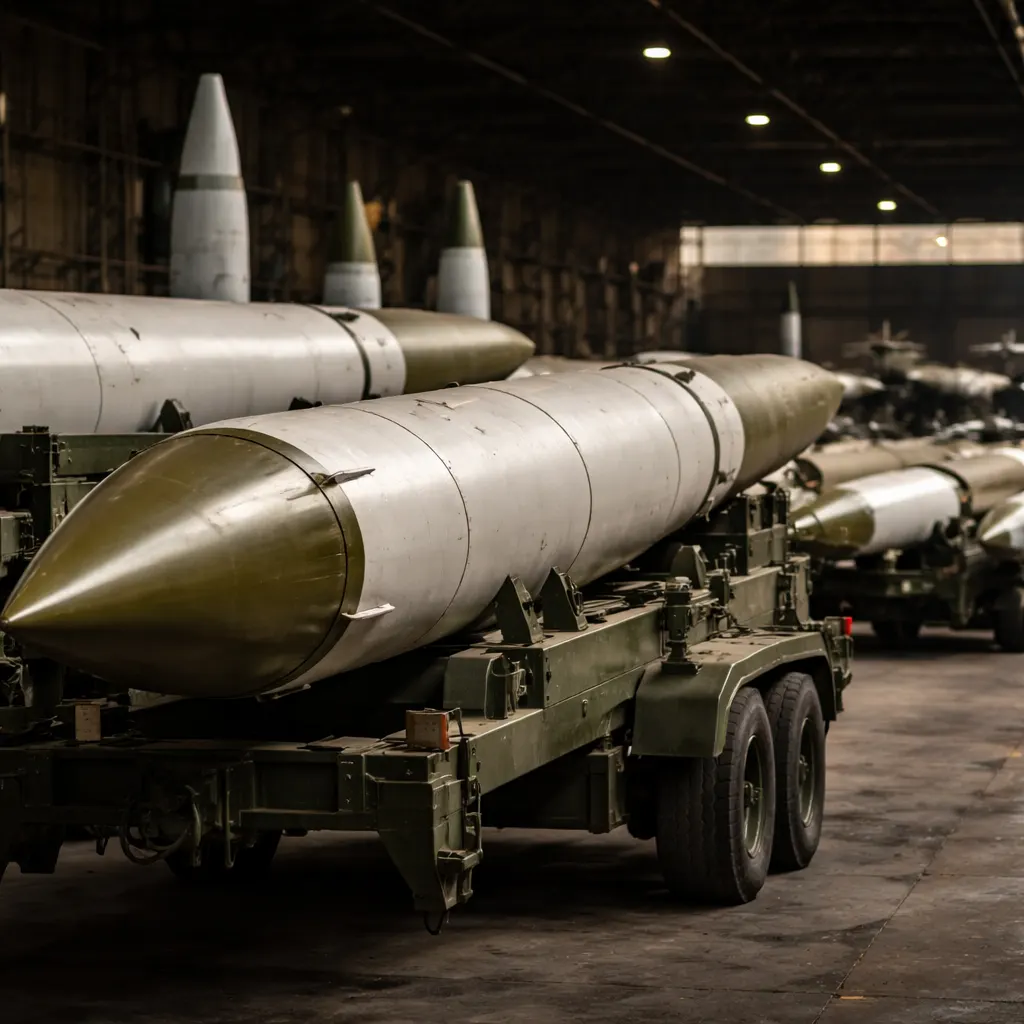
Iran's Islamic Revolutionary Guard Corps has retained roughly 70 percent of its ballistic missile stockpile despite months of American and allied strikes, though its ability to launch those weapons has been sharply constrained, according to a Hudson Institute assessment published this week. The report, written by senior fellow Can Kasapoğlu, finds that while Iran's missile and drone forces have suffered heavy losses, their command structure, operational discipline, and institutional coherence remain intact. The IRGC has launched more than 2,000 ballistic missiles across the Middle East since early 2024, with nearly 170 penetrating regional defenses and hitting their targets.
Between March 1 and March 8 of this year, the United Arab Emirates absorbed 1,422 Iranian drones and 246 missiles, while Saudi Arabia faced a similarly drone-heavy campaign against energy infrastructure and military sites, the report states. Drones made up 71 percent of all Iranian strikes during those opening weeks. During the June 2025 Twelve-Day War, US forces fired more than 150 THAAD interceptors and 80 SM-3 interceptors—representing roughly a quarter of America's THAAD magazine—while allies intercepted 270 of the 570 ballistic missiles Iran launched at Israel. Over a full year, Washington used roughly 200 SM-2 and SM-6 interceptors against Houthi salvos from Yemen alone. By the tenth day of Operation Epic Fury, the US-led campaign that began in late February 2026, Iranian drone launches had dropped 83 percent from initial levels, alongside a roughly 90 percent decline in ballistic missile activity.
According to Kasapoğlu, Iran's limited launcher inventory—from road-mobile transporter erector launchers to hardened underground missile cities—has become a chokepoint that constrains the regime's ability to generate sustained salvos even when missile stocks remain substantial. The report notes that some US combat aircraft have tracked Iranian launchers back to storage sites and destroyed them. "Iran's modular, dispersed drone enterprise can regenerate far more quickly than its missile complex," the assessment finds, highlighting separate industrial chains for solid- and liquid-propellant missiles as a key factor shaping Tehran's recovery timeline.
The report explains that Iran's shift toward solid-propellant missiles reflects hard wartime lessons: these weapons can be prepped for launch in minutes rather than the hours required for liquid-propellant systems, reducing exposure to surveillance and preemption. Tehran favors newer solid-propellant designs like the Kheibar Shekan and Fattah-1 for speed and survivability, while retaining heavier liquid-propellant Khorramshahr and Emad missiles for long-range strikes requiring larger payloads. China supplies the industrial machinery and chemical precursors—especially sodium perchlorate, which Iran converts into ammonium perchlorate for solid rocket fuel—that make missile regeneration possible. An estimated 1,000 tons of sodium perchlorate can yield enough propellant for approximately 260 medium-range ballistic missiles, and two ships can carry that volume in a single transfer. Meanwhile, Iran's drone ecosystem depends on modular, often substitutable components sourced globally through Chinese distributors that obscure the origin and end use of dual-use electronics, navigation modules, and engines.
Kasapoğlu warns that the competition between offensive mass and high-tech defense remains offense-dominant: Iran can assemble drones and mixed-strike packages faster and more cheaply than the US and allies can replenish expensive interceptors. Future Iranian strike packages will combine inexpensive propeller-driven drones to exhaust defenses, jet-powered variants like the Hadid-110 to suppress air defenses and compress warning time, cruise missiles to complicate engagement geometry, and ballistic missile salvos for speed and heavier effects. The report concludes that destroying Iranian factories will remain insufficient if the transnational network supplying components, propellants, production expertise, and real-time targeting data survives. "The strategic task facing the US and its allies is therefore twofold: preserving the cohesion of their own coalition while fracturing the opposing coalition that enables Iran," the assessment states.