
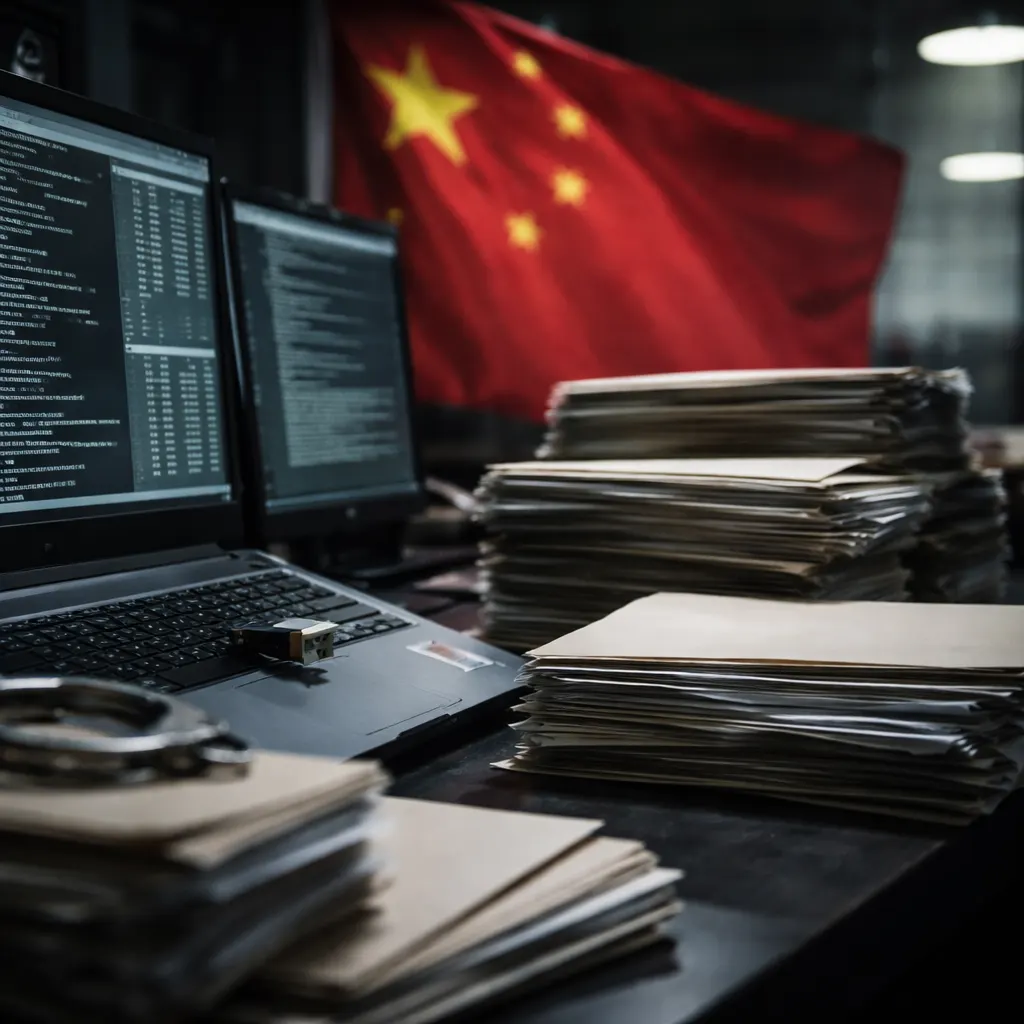
President Trump revealed that U.S. intelligence discovered Chinese Communist Party operatives acquired data on roughly 220 million American voter files, according to a report published by Hudson Institute scholar Miles Yu. Newly declassified documents show that Chinese intelligence assigned dedicated units to mining this information and viewed centralized election databases as high-value intelligence targets. The report argues this incident represents just one piece of what it calls the largest state-sponsored information theft operation in human history, with communist China systematically harvesting data on foreign citizens at an industrial scale never before attempted by any empire or intelligence service.
The scale of Chinese data collection spans multiple major breaches over the past decade. In 2015, Chinese operatives penetrated the U.S. Office of Personnel Management and extracted security clearance files covering more than 21 million current and former federal employees, including fingerprints, financial histories, foreign contacts, psychological evaluations, marital issues, and medical records. That same year, Anthem lost nearly 80 million health records to Chinese hackers. The 2017 Equifax breach handed personal financial data on roughly 147 million Americans to Chinese actors, an operation that led to U.S. Department of Justice indictments against four People's Liberation Army officers. Marriott's Starwood database exposed 383 million international traveler registration records to Chinese hackers in 2018, complete with passport numbers, travel histories, and personal preferences. The 2021 Microsoft Exchange attacks, carried out by the Chinese state, compromised tens of thousands of organizations across government, academia, defense, and industry. Chinese hackers also targeted the U.S. Naval Undersea Warfare Center in Newport, Rhode Island, in 2023, stealing sensitive information on submarine warfare and other military technologies.
The report states that under Xi Jinping's Military-Civil Fusion doctrine, information gathered anywhere can be deployed everywhere. The report explains that "data has become the oil of the 21st century" and China intends to control those oil fields. According to the analysis, the Chinese Communist Party recognizes no boundary between military, commercial, political, technological, or personal intelligence—a database stolen by the Ministry of State Security today might assist a state-owned enterprise tomorrow, a PLA artificial intelligence laboratory next year, and a political influence campaign years later. The report notes that for nearly five years, data from the African Union's headquarters—built and equipped by China—was copied nightly to servers in Shanghai before discovery, illustrating the global reach of these operations.
The report's analysis centers on why the Chinese Communist Party pursues such vast data accumulation. The CCP's intelligence philosophy operates on accumulation, treating every data point as a puzzle piece that gains value when combined with other information. A voter file alone may reveal little, but merged with commercial purchasing data, health records, travel histories, social media profiles, financial information, leaked passwords, facial recognition databases, genetic information, and artificial intelligence, it produces an extraordinarily detailed map of an entire society. Modern AI systems depend not only on sophisticated algorithms but on enormous datasets, and whoever possesses the world's largest reservoirs of personal information gains a decisive advantage in predictive analytics, facial recognition, behavioral modeling, social network analysis, influence operations, and intelligence targeting. The report argues that previous generations fought over oil fields, steel mills, and sea lanes, but the defining struggle of this century will be over databases.
The report concludes that democracies have spent too long treating each Chinese cyberintrusion as an isolated incident—a corporate breach here, a government compromise there—which is precisely the reaction the CCP counts on. The nation that masters information will possess an enduring advantage in intelligence, technology, commerce, diplomacy, and war, and the CCP recognized that reality long before the West did. The question the report poses is whether America has finally realized it.