
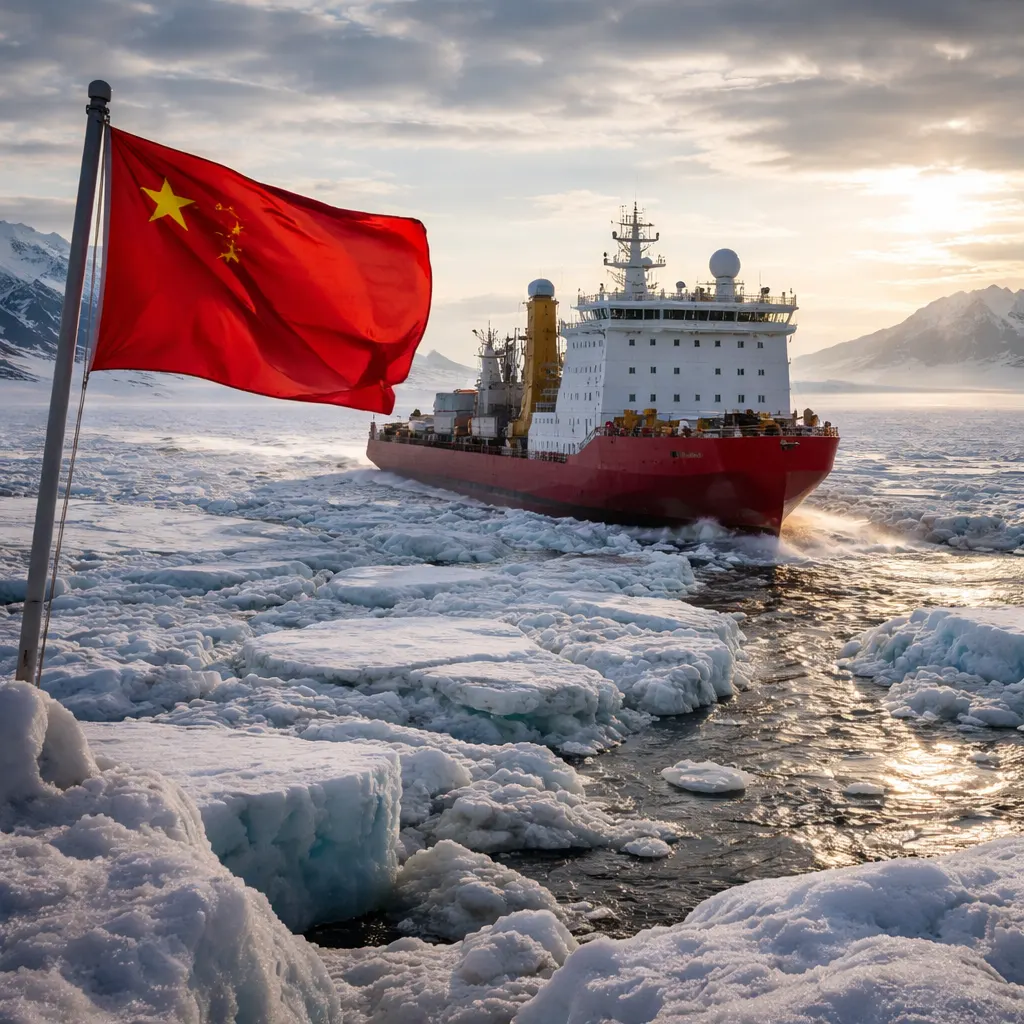
Arctic governments now view China not merely as an economic player or scientific partner, but as a potential strategic challenge, according to a new report published by the Hudson Institute. The shift reflects China's deepening partnership with Russia and expanding maritime capabilities in the region. Despite mounting political resistance from most Arctic states, Beijing remains committed to expanding its knowledge, presence and influence in polar waters.
China has established itself as a long-term Arctic stakeholder through multiple channels. The country launched a weekly container route along the Northern Sea Route and became a major investor in Russia's Arctic energy sector through its stake in the Yamal Liquefied Natural Gas project. China maintains a sustained scientific presence through the Yellow River research station in Svalbard and conducts regular Arctic expeditions using its icebreakers Xue Long and Xue Long 2. Diplomatically, Beijing has pursued a larger role in Arctic governance since gaining observer status in the Arctic Council in 2013. The country's 2018 Arctic Policy presented China as a "near-Arctic state" with legitimate interests in Arctic shipping, resource development, scientific research and governance. Most of China's economic involvement in the Russian Arctic concentrates on energy, fisheries and shipping projects, particularly liquefied natural gas production and exports to Asian markets. Several Arctic states have blocked or restricted proposed Chinese investments in strategically sensitive sectors, including infrastructure projects in Greenland, and Canada has become increasingly cautious about Chinese scientific activities in the Arctic.
The report finds that China continues to expand its Arctic capabilities despite setbacks, with research expeditions, satellite systems, seabed mapping projects and polar infrastructure contributing to a steadily growing body of operational knowledge. Much of this activity serves legitimate scientific and commercial purposes, but many technologies involved possess dual-use potential—data collected for climate research, navigation safety and oceanography can also improve maritime domain awareness and support future naval operations. The authors write that China–Russia military cooperation has expanded with joint bomber patrols near Alaska, coast guard operations through the Bering Strait and naval exercises that demonstrate growing operational familiarity and strategic coordination. However, the report notes that Russia continues to regard much of the Arctic as a highly sensitive strategic domain in which it remains the dominant actor, which is why China–Russia Arctic cooperation is often characterized as pragmatic and project-based rather than as a fully integrated military partnership.
The report explains that China's significance in the Arctic lies less in immediate military deployment than in its adaptability and long-term determination. Arctic deployment could offer China significant strategic advantages, including a more survivable sea-based nuclear deterrent, enhanced second-strike capability and the ability to threaten North America from unexpected directions. It would also complicate US and allied maritime surveillance by creating new avenues of Chinese access through the Bering and Aleutian approaches. Though Arctic shipping has fallen short of early expectations that the Northern Sea Route would become a major artery of Eurasian trade due to challenging operating conditions, infrastructure constraints and geopolitical uncertainty, the route retains strategic significance as an increasingly important arena for geopolitical competition. Even if China doesn't establish a military presence in the Arctic, its growing maritime capabilities, expanding Arctic expertise and closer ties with Russia make it a more consequential factor in Arctic security calculations. The report's bottom line: policymakers shouldn't underestimate Beijing's determination to remain an Arctic stakeholder regardless of growing political headwinds.