
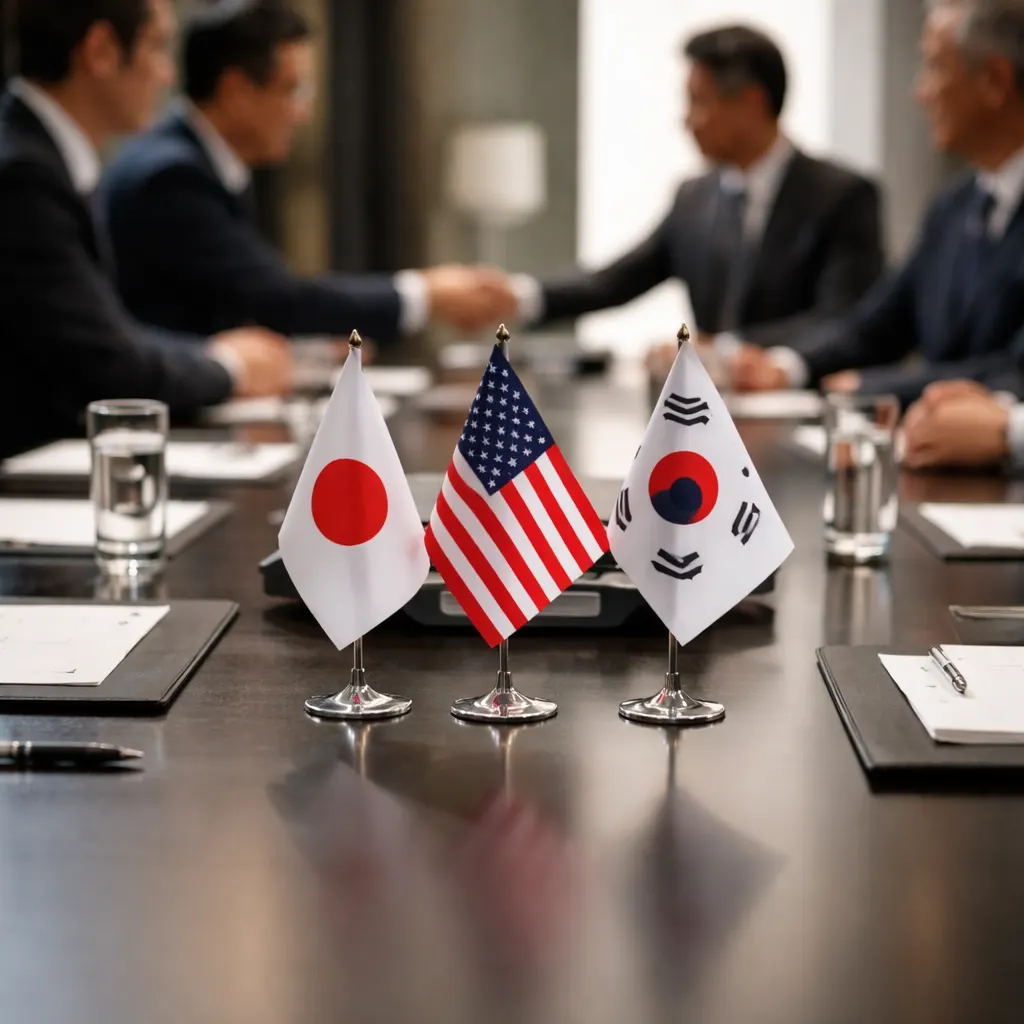
U.S. allies in Asia have adapted far more successfully to President Donald Trump's "America first" agenda than their European counterparts, according to an analysis published by the Hudson Institute. While western European nations struggle to manage what they view as an antagonistic White House or delay difficult decisions in hopes of a friendlier successor in 2028, Japan, the Philippines, South Korea, Taiwan, and Thailand are focused on securing unique benefits from the disruption Trump is causing. The analysis finds that Asian allies' willingness to work with Trump on his terms stems from a sense of vulnerability that European allies neither experience nor comprehend.
The divergence is rooted in fundamentally different security realities. Asian allies face China, which accounts for roughly half of Asia's entire economic output and spends more on defense annually than all U.S. Asian allies combined. Russia's economy, by contrast, is about one-tenth the size of western Europe's, and its military spending is approximately one-third. From 2014 to 2019, defense spending as a share of GDP in Germany, France, Italy, and Spain remained largely stagnant despite Russia's annexation of Crimea. In 2024, these same countries allocated 27.9 percent, 30.6 percent, 27.6 percent, and 25.9 percent of GDP, respectively, to public social spending—well above the 21.2 percent OECD average. Meanwhile, eastern European states facing direct Russian threats spent far more on defense in 2025: Estonia allocated 3.4 percent of GDP, Latvia 3.6 percent, and Lithuania 3.1 percent, compared to most western European nations.
The report documents how Asian nations responded to Trump's April 2025 "Liberation Day" tariffs with immediate bilateral negotiations rather than laments about the old trading system. Japan signed a trade deal in July 2025 that included an agreement to invest $550 billion to rebuild and expand U.S. industries in fossil fuels, semiconductors, critical minerals processing, and pharmaceuticals, explicitly linking the investment to revitalizing the U.S. defense industrial base. South Korea, facing a 25 percent levy that violated its 2012 free trade agreement, dispatched senior officials to Washington rather than threatening retaliation. Seoul ultimately announced a $350 billion investment fund for U.S.-owned companies and an additional $100 billion in oil and gas purchases from American firms as part of a deal to reduce tariffs to 15 percent.
The analysis explains that Asian allies accept unequal arrangements because they view American power as the only check against Chinese dominance. Without multilateral security institutions like NATO, U.S. alliances in Asia operate through bilateral agreements with ambiguous security guarantees that each new administration redefines, making these relationships inherently more transactional than European equivalents. Western Europe, insulated by the territorial buffer of eastern Europe and NATO's institutional protection, has prioritized vast welfare states and positioned itself as a normative and regulatory superpower. European countries retain considerable influence in international institutions and view this outsize role as something to celebrate, not apologize for—a perspective directly threatened by Trump's attacks on the postwar order.
The report warns that western Europe's unwillingness to accept the new reality creates a bind: if European nations rely less on Washington, they must spend far more on their own security by cutting welfare programs that governments are reluctant or unable to touch. The Trump era will pass when the next president is elected in November 2028, but the power disparity between Washington and its allies is likely to increase as the United States continues leading technological innovation and expanding its military. The analysis concludes that U.S. Pacific allies have positioned themselves advantageously in a changing world order, while Atlantic ones must accept that Europe's privileged position in the global order is fading and learn to play by Washington's new rules.