
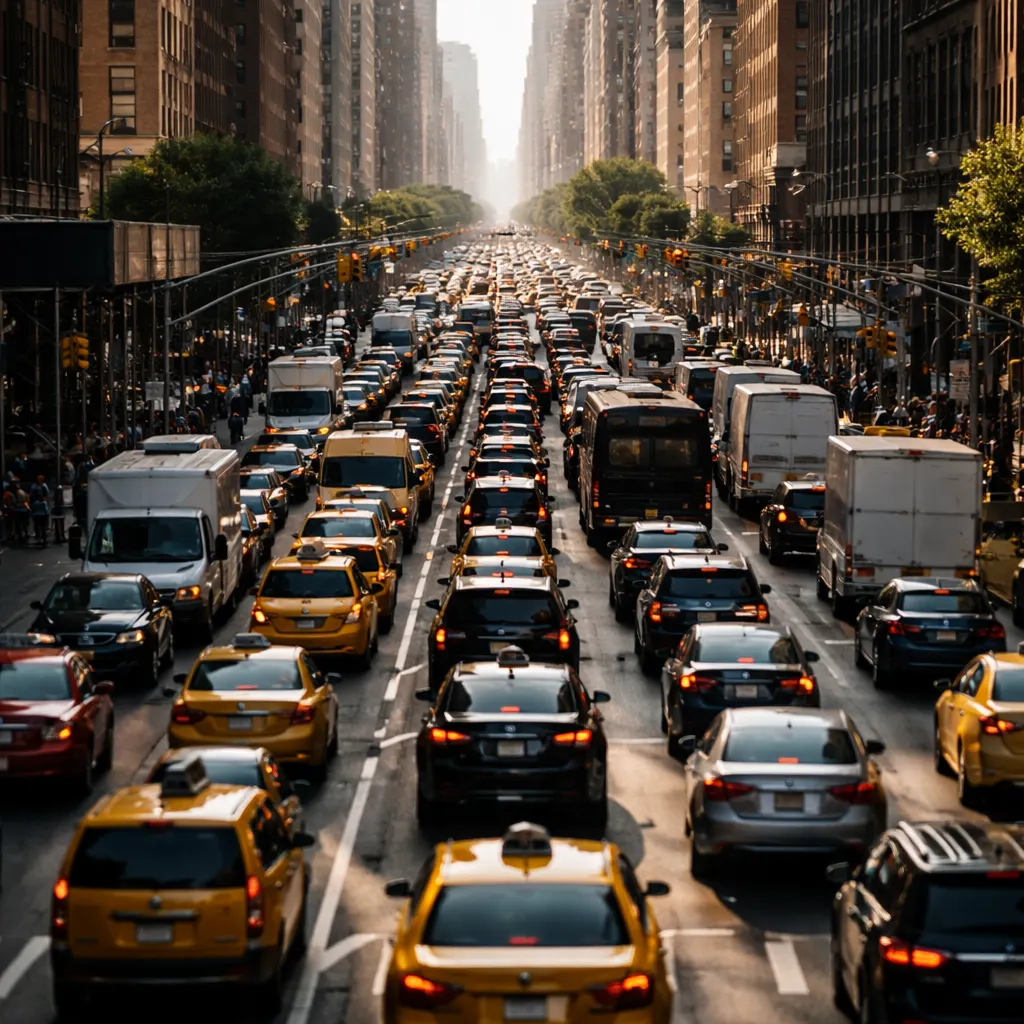
New York City's congestion pricing program cut vehicle entries into Manhattan's central business district by 11 percent while raising an average of $55 million per month, according to the Metropolitan Transportation Authority's First Evaluation Report analyzed by the Tax Foundation. The $9 daily toll, which launched in January 2025, has delivered on both of its core goals: reducing gridlock and generating revenue for the city's struggling transit system. The program marks the first congestion pricing scheme in the United States and has already sparked similar proposals in Los Angeles and Washington, DC.
The report found that average vehicle speeds within the Congestion Relief Zone increased by 4.6 percent, while speeds on crossings into Manhattan jumped 23 percent when comparing 2024 and 2025. Transit ridership rose 9 percent over the same period as drivers shifted away from cars. Emergency medical service response times dropped an estimated 5 to 6 percent, or 63 to 70 seconds faster. The revenue collected allowed the MTA to bond $15 billion for its capital plan. Traffic shifted to off-peak hours, with the periods immediately before and after peak pricing seeing the only increases in vehicle travel compared to 2024. Large trucks and sightseeing buses pay the highest toll at $21.60 per entrance, while motorcycles pay $4.50. Taxis are charged 75 cents per trip and rideshare vehicles $1.50, with off-peak drivers receiving a 75 percent discount.
The report describes congestion pricing as serving two functions: a user fee to offset road wear and tear, and a Pigouvian tax that forces drivers to account for the external costs they create through traffic and pollution. The authors note that while each driver loses time to delays, "there isn't an inherent mechanism that charges drivers for the marginal congestion that they create." The Tax Foundation states that faster EMS response times mean lives saved, since "when 'time is tissue,' improved EMS performance saves lives." The MTA designed the system to minimize disruption using E-ZPass electronic tolling and over 1,400 license plate scanners to track entries without slowing traffic.
The report explains that New York City faced a vicious cycle before the toll launched: in 2024, congestion reached 102 hours of delays per driver, the worst in the United States, while the MTA struggled with an $8.3 billion deficit. As the transit system's service quality declined, more commuters turned to driving, which further lowered MTA revenue and worsened delays. The program faced federal legal challenges in February 2025 when Transportation Secretary Sean Duffy attempted to withdraw approval, alleging violations of federal restrictions, though a court rejected attempts to stop the program and the case now awaits the 2nd Circuit Court of Appeals.
The report cautions that New York's success may not translate to other American cities. The authors note that NYC is unique with the nation's largest population, serious traffic congestion, a sprawling mass transit system, and one of the world's densest job concentrations in Lower and Midtown Manhattan. Many cities are struggling to attract workers back downtown in the work-from-home era, making congestion pricing potentially harmful in those contexts. Still, the report concludes that New York's positive first-year experience "could prove to be a vital data point for the expansion of congestion pricing traffic policies" as an economically efficient tax that reduces traffic while raising revenue.