
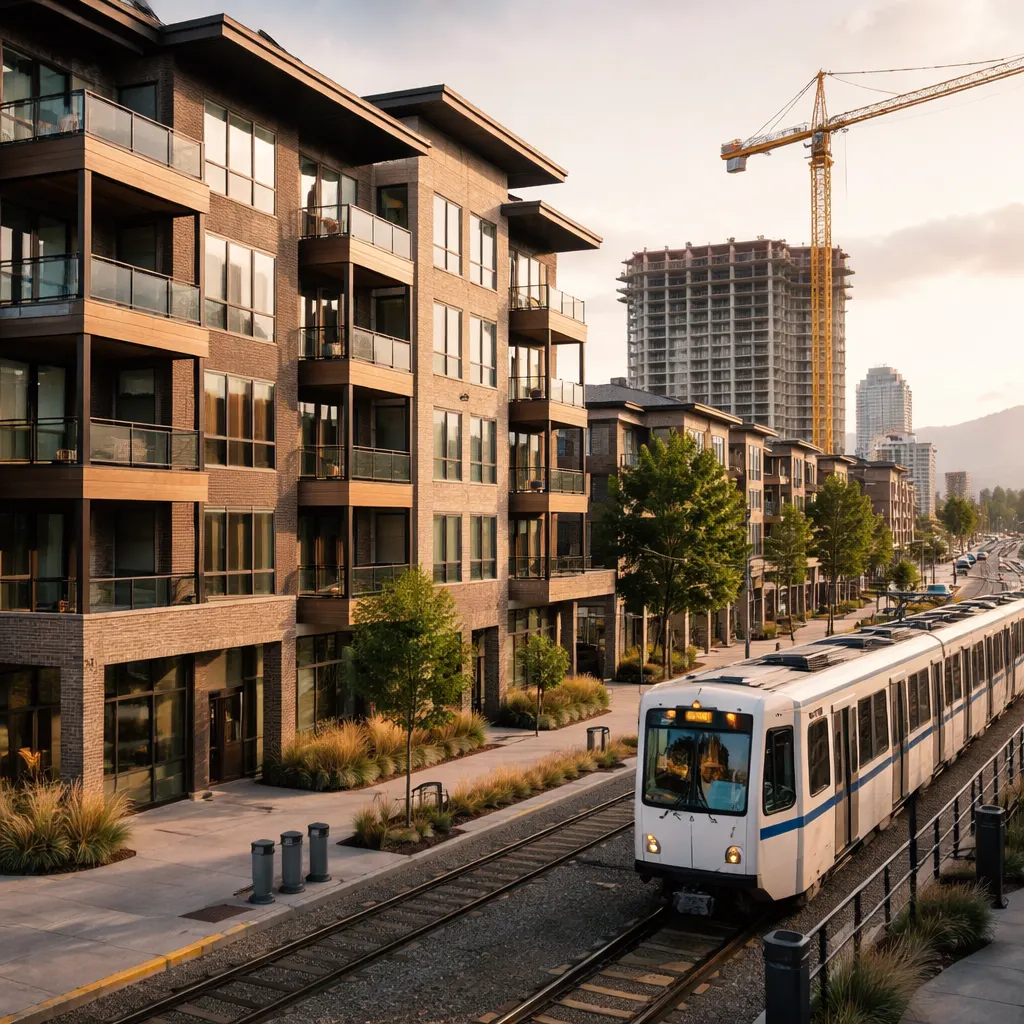
Colorado enacted a Transit Oriented Communities law in 2024 that could add between 121,000 and 480,000 housing units near transit stations over the next four decades, addressing the state's housing shortage while boosting rail ridership by as much as 800 percent, according to a report published this month by the Niskanen Center. The legislation requires cities with qualifying transit service to allow higher-density development within half a mile of rail stations and bus rapid transit stops, with the dual goal of expanding housing supply and rescuing an underused transit system. Denver home prices have climbed to nearly six times the region's median household income, making it the 12th most expensive metro area in the country, while its rail transit system struggles with just 638 boardings per mile on weekdays for light rail.
The law calculates each community's "housing opportunity goal" by multiplying buildable land within half a mile of rail stations by 40 units per acre, creating a zoned capacity of roughly 3.6 million housing units across the Denver region's transit areas. The report models three scenarios based on how much new housing actually gets built: at 15 percent buildout of zoned capacity, the region would gain 480,000 units above current growth trends by 2067; at 10 percent, about 298,000 units; and at 5 percent, roughly 121,000 units. Currently, population density within a half-mile walk of Regional Transportation District rail stations sits at just 5,394 people per square mile, far below the 10,000 to 15,000 people per square mile needed to support light rail service. Under the middle buildout scenario, station-area density would eventually reach 34,000 people per square mile, while the highest scenario would push density to over 52,000 people per square mile.
The report traces Denver's transit struggles to route-planning decisions made to speed construction of the FasTracks rail system, which voters approved in 2004. Planners deliberately avoided dense neighborhoods where opposition could have triggered legal delays, instead routing lines along railroads and highways where rights of way were easily acquired. The strategy delivered a system quickly but left stations in industrial areas and highway medians, often far from where people live. Many of the region's densest census tracts, with over 15,000 residents per square mile, aren't served by rail transit at all, while several of the lowest-density areas—below 3,000 people per square mile—have stations despite lacking enough population to justify even regular bus service.
The law's success depends on whether cities embrace upzoning and whether the state provides adequate support for the infrastructure costs that come with growth, the report argues. Communities that comply become eligible for additional state infrastructure funding, while noncompliant cities lose their share of state highway funds after 180 days, with those dollars redistributed to other communities covered by the law. But the report warns that the state's one-time $35 million infrastructure fund represents a small incentive relative to the scale of projected growth, and recommends the state expand financing options to help localities cover near-term costs for schools, public safety personnel, and water infrastructure. Author Andrew Justus suggests a "reverse impact fee" that would give local governments a modest per-unit grant for every housing unit permitted within transit centers, conditioned on cities not charging traditional impact fees to developers. As rail ridership climbs and fare revenues rise, those grants could be partially offset by lower operating subsidies for the Regional Transportation District, creating a financial cycle that rewards both housing production and transit use.