
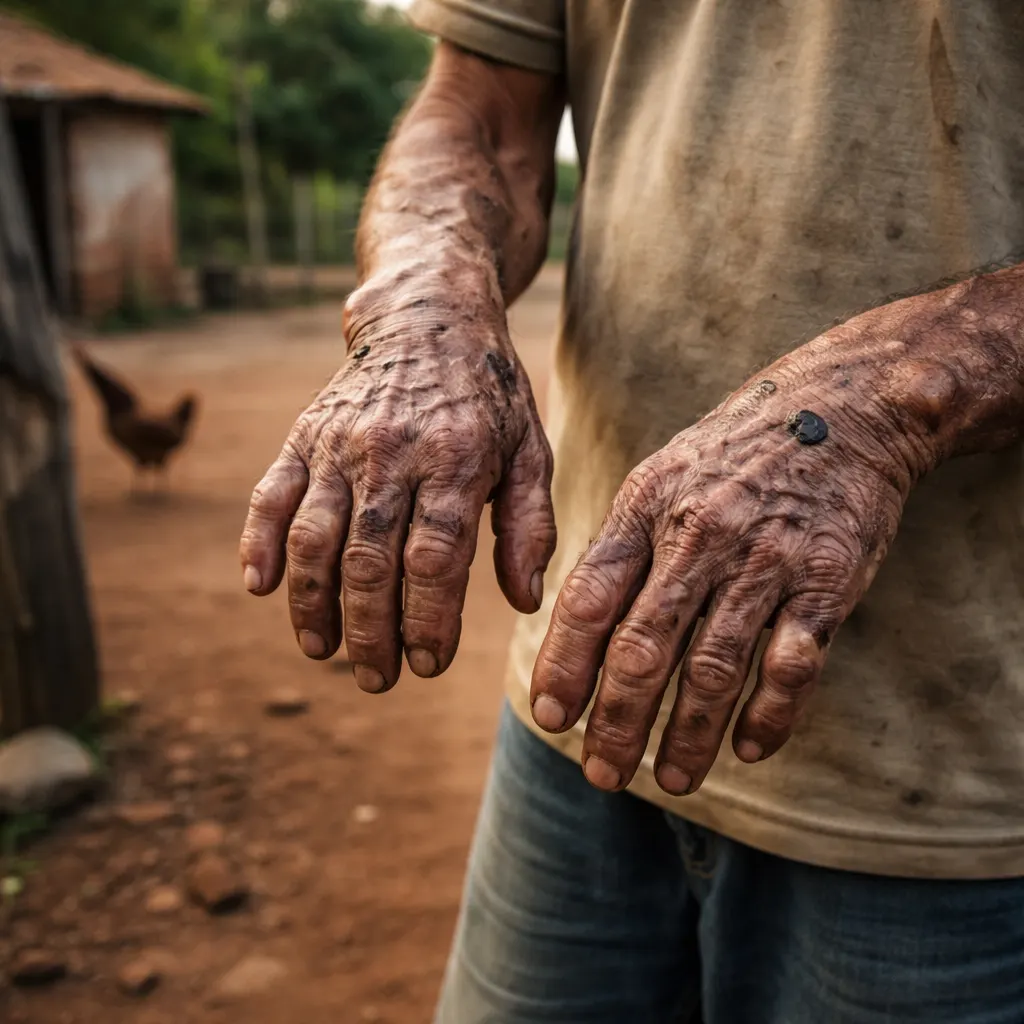
In the municipalities around Governador Valadares, a city of roughly 280,000 in Brazil's Minas Gerais state, people living in rural areas were roughly twice as likely to show immune evidence of exposure to the leprosy bacterium or a clinical history of the disease compared with urban residents, according to a study published in PLOS Neglected Tropical Diseases. The research, led by investigators including Audra Bass, Jessica K. Fairley of Emory University, and Lucia A. O. Fraga of the Universidade Federal de Ouro Preto, tested 1,311 residents aged three and older for immune signatures of three pathogens: the bacterium that causes Hansen's disease, commonly known as leprosy, and two parasitic worms. The findings reveal a region where these infections aren't isolated occurrences but simultaneous, everyday exposures.
Among the 1,311 participants, 72 people, or 5.5 percent, reported a previous history of Hansen's disease. An additional 94 individuals, 7.2 percent, tested positive for antibodies against LID-1, an antigen specific to Mycobacterium leprae that signals exposure to the bacterium even in people without diagnosed disease. Parasitic infections were even more widespread: 836 participants, a striking 63.8 percent, reported having at least one parasitic disease in the past. Laboratory testing confirmed substantial ongoing exposure to the two worms studied, with 153 participants, or 11.7 percent, carrying antibodies against schistosome egg antigen, and 69 participants, 5.3 percent, positive for the NIE antigen of Strongyloides stercoralis. After adjusting for other variables, rural residence was positively linked with both anti-LID-1 positivity, with an adjusted odds ratio of 1.79, and with a history of Hansen's disease, with an adjusted odds ratio of 1.97.
The authors are careful not to overinterpret the immunological signals between parasitic worms and leprosy exposure. Participants with antibodies to Strongyloides showed a positive but non-significant association with anti-LID-1 positivity, with an adjusted odds ratio of 1.57, while the association between anti-LID-1 and schistosome antibodies ran in the opposite direction, with an adjusted odds ratio of 0.79. Neither result reached statistical significance, so the study can't confirm that helminth infections modify M. leprae infection risk in this population. According to the report, what the study does establish firmly is the sheer burden of neglected tropical diseases in this corner of Minas Gerais, alongside the strong and statistically significant link between rural residence and M. leprae exposure.
The geographic signal points toward spatial and environmental risk factors, such as contact patterns, housing conditions, water and sanitation infrastructure, or ecological features of the Doce River valley. The broader significance of the work lies in its method: by measuring seroreactivity to multiple pathogens simultaneously in a single community sample, the study demonstrates a practical template for integrated surveillance of neglected tropical diseases. It also underscores a persistent reality about Hansen's disease: transmission continues in endemic regions even where case detection and multidrug therapy have expanded, and the reservoir of exposure is larger than the case registry suggests.
For the communities of Governador Valadares and its rural surroundings, the study's message is twofold. These infections are common enough to be considered a shared background risk, and the places people live, particularly rural households, carry a measurably higher burden of exposure to the leprosy bacterium. Follow-up work on the environmental and spatial drivers of that exposure, the authors suggest, is the natural next step, and could ultimately sharpen both leprosy control and the integrated treatment of the parasitic diseases that so often travel alongside it.