
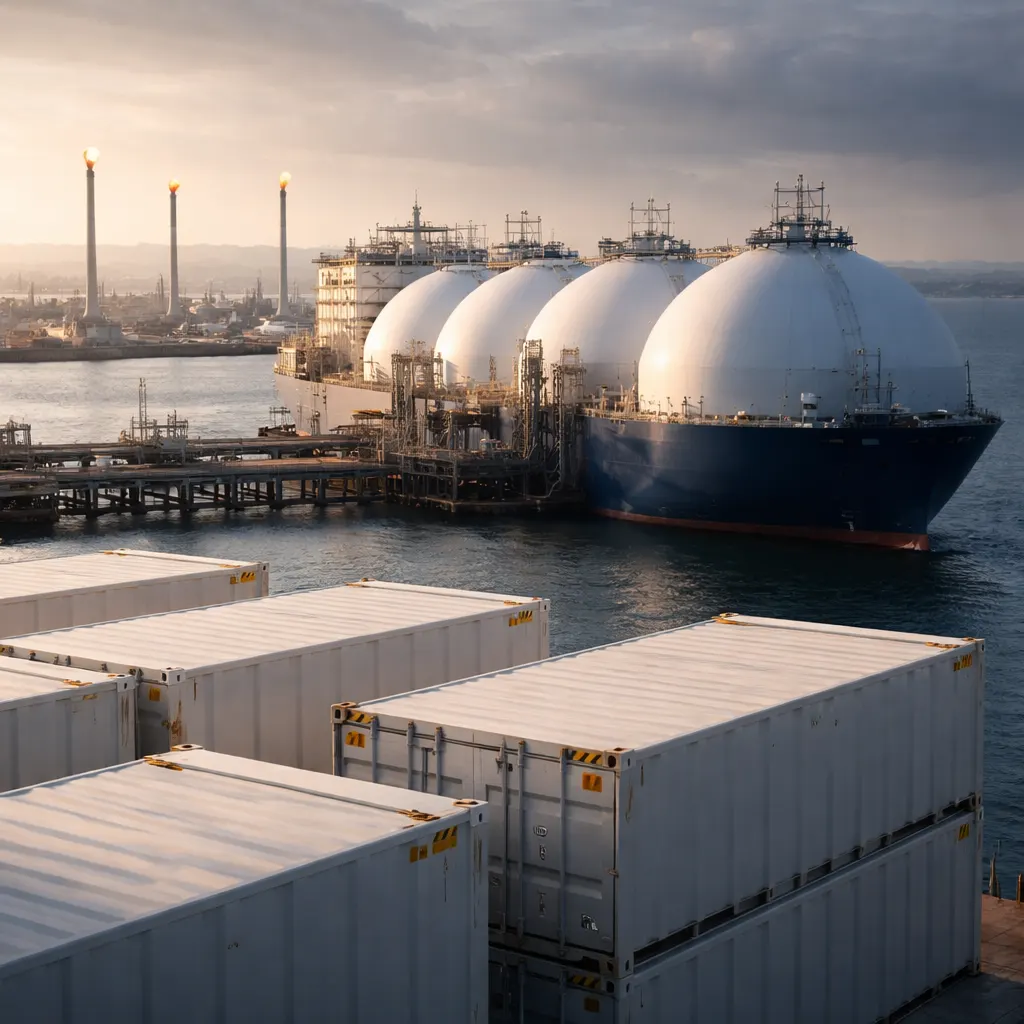
U.S. liquefied natural gas exports reached an average of 17.4 billion cubic feet per day during the first six months of 2026, marking a 23% increase over the same period in 2025, according to a report published September 1 by the U.S. Energy Information Administration. The surge represents the fastest growth rate since the country launched large-scale exports in 2016. New terminal startups and expansions at existing facilities drove the jump, with the agency projecting exports will average 17.3 Bcf/d in the second half of 2026 before climbing to 18.7 Bcf/d in the first half of 2027.
Plaquemines LNG is now exporting at maximum capacity, while Corpus Christi Stage 3 is currently shipping from six of its seven liquefaction trains, the report states. These two terminals will add a combined 4.0 Bcf/d of nominal export capacity when fully operational. Golden Pass LNG started exports in April 2026 and is expected to ramp up production from Train 1 through year-end, contributing another 0.7 Bcf/d of capacity, with Train 2 anticipated to come online in late 2026. Global benchmark prices remained elevated throughout the first half of the year, with Europe's Title Transfer Facility averaging $14.74 per million British thermal units, up from $13.10/MMBtu in the first half of 2025 and the highest level since Russia's 2022 invasion of Ukraine pushed prices to $32.42/MMBtu. The Japan-Korea Marker price hit a four-year high of $15.56/MMBtu, climbing $2.38/MMBtu from the previous year's first half and reaching the highest point since the $29.00/MMBtu recorded in 2022.
Market upheaval stemmed from disruptions to LNG shipments through the Strait of Hormuz in March, which cut off 20% of worldwide LNG supplies, predominantly from Qatar, the report explains. Asian buyers, who receive roughly 80% of Qatari LNG, were forced to compete for scarce spot cargoes on the open market, and hot weather in the region boosted spot demand further. U.S. exports to Asia doubled compared with last year, while shipments to Europe rose 0.1 Bcf/d, or 1%, and volumes to both Europe and Asia increased in absolute terms. Exports to Latin America, the Caribbean, the Middle East, and North Africa climbed 0.8 Bcf/d, representing a 46% gain from the first half of 2025.
The report finds that global LNG prices stayed "sufficiently high throughout 1H26 to continue incentivizing U.S. exports near maximum output levels." Top destination countries included Egypt at 1.7 Bcf/d, the Netherlands at 1.7 Bcf/d, Italy at 1.4 Bcf/d, France at 1.2 Bcf/d, and the United Kingdom at 1.1 Bcf/d. The combination of new capacity coming online and sustained price incentives positioned the United States to maintain strong export volumes heading into the second half of the year, with further growth expected as additional trains reach full operation.