
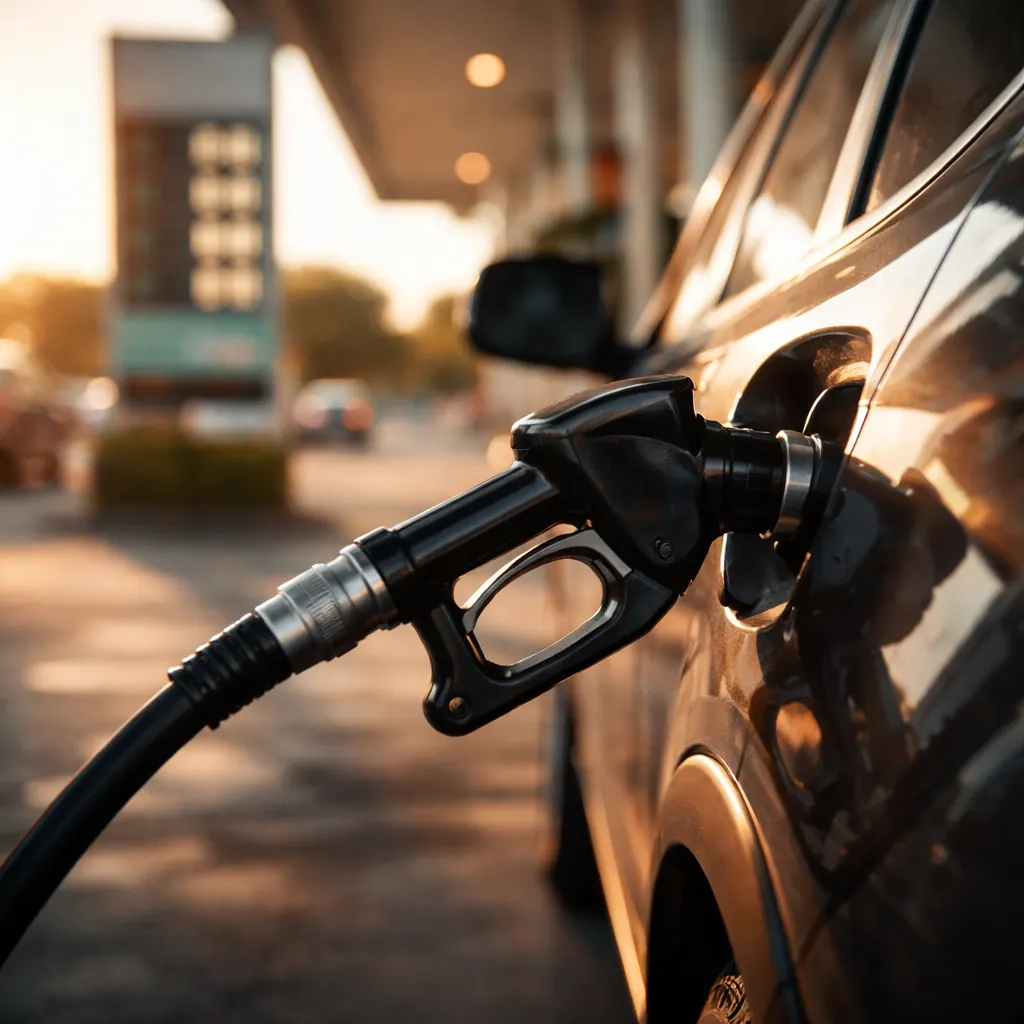
When households expect gasoline prices to climb 10 percentage points higher, their inflation expectations rise by 0.24 percentage points — but when they expect gas prices to fall by the same amount, their inflation outlook barely budges. That's the central finding of a Federal Reserve Bank of San Francisco Economic Letter published in August 2026, which examined how Americans' beliefs about future gas prices shape their broader views on inflation. The research reveals an asymmetric pattern: concerns about rising gas costs amplify inflation fears, but relief from falling gas prices doesn't produce an equal and opposite calming effect.
The analysis drew on monthly surveys conducted by the New York Federal Reserve from June 2013 through June 2025, tracking the same individuals over time to see how their expectations evolved. Researchers restricted their sample to respondents who participated for at least eight consecutive months, retaining roughly 70% of all survey observations. The study found that upward revisions in expected gas price growth were associated with statistically significant increases in inflation expectations, while comparable downward revisions showed no statistically meaningful decline. The asymmetry was even more pronounced among vulnerable populations: lower-income households showed a response more than three times larger than high-income households. For households earning under $50,000 annually, a 10 percentage point upward revision in gas price expectations corresponded to a 0.38 percentage point rise in inflation expectations, compared with just 0.12 percentage points for those earning over $100,000. Education levels produced a similar but less dramatic pattern, with high school graduates showing a 0.32 percentage point increase versus 0.21 percentage points for college graduates.
The researchers also measured how uncertainty about future inflation changed alongside gas price expectations. They used the interquartile range — capturing the middle 50% of possible outcomes each respondent reported — as a proxy for perceived uncertainty. A 10 percentage point upward revision in expected gas price growth was linked to a 3.3% increase in inflation uncertainty, while a comparable downward revision still produced a 1.4% increase. According to the report, "revisions of gas price growth in either direction are associated with greater perceived uncertainty, with a larger increase coinciding with consumers raising their expectations for gas price growth." The authors noted that average monthly retail gasoline prices in the United States hit $4.65 per gallon in May 2026, up from $3.06 in February before the start of the U.S.-Iran conflict, following similar spikes after Russia's invasion of Ukraine in 2022.
The asymmetry matters because it suggests inflation expectations can ratchet upward during gas price surges but fail to reverse when prices retreat, potentially leaving a lasting mark on consumer psychology. The report explains that gasoline ranks among the most visible and volatile expenses consumers face, and sharp increases may prompt people to interpret the change not merely as a shift in one category but as a broader signal about inflation trends. Lower-income households feel this signal more acutely because gasoline claims a larger share of their budgets, making price swings harder to absorb without cutting other spending. The methodology tracked individuals against their own baselines over time rather than comparing different people, isolating genuine shifts in belief from persistent differences in outlook. This asymmetric response means that even when gas prices stabilize or decline, the inflationary concerns they triggered may linger, complicating efforts to anchor public expectations and potentially influencing spending and saving behavior long after prices fall.