
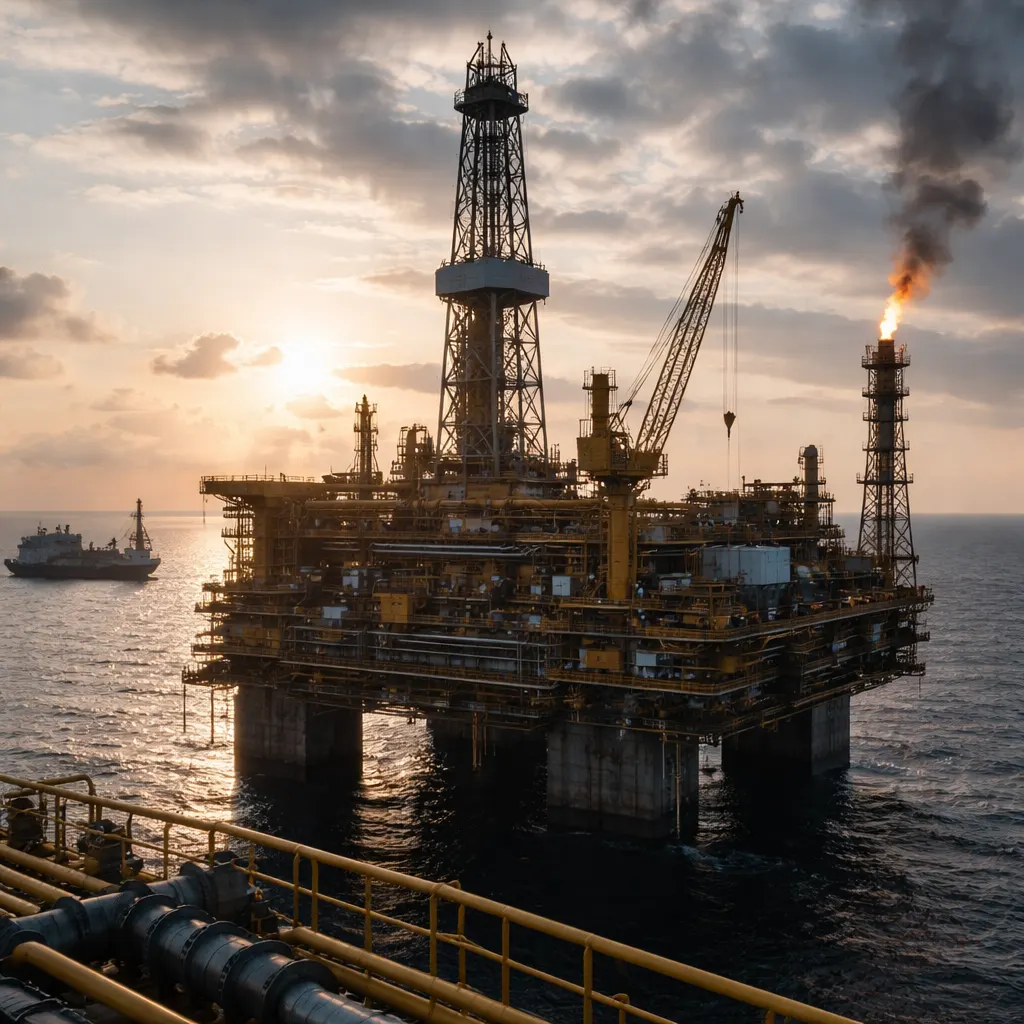
A massive offshore oil and gas development in Suriname is progressing toward its first production in mid-2028, marking the small South American nation's entry into deep-water petroleum extraction. Annand Jagesar, head of state-run Staatsolie, confirmed the timeline during a September 19 site visit to the $12 billion GranMorgu project, which is being developed by TotalEnergies, Staatsolie, and APA Corp. The venture represents Suriname's attempt to replicate the oil-driven economic transformation seen in neighboring Guyana, where international energy firms have turned offshore discoveries into major production.
The GranMorgu development, located in Block 58—a 1.4 million-acre offshore area adjacent to Exxon Mobil's prolific Stabroek block in Guyana—will tap into substantial petroleum reserves discovered since 2019. Wood Mackenzie estimated in 2024 that Suriname's discovered resources total more than 2.4 billion barrels of oil and liquids, plus over 12.5 trillion cubic feet of gas. The project partners have already invested roughly half of the total planned expenditure, according to TotalEnergies chairman Patrick Pouyanne. The development will employ a floating production storage and offloading (FPSO) vessel designed to produce 220,000 barrels per day, with recoverable reserves estimated at approximately 750 million barrels. Installation of wellhead components, tubing hangers, and other equipment manufactured in Malaysia is scheduled to begin soon, enabling oil and gas to flow back to the platform through underwater subsea infrastructure and pipelines.
During the Paramaribo event, Jagesar said the partners are "not only developing an energy project, we are writing a new chapter in Suriname's history," emphasizing the venture's significance for the nation. TotalEnergies plans to drill four new exploratory wells in Block 58 next year, and Jagesar expressed ambitions for expansion, stating he dreams of "a second project, a second FPSO in Block 58." Despite the wealth of discovered deposits in Suriname's waters over the past five years, the country has yet to produce any offshore oil or gas, making GranMorgu the first project to develop these vast resources.
The project's design prioritizes low-emissions production, incorporating an all-electric FPSO, zero routine flaring, and full gas reinjection, with methane detection sensors installed throughout. The development targets scope 1 and 2 emissions below 16 kilograms of CO₂ equivalent per barrel of oil equivalent, reflecting industry pressure to reduce the carbon footprint of new oil ventures. By end-2025, overall project completion had reached approximately 28%, with the FPSO itself about 50% complete, following a final investment decision made in October 2024. If GranMorgu meets its mid-2028 timeline and Jagesar's expansion hopes materialize, Suriname could follow Guyana's path from oil discovery to economic reinvention—transforming government revenues, employment, and the nation's role in global energy markets within the next decade.