
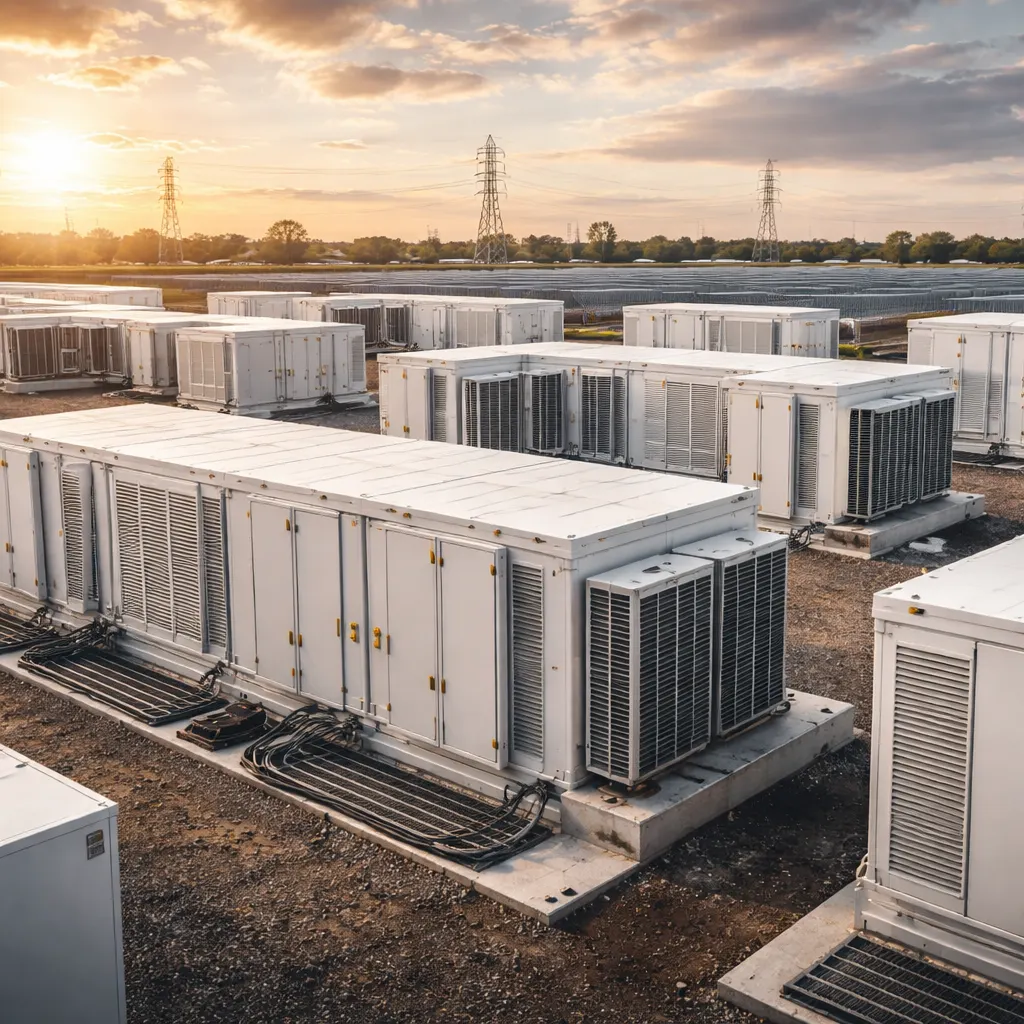
The global battery energy storage industry crossed 100 GW of annual installations in 2025 for the first time, marking a major milestone as storage becomes critical infrastructure for modern power systems. Wood Mackenzie's first-ever Global Battery Energy Storage System (BESS) Integrator Comprehensive Ranking, published in 2026, finds that buyers are increasingly selecting suppliers based on their ability to deliver across the entire project lifecycle rather than on price or technology specs alone. The ranking evaluates companies that produce AC-integrated battery storage systems—factory-assembled solutions that bundle batteries, power conversion, thermal management, and control systems into a single product.
Sungrow ranked first in the comprehensive ranking, followed by Tesla in second place and CATL in third. BYD took fourth, while Envision and Trina Storage tied for fifth. Fluence, LG, Canadian Solar, and Wärtsilä rounded out the top ten. The ranking assessed suppliers across ten criteria including technology maturity, research and development spending, safety, vertical integration, supply chain resilience, ESG performance, and financial strength. In total, 24 manufacturers achieved Wood Mackenzie's Grade A designation, reflecting what the report calls the continued maturation of the global BESS industry and the growing number of suppliers meeting rigorous performance benchmarks.
According to Timothy Shen, senior research analyst for solar supply chain at Wood Mackenzie, "Battery storage is following the same path as other critical infrastructure industries. As projects become larger and operate over decades rather than years, buyers are placing greater emphasis on execution certainty." The report finds that six of the global top ten integrators have more than a decade of battery storage integration experience, while every company in the top ten manufactures at least one critical system component—battery cells, power conversion systems, or battery management systems—to support its own deployments. Eight of the top ten exceeded Wood Mackenzie's benchmarks for system efficiency and lifetime cycle performance, nine invested more than 4% of annual revenue in research and development during 2025, and nine reported positive profitability.
The report explains that vertical integration is helping companies improve product compatibility, strengthen quality control, and reduce execution risk as storage projects grow in size and complexity. Higher profitability among leading suppliers provides greater confidence in their ability to support long-term warranties and service commitments, especially as battery storage assets are increasingly expected to operate for decades rather than years. The report notes that leading suppliers are expanding their global manufacturing footprint to respond to changing trade policies and local content requirements while maintaining internationally recognized safety certifications and robust thermal management systems.
Shen notes that "the next phase of competition will be determined less by manufacturing scale alone and more by the ability to execute consistently across global markets." The report concludes that as localization requirements, financing expectations, and technical standards continue to evolve, suppliers that can adapt while maintaining quality and delivery certainty will be best positioned for long-term growth. The industry's maturation means execution capability, engineering expertise, and financial resilience now matter as much as technology performance when utilities and developers choose their partners.