
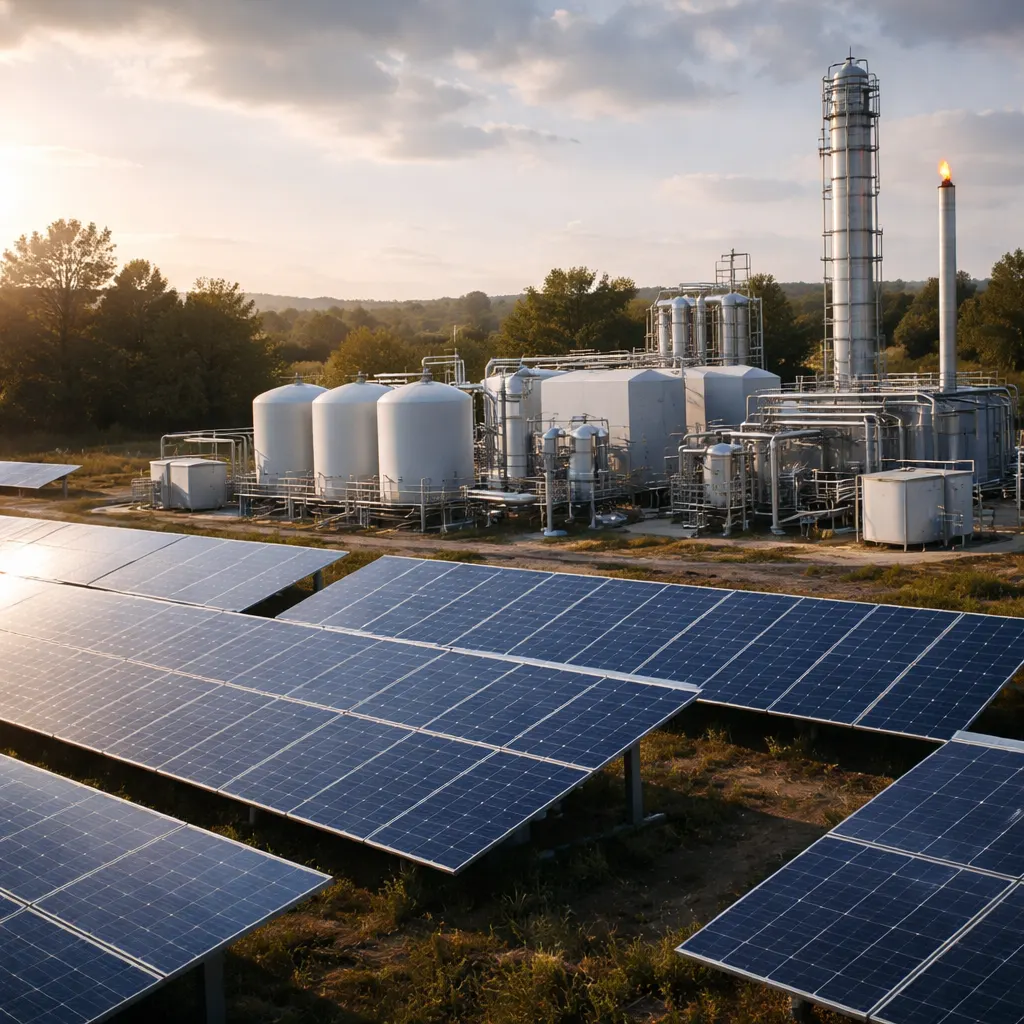
A California startup has developed a pilot plant that produces pipeline-ready natural gas from air and water using solar electricity, potentially marking a breakthrough in synthetic fuel production as renewable energy costs continue their historic collapse. Terraform Industries, profiled in a new report from the California Policy Center, operates a facility in Rosamond that extracts hydrogen from water through electrolysis and combines it with CO2 captured from the atmosphere to synthesize methane. The report examines whether plummeting solar costs have finally made direct fuel synthesis commercially viable.
The company's five-acre photovoltaic array produces 6 megawatt-hours per day, enough energy to generate 6.4 thousand cubic feet of natural gas daily, according to the report. Terraform Industries claims its PV installation already delivers electricity at around $17 per megawatt-hour, well below the typical construction financing cost estimate of $30 per MWh for solar projects, and the company's business model assumes costs will drop to $10 per MWh. The industrial price of natural gas has fluctuated dramatically over the past two decades, peaking at $13.06 per thousand cubic feet in July 2008 and bottoming at $2.58 in July 2020, creating a wide range of potential profitability scenarios. The report notes that these variables imply a break-even electricity price of $13.93 per MWh if natural gas sells at 2008 highs, and $2.75 per MWh at 2020 lows.
The report contextualizes this development within solar energy's explosive growth trajectory. Worldwide photovoltaic capacity has surged from around 6 gigawatts in 2006 to nearly 2.4 terawatts by the end of 2025, a 400-fold increase over 20 years with "no end in sight," the report states. Report author Edward Ring, Director of Water and Energy Policy at the California Policy Center, writes that PV production increased 40,000 percent between 2006 and 2025, while total worldwide raw energy production grew just 33 percent over the same period. The technology stack at Terraform's pilot plant includes a 1-megawatt solar array, an electrolyzer that converts solar electricity directly into hydrogen without inverters or transmission, a CO2 absorption bed that processes large volumes of air, and a Sabatier reactor that converts CO2 and hydrogen into pipeline-ready natural gas.
The report argues that continually falling electricity prices are shifting the economic viability of energy-intensive processes that were previously impractical. Ring explains that synthesized fuel from this process achieves "a level of purity that far exceeds conventional fossil production, justifying a higher sale price." The technology potentially enables commercial production of methane and other products currently dependent on the petrochemical industry by using only renewable electricity, water, and atmospheric carbon dioxide as inputs. Ring notes that Terraform Industries is led by founder and CEO Casey Handmer, a Caltech PhD physicist with previous roles at Hyperloop and NASA JPL, alongside a technical team drawn from SpaceX, Boeing, Sandia Labs, and GE, representing what "California still does best" despite regulatory headwinds.
The report concludes that one thing appears certain: the question isn't if electricity prices will drop to a point where previously unviable conversion processes suddenly become profitable, but when. "That line is moved further every year," Ring writes. When that threshold is crossed for Terraform Industries, the result could be commercially competitive direct synthesis of methane and many other petroleum-dependent products extracted entirely from water and air.