
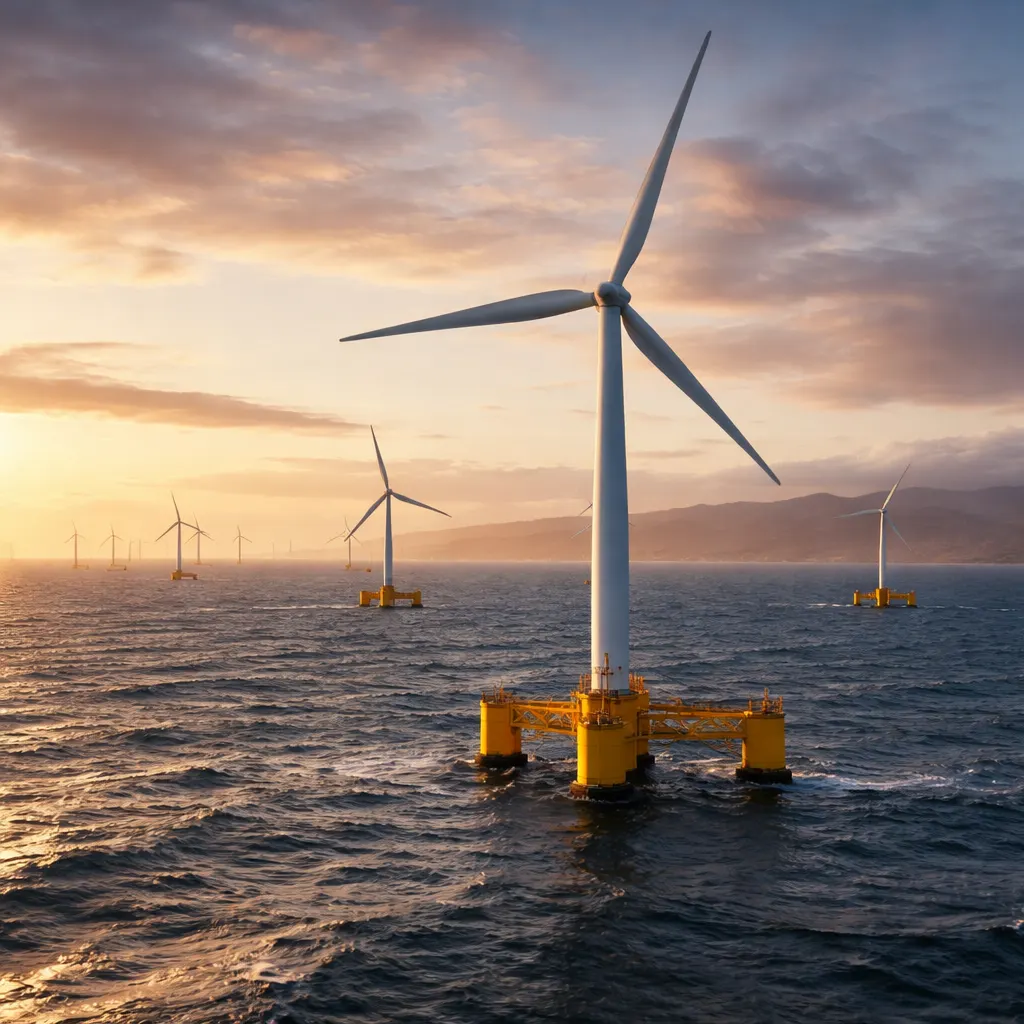
A new analysis finds that electricity from California's planned floating offshore wind program would cost at least $0.45 per kilowatt-hour, according to a report published by the California Policy Center. That's 29 percent more than the current average residential rate of $0.35/kWh in California, which already runs 72 percent higher than the national average of $0.18/kWh. The analysis questions the economic viability of the state's offshore wind strategy, which calls for building 25 gigawatts of capacity.
The report breaks down the construction costs using official government estimates. According to data from the National Renewable Energy Laboratory, building and installing floating offshore wind would cost $7.3 million per megawatt of capacity, bringing the total to $183.7 billion for 25 gigawatts. Port upgrades would add another $12 billion, based on figures from the California Energy Commission's strategic plan. Transmission line upgrades, substations, and grid connections would require an additional $36.5 billion, according to the California ISO's 20-year transmission outlook. The combined construction cost totals $232.2 billion. While the state's offshore wind plan targets 25 gigawatts of capacity, actual electricity generation would be far lower. California's existing onshore wind turbines have 6.3 gigawatts of capacity but generated only 15,172 gigawatt-hours in 2025, a yield of 27 percent. Offshore wind proponents estimate a 40 percent capacity factor for floating turbines, which would mean 25 gigawatts would generate 87,600 gigawatt-hours annually.
The report calculates that financing a $232.2 billion construction bond at 4.5 percent interest over 25 years would require annual payments of $15.7 billion. Divided across 87.6 billion kilowatt-hours, that comes to $0.18/kWh just to pay off the construction debt. Operations and maintenance would add another $0.031/kWh for more than 2,000 floating turbines, each roughly 800 feet tall, tethered in water nearly a mile deep and 20 miles offshore. According to the analysis, additional retail costs based on PG&E's rate structure would add $0.239/kWh, covering transmission, distribution, wildfire charges, public purpose programs, taxes, and other costs. "None of these additional costs are going to go away simply because the source of the electricity is floating offshore wind," the report states.
The report argues these cost estimates probably understate the true price because they don't account for likely cost overruns, the expense of additional battery storage needed to buffer intermittent power, or the fact that infrastructure projects typically cost more in California than elsewhere. The financing calculations assume a 25-year bond term, but the report notes that extending that timeline "would require an assumption that these turbines are going to have an operating life in excess of 25 years," which it calls unlikely. The analysis also questions recent polling showing majority support for offshore wind, suggesting respondents might answer differently if asked whether they'd support it "if you learned that the electricity from floating offshore wind would cost significantly more than you already pay for electricity." Despite what the report describes as favorable polling, the bottom line is clear: floating offshore wind doesn't pencil out economically.