
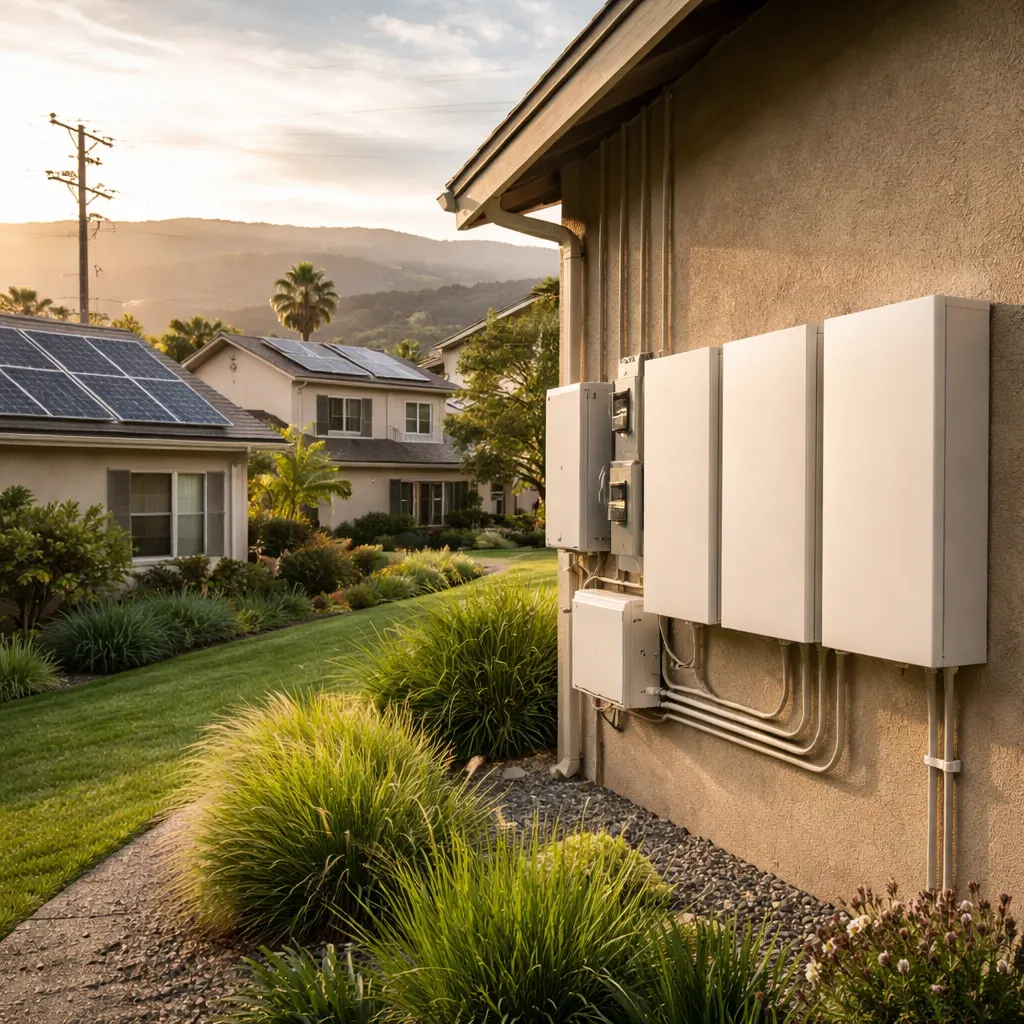
Pacific Gas & Electric is launching a pilot program to link tens of thousands of household batteries, solar panels, and smart thermostats into a coordinated virtual power plant, fully funded by Google through 2027, the utility announced Sept. 3, 2026. The initiative, called SHARE, aims to create additional grid capacity and improve reliability while lowering electricity bills for participating households. The program represents what may be the first major real-world test of whether tech giants can offset their own surging power demand from artificial intelligence by bankrolling distributed energy projects at scale, rather than building new fossil fuel plants.
Partners Tesla, Sunrun, and Renew Home will begin enrolling nearly 21,000 existing residential energy devices this fall across two Northern California counties, PG&E said. Tesla and Sunrun rank among the nation's largest residential battery suppliers, while Renew Home manages 4 gigawatts of controllable load across millions of smart thermostats. In June, the three companies said they could collectively unlock nearly 17 GW of flexible energy capacity nationwide, with California accounting for 4.7 GW of that total — roughly three-quarters from batteries and one-quarter from thermostats. HVAC manufacturer Carrier will support deployment of new resources, including variable-speed heat pumps with up to 10 kilowatt-hours of integrated battery storage that the company began piloting last year. The existing resources could start supporting the grid through SHARE later this year, with initial findings expected to be shared publicly in late 2026 or early 2027.
Amanda Peterson Corio, Google's global head of energy and power, said in a statement that the program would demonstrate how "today's electricity grid can meet rising power demand without burdening ratepayers" when properly optimized. According to PG&E, SHARE uses a "location-based approach … designed to inform future solutions for transmission constraints, local capacity challenges and rising demand across the electric system." Hakan Yilmaz, president of Carrier Energy, said the initiative would show how his company "can help deliver distributed capacity with the firmness to scale as a fast and reliable grid resource."
SHARE builds on a concept Rewiring America proposed last year: that hyperscale tech companies like Google can offset expected near-term electricity demand from AI computing — and do so more cheaply than constructing new natural gas generation — by subsidizing distributed energy deployments on a large scale. The utility calls SHARE a "proof-of-concept" VPP that could eventually grow to include commercial, industrial, and utility-scale assets beyond the initial residential focus. By aggregating thousands of small energy devices and coordinating when they charge, discharge, or adjust temperature settings, the program seeks to create a flexible resource that can respond to grid needs in real time — essentially turning scattered home equipment into a single, steerable power plant. The location-based design also allows PG&E to target specific areas where transmission lines are constrained or local capacity is tight, potentially deferring expensive infrastructure upgrades.
The pilot runs through 2027, operated jointly by PG&E and Demand Side Analytics, with Google covering all costs. If successful, the model could offer a blueprint for utilities and tech companies nationwide grappling with the twin challenges of AI-driven electricity demand and the need to add clean, flexible capacity without raising rates. For participating households, the deal is straightforward: enroll your battery or thermostat, let the program manage it during peak periods, and see your net electricity bill drop while the grid gets stronger.