
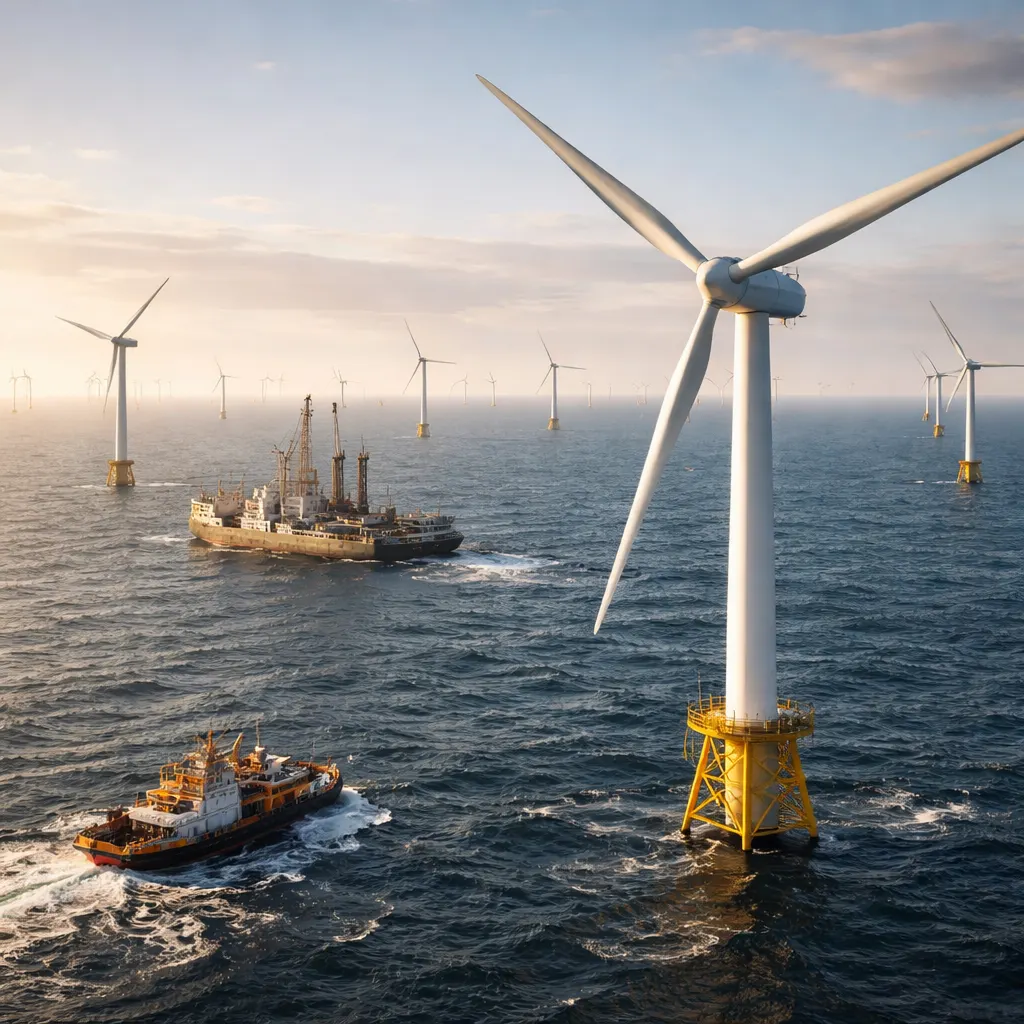
Building California's planned 25 gigawatts of floating offshore wind capacity would cost $232 billion in construction and infrastructure upgrades alone, according to an analysis published by the California Policy Center. The report, written by Edward Ring, the organization's director of water and energy policy, argues that even without cost overruns, the projects would produce electricity at $0.19 per kilowatt-hour—seven times more expensive than solar power—and concludes the entire initiative should be canceled.
The cost breakdown includes $184 billion to procure and install the 25 gigawatts of floating offshore wind turbines, cited from the National Renewable Energy Laboratory, plus $12 billion for port infrastructure upgrades from the California Energy Commission and $36 billion for transmission infrastructure improvements from CAISO. Using current commercial bond market terms of 25 years at 4 percent interest, the annual financing payment would reach nearly $15 billion. At a 40 percent yield and 90 percent uptime, the 25 gigawatts would generate 78,840 gigawatt-hours per year—equal to 28 percent of California's total 2024 electricity consumption of 278,338 gigawatt-hours. The analysis notes these cost projections don't include operating and maintenance expenses for 2,083 floating towers, each approximately 800 feet tall with 12-megawatt turbines positioned at least 500 feet above water, anchored in water 4,000 feet deep and connected by undersea cables 20 miles to shore.
The report compares this to solar energy at a financing cost of just $0.03 per kilowatt-hour, calculating photovoltaic installations at $1 million per megawatt of capacity with a 25 percent yield under the same financing terms. "That's a lot of maintenance," the analysis states about the massive floating structures. Ring writes that the projects "would rob electricity ratepayers statewide in order to profit developers who could not hope to make their projects compete in a fair market." The report points out that two of three offshore wind developers in Morro Bay have already terminated their leases, suggesting the decision came because "absent massive public sector incentives, the projects could not make a profit."
Ring explains that while subsidies and tax breaks can improve private returns on investment, "those costs were socialized, and the economy at-large still covers the full cost." The analysis argues floating offshore wind must be compared against California's existing generating assets that are fully paid for with decades of useful life remaining, as well as emerging technologies like new nuclear power and enhanced geothermal generation. The report questions whether offshore wind farms will last beyond their 25-year financing term and notes the cost projections represent optimistic scenarios—if California High Speed Rail cost overrun metrics applied, the price would reach $1.90 per kilowatt-hour. Ring concludes that "for economic growth to benefit everyone in the economy, it has to be a financially sustainable investment," calling the floating offshore wind proposal "preposterous" and urging cancellation before more money is spent.