
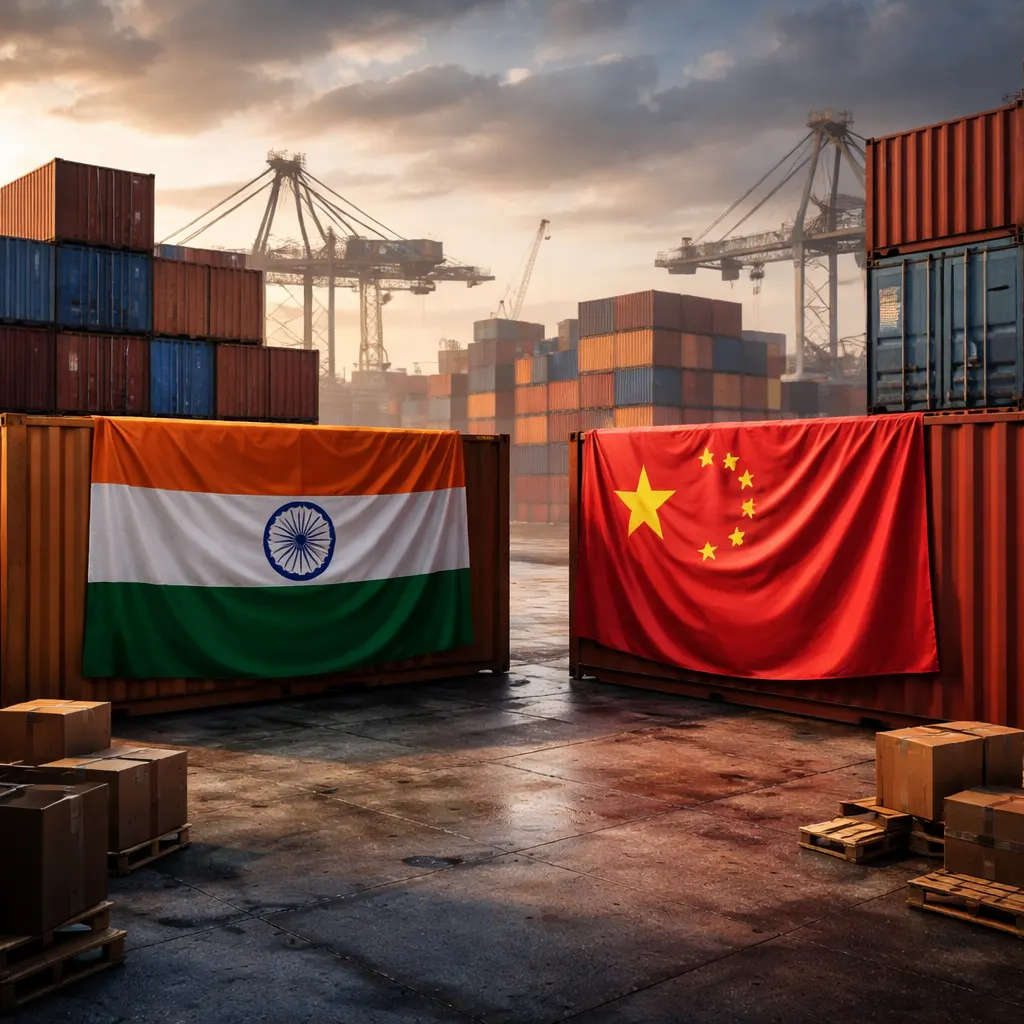
India's trade deficit with China reached $112 billion in 2025, even as New Delhi maintained strict investment restrictions designed to limit Chinese economic influence. A new analysis from the Foundation for Economic Education finds that India's security-focused protectionist measures have failed to narrow the trade gap and may have actually widened it. The report examines how India's conflicting policies—blocking Chinese investment while simultaneously pursuing industrial growth that depends on Chinese components—have created a self-reinforcing cycle that leaves the country increasingly dependent on its northern neighbor.
Bilateral goods trade between the two nations reached $151.1 billion in the fiscal year ending March 2026, with imports to India from China totaling $131.63 billion—the highest India recorded from any country—while exports to China stood at just $19.47 billion. The pattern has continued into the current fiscal year, with June's deficit alone hitting $15.3 billion. Between 2021 and 2024, Chinese direct investment collapsed to a mere $67.34 million after India introduced Press Note 3, a rule requiring government clearance for investment from countries sharing a land border. Yet during that same period, the trade deficit ballooned from $44 billion in 2021 to nearly $85 billion in 2024. When India amended Press Note 3 in March 2026 to ease restrictions, investors brought ₹4,896 crore ($512 million) across 29 projects by August's end—but that investment came from Mauritius, Korea, Japan, Singapore, and the United States, not China.
The report concludes that the Sino–Indian trade profile resembles a relationship "between a supplier and a manufacturer" rather than between two comparable advanced economies. What India purchases from China falls into four broad categories—electronics, machinery, organic chemicals, and plastics—plus the pharmaceutical agents that India's generic drug industry depends on. In contrast, what India sells consists of raw materials: ores and slag, mineral fuels, and marine products. The Carnegie Endowment noted approvingly that India's liberalization efforts addressed a genuine problem, observing that "the system was deterring not just Chinese capital but also legitimate global investment."
The analysis explains that India's industrial policy designed to rapidly build a modern manufacturing base has inadvertently deepened the trade imbalance. The first industries to benefit were assembly-based sectors: phones, appliances, and solar panels. These industries are resource-intensive and require more components as they expand, meaning India's manufacturing boom actually fuels demand for Chinese resources. Because the Indian economy supplies the very raw materials that China then exports back to India as finished goods, it becomes a self-reinforcing cycle. As Indian industry grows and the country becomes wealthier, it will purchase more of the products China manufactures using the very items it bought from India. Meanwhile, the barriers to Chinese investment have been lowered through reforms—including a digital sponsorship platform launched in December and Press Note 2, which automatically processes noncontrolling stakes up to 10%—but Chinese investment hasn't automatically flowed through.
Over 400 Chinese officials will be in New Delhi this month for the BRICS summit on September 12–13, more than double the previous delegation in 2019, with Xi Jinping making his first visit to India since 2019. The size of the delegation signals the seriousness of the summit and the potential for both nations to take advantage of manufacturers' "China Plus One" diversification strategy in response to a fragile global economy. The report warns that trade between the two nations will continue growing because both economies are expanding and complement one another, but the trade deficit will grow too unless serious rebalancing occurs. India's attempt to use protectionism to address a trade asymmetry that negotiation can't alter seems to have made the gap wider instead of narrower.