
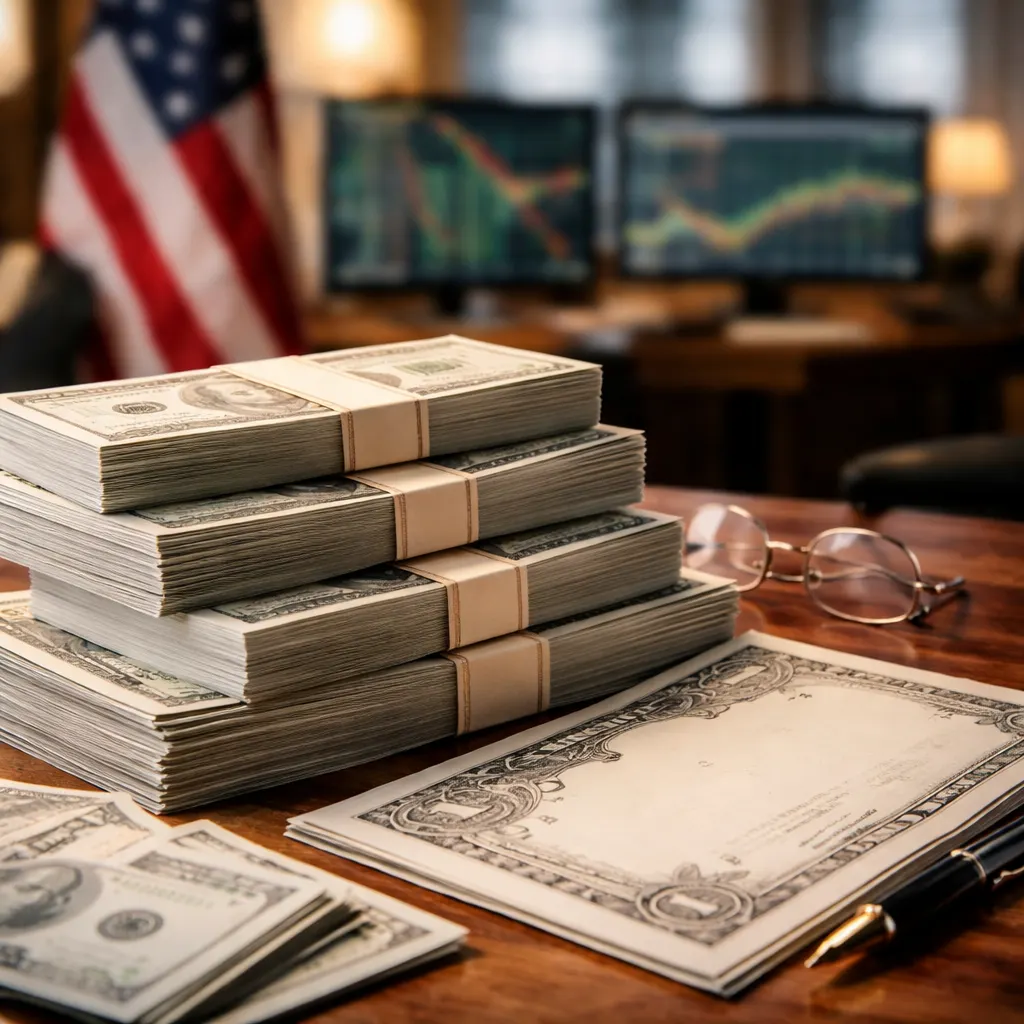
Foreign institutions owned 24.8% of U.S. government debt in late 2025, according to an analysis published by the Federal Reserve Bank of St. Louis in October 2026. The report explains why retirement accounts, corporate cash reserves, and central banks worldwide all hold the same asset: U.S. Treasury securities. Japanese institutions and the Bank of Japan together held $1.1 trillion in American government debt, followed by holders in the United Kingdom, China, Belgium, Canada, the Cayman Islands, and Luxembourg.
The U.S. Treasury market's value reached nearly $29.9 trillion in August 2026, making it the world's largest borrower-created market. In 2025, more than $1 trillion worth of U.S. government debt traded hands on an average day, compared with $824.3 billion for U.S. equity markets including stocks and exchange-traded funds, according to data cited in the report. The dollar made up 57% of foreign exchange reserves in the first quarter of 2026, according to International Monetary Fund data referenced in the analysis. Less than 15% of exports go to the United States, yet nearly 40% to 45% of world exports are invoiced in dollars—rising to approximately 60% when the European Union is excluded.
The report finds that central banks invest significant portions of reserves in highly liquid assets like U.S. government debt because they need reserves in "an asset that is safe and readily available during a crisis." St. Louis Fed economist Chris Neely and Research Associate Anna Cole are quoted noting that international investors see U.S. dollar assets such as Treasury bonds as safe, "with the U.S. government very unlikely to default on them." The analysis points out that Japan's central government budgeted $809.6 billion in spending for 2025, while Japanese institutions held $1.1 trillion of U.S. debt—and India's government estimated $587.4 billion in spending for fiscal 2026-27, while Indian institutions held $186 billion of American debt.
The report explains that the dollar's role in global trade creates the underlying demand for Treasuries. When a South Korean chocolate-maker buys cocoa from a Brazilian company, the two firms may use dollars for the transaction rather than won or reals, because currencies that are widely held and traded tend to be cheaper and easier to convert into. Central banks like the Bank of Korea maintain large dollar reserves to ensure companies can conduct international trade smoothly—but they don't keep billions in cash sitting in vaults. They need a safe and liquid way to store dollars, and Treasury securities fill that role. The analysis describes how U.S. Treasuries became a "flight to safety" destination during financial crises, noting that during the 2007-09 financial crisis and the COVID-19 pandemic, investors rushed to these assets, driving prices up and yields down. This surge in demand enabled the U.S. government to borrow at lower costs to finance crisis response measures.
The report concludes that three reinforcing factors make U.S. government debt a global safe haven: the dollar's dominance in global trade creates constant demand, the depth and liquidity of the Treasury market allow it to handle transactions of all sizes, and the flight-to-safety phenomenon makes Treasuries the go-to asset during crises. These aren't separate forces—they create a self-sustaining cycle. Whether you're planning for retirement or safeguarding a nation's financial stability, the bottom line is the same: when you need that money, it will be there, holding its value, ready to be converted to cash.