
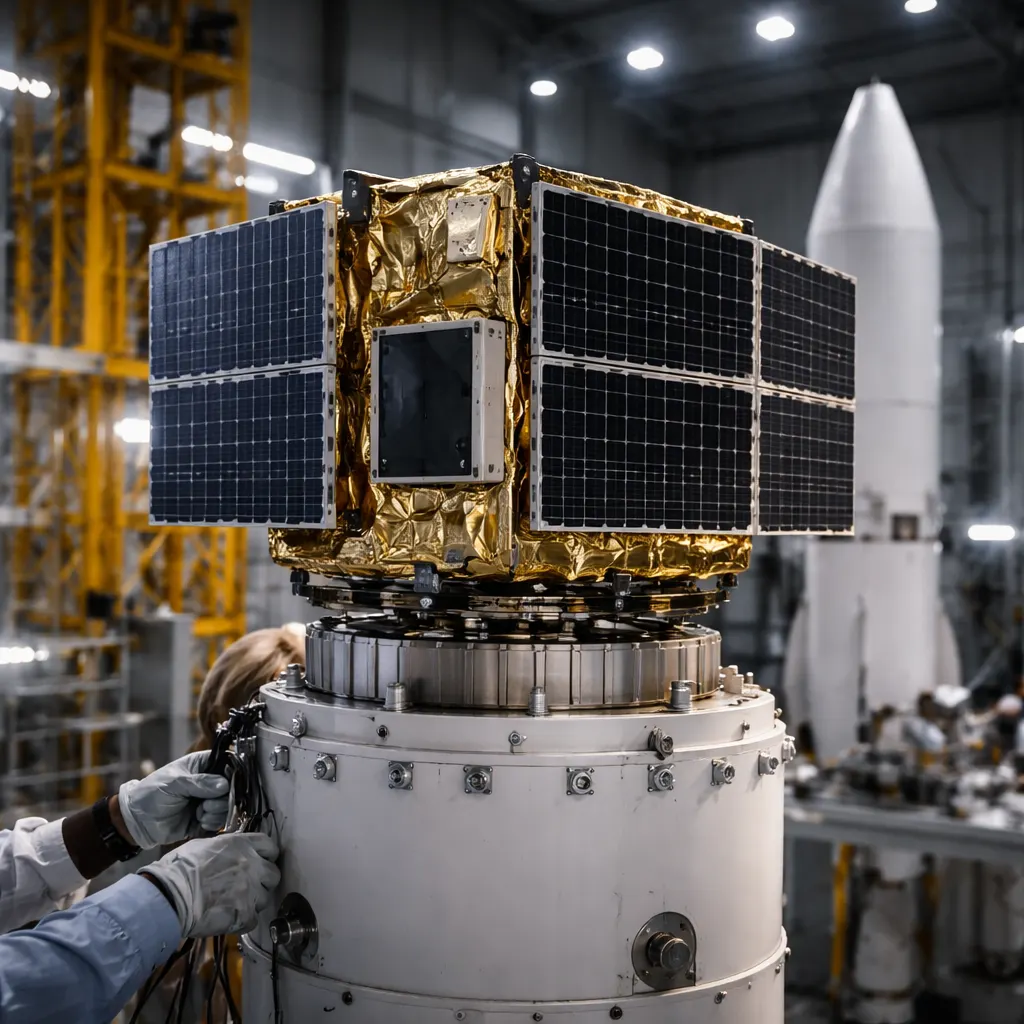
Nanyang Technological University has launched a satellite into orbit carrying next-generation perovskite solar cells and artificial intelligence systems designed to process images directly in space. The CRIMSON-1 satellite, NTU's 14th spacecraft, lifted off aboard a SpaceX Falcon 9 rocket from California on October 1. The mission will evaluate how lightweight perovskite solar technology and on-orbit AI-based image processing perform in the harsh conditions of space.
The satellite will gather real-world performance data on perovskite solar cells developed by NTU researchers and Singfilm Solar, a deep-tech spin-off from the National University of Singapore. According to the National Space Agency of Singapore, the mission is among the first projects supported under the country's Space Access Programme, part of a national initiative that has allocated S$210 million since 2022 to support research and development in space technologies. CRIMSON-1 will measure the cells' physical durability and efficiency after launch and track how much electrical power they generate in Low Earth Orbit. This marks the first time Singfilm's technology has flown in space and the first deployment of a Singapore-made solar module in orbit.
Perovskites are a class of materials that can produce lightweight solar cells with high power-generation efficiency using commonly available materials. NTU has pioneered perovskite solar cell research since a landmark 2013 Science paper demonstrated that electrical charges could travel unusually long distances through these materials. For space applications, new solar technologies must prove they can survive the physical stresses of a rocket launch and endure extreme conditions while generating consistent power. "Perovskite solar cells will provide a compelling advantage over conventional solar panels," said Ms Ngiam Le Na, Chief Executive of the National Space Agency of Singapore. "Their thin, lightweight properties make them particularly well-suited for space applications, where every gram matters."
The satellite will also test edge AI computing, where data collected by a spacecraft is analyzed on board instead of transmitting all raw images back to Earth. During the mission, CRIMSON-1 will run AI-based image-processing tasks in orbit while researchers study how well its computing system manages heat and power consumption under heavy workloads. Analyzing images in space could allow future satellites to identify useful information before transmitting data to Earth, reducing the amount of raw data sent through limited satellite communications links. NTU Deputy President and Provost Professor Christian Wolfrum noted that the university brings satellite engineering, artificial intelligence, and advanced materials research together in one place, with each mission building capability across Singapore's space sector.
The mission represents a pathway for homegrown innovations to gain the flight heritage needed to progress toward commercial application. By giving researchers and companies the opportunity to test and validate their technologies in orbit, Singapore is helping them build the credibility and track record needed to compete in the global space economy. NTU's Satellite Research Centre has designed, built, tested, and operated satellites ranging from small CubeSats to larger spacecraft since launching X-SAT, Singapore's first locally built satellite, in 2011. Data and learnings from past missions have helped pave the way for CRIMSON-1 and the university's ongoing development of future satellite operations.