
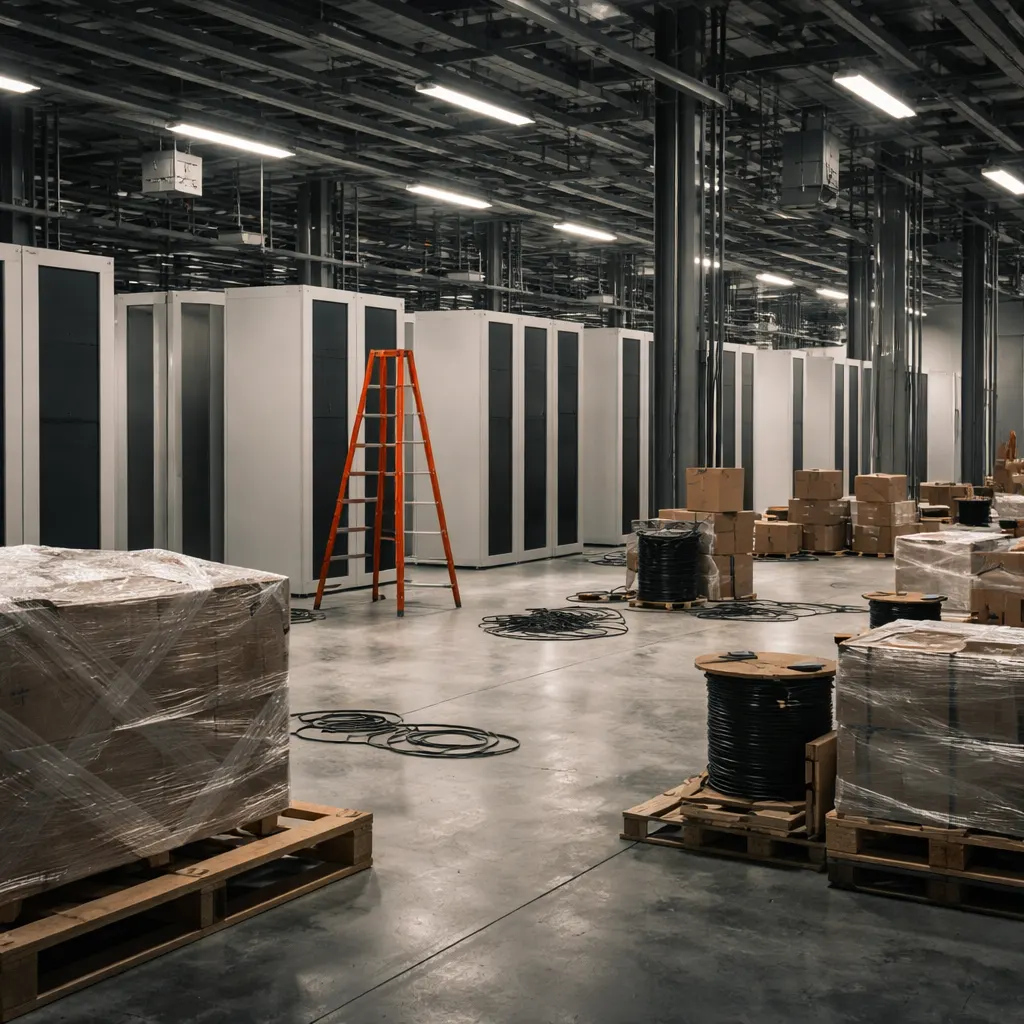
America's data center construction surge is running into a wall of physical constraints and local resistance that's forcing developers to rethink their plans. Goldman Sachs now estimates only 50% to 60% of planned data center capacity will come online as expected over the next two years due to delays and cancellations, according to a July report in Utility Dive. Projects backed by Microsoft, Google, and Oracle face permitting roadblocks, environmental reviews, and regulatory fines, even as the Electric Power Research Institute forecasts data centers will consume up to 17% of U.S. electricity demand by 2030 and as much as 20% by 2035.
The development pipeline added 36 gigawatts of capacity in the first quarter of 2026, but that's down 19% from the final quarter of 2025 as developers concentrate on existing projects amid what Wood Mackenzie senior analyst Caitlin Connelly called "an increasingly challenging development and regulatory environment." Equipment shortages have stretched lead times to two or three years for standard power transformers, with no improvement expected before 2027 when new U.S. manufacturing capacity comes online, according to electrical equipment marketplace Fluxco. GE Vernova, the leading U.S. gas turbine maker, is quoting delivery dates in the early 2030s for a backlog exceeding 100 gigawatts. Public opposition has intensified sharply: 71% of Americans would oppose a data center being built nearby, up nearly 30 percentage points from September, according to a May poll by Heatmap News. Local resistance killed at least 20 proposed projects in the first quarter of 2026 alone, the most of any quarter on record.
Blake Nixon, president and CEO of Geronimo Power, told Utility Dive that data center opposition "has reached a pitch I have never seen before in my 20-plus years in development." After officials in Nobles County, Minnesota, rejected Geronimo's proposal for a 400-megawatt "data park" this spring, the company began scouting alternative sites in neighboring communities. Andrew Maxson, a program manager at the Electric Power Research Institute, said skilled labor shortages have "emerged as a binding constraint on data center development and the energy infrastructure that serves it, rivaling land availability, permitting and energy supply as a top concern." The construction industry trade group Associated Builders and Contractors estimated in 2024—before the AI-driven building boom began in earnest—that the U.S. was short roughly 500,000 construction workers.
The obstacles stem from what Nixon described as physical problems "manifesting as market problems, political problems, regulatory problems and ultimately problems down on the ground." Texas Governor Greg Abbott successfully pushed for a sweeping pause on data center grid connections that threatens up to 20% of the total U.S. development pipeline, BloombergNEF reported earlier this month. The independent market monitor for the PJM Interconnection blamed data centers for 38% of charges at its most recent capacity auction. Democratic governors in Pennsylvania, Virginia, and New Jersey have taken steps to require data centers to bring more generation and transmission capacity online rather than drawing from existing grid resources. Even behind-the-meter projects designed to bypass interconnection queues face the same equipment backlogs as grid-connected facilities, according to EPRI's Maxson. State and local permitting challenges layer federal, regional, and local constraints on top of one another, he noted, meaning "local ones are on top of both of those."
Utilities and developers are responding with "bring your own capacity" arrangements, including OpenAI's agreement earlier this month to take 8 gigawatts from a planned 10-gigawatt power generation project in Ohio pursued by Japan's SoftBank Group and the U.S. Department of Energy. Cleanview, a grid data platform, counted more than 90 gigawatts of behind-the-meter capacity across 59 large-scale data center projects earlier this year, with as much as 13 gigawatts potentially coming online by the end of 2027. The report notes these developments inject unwelcome uncertainty into utility planning cycles that must look years or even decades ahead, raising fundamental questions about how much computing load will actually materialize in the near term.